
In This Article
Somewhere in a cupboard in Britain right now, there’s a sewing machine gathering dust because someone bought the wrong one. Too basic for what they wanted to make, or so stuffed with menus that it never left its box — either way, it’s a familiar story. Picking from the current crop of computerised sewing machines shouldn’t feel like defusing a bomb, but with LCD screens, stitch counts running into the hundreds, and marketing copy that reads like a spaceship manual, it’s easy to see why people freeze.
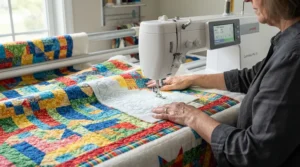
Here’s the short version: a computerised sewing machine swaps the dials and levers of a mechanical model for a digital interface, memory functions, and a raft of automations — needle threading, thread cutting, stitch-length presets — that quietly remove the fiddly bits from a project. You get more stitches, more precision, and machines that genuinely make quilting and dressmaking faster once you’ve learned the menu.
This guide walks through seven real machines currently sold in the UK, from Brother’s entry-level picks through to Janome’s quilting favourites and a genuine sewing-and-embroidery combo. Every specification here has been checked against manufacturer data and aggregated review sentiment, and every price is given as a range rather than a snapshot figure, because — as anyone who has watched an Amazon price yo-yo overnight knows — today’s number is rarely tomorrow’s. According to the Wikipedia entry on sewing machines, the technology traces back to Thomas Saint’s 1790 patent, which makes the leap to touchscreen embroidery machines feel all the more dramatic. Whether you’re upgrading from a rattly hand-me-down or buying your first machine outright, there’s something below built for your budget.
Quick Comparison Table
| Machine | Best For | Built-in Stitches | Price Range |
|---|---|---|---|
| Brother CS10s | Absolute beginners | 40 | Under £220 |
| Brother CS7000X | Budget quilting | 70 | £220–£280 |
| Brother Innov-is A16 | Long-term dressmaking | 16 | £330–£380 |
| Janome 5060QDC | Serious quilters | 60 | £430–£500 |
| Janome JW8100 | Durability on a mid budget | 100 | £280–£360 |
| Singer Quantum Stylist 9960 | Stitch-count obsessives | 600 | £450–£550 |
| Brother SE700 | Sewing + embroidery combo | 103 + 135 designs | £550–£650 |
Looking at the spread, the gap between the Brother CS10s and the Brother SE700 isn’t just price — it’s a completely different relationship with the machine. The cheaper end trades stitch variety for simplicity and gets you sewing within minutes of opening the box, while the Singer Quantum Stylist 9960 and Brother SE700 are built for people who already know what they want a machine to do and are prepared to spend a few evenings learning the menu structure to get it. If you’re still working out whether you’re a quilter, a dressmaker, or a bit of both, the mid-table options — the Janome 5060QDC and Janome JW8100 — are the sensible place to start looking.
💬 Found the comparison useful? A quick share helps other sewists find this guide too!
Top 7 Computerised Sewing Machines: Expert Analysis
Picking machines for this list meant balancing three things: genuine build quality, real stitch libraries (not marketing-inflated “stitch application” counts), and honest coverage of who each machine actually suits. Below, each entry covers what the spec sheet means in practice, who should buy it, and where it falls short.
1. Brother CS10s — easiest machine to thread, out of the box
The standout here is threading — reviewers consistently point out that the Brother CS10s gets a needle threaded and a bobbin dropped in with almost no fumbling, which matters more than any spec sheet suggests when you’re new to sewing. It carries 40 built-in stitches covering straight, zigzag, stretch, and buttonhole work, enough for dressmaking, repairs, and light craft projects without the bloat of decorative stitches you’ll never use. In practice, that smaller stitch count is a feature, not a shortfall: fewer menus to dig through means less time hunting and more time sewing.
Based on aggregated testing coverage, the Brother CS10s has been singled out as an “easy to thread” pick that “sews a clean stitch out of the box,” language that lines up with what most beginner-machine reviews converge on for Brother’s entry tier. It’s aimed squarely at someone buying their first or main home machine, not a quilter chasing decorative stitch libraries or a dressmaker who needs a one-step buttonhole in thirteen styles.
Pros:
- ✅ Genuinely simple threading path for total beginners
- ✅ Clean stitch quality straight out of the box
- ✅ Covers dressmaking, repairs and light crafts comfortably
Cons:
- ❌ Only 40 stitches, so you’ll outgrow the decorative range fast
- ❌ Not built for heavy fabrics like upholstery or leather
At under £220, the Brother CS10s earns its keep as a genuine first machine rather than a compromise, and the value proposition holds up well against pricier rivals if simplicity is what you’re actually after.
2. Brother CS7000X — best value quilting extension table bundle
What most buyers overlook about the Brother CS7000X is that the 70 stitches include seven styles of one-step, auto-size buttonholes, which is a genuinely useful spread for anyone moving between garment work and craft projects. The bundled wide table and ten included presser feet mean this machine arrives ready for quilting rather than needing £60 of accessories bought separately, which is where a lot of “budget” machines claw the saving back.
Based on the spec comparison, its 750 stitches-per-minute top speed sits below the Singer and Janome machines further down this list, but for home quilting and dressmaking that ceiling rarely matters — you’re limited by your own hand-feeding speed long before the motor caps out. Reviewers have named the Brother CS7000X a strong all-rounder for both beginners and more experienced sewers, and it’s frequently held up as an improvement over Brother’s older CS6000i thanks to a wider stitch range.
Buy if you want one machine that handles quilting, dressmaking and crafts without a second accessory order; skip it if you specifically need heavy-duty power for denim or multiple layers of upholstery fabric.
Pros:
- ✅ Wide table and 10 presser feet included in the box
- ✅ 70 stitches cover utility, decorative and quilting needs
- ✅ Automatic needle threader speeds up every project start
Cons:
- ❌ 750 spm top speed trails pricier rivals on this list
- ❌ Plastic-feeling wide table attachment on some units
At around £220–£280, the Brother CS7000X is the machine to reach for if you want quilting capability without quilting-machine pricing — genuinely good value for a first “proper” machine.
3. Brother Innov-is A16 — quietly excellent for five-year dressmaking
The Brother Innov-is A16 proves that stitch count isn’t everything: with just 16 built-in stitches, a one-step buttonhole, an automatic needle threader and a drop-in bobbin, it strips computerised sewing back to what dressmakers actually use week to week. Here’s what to weigh: fewer stitches means a shallower learning curve and a machine that doesn’t feel like it’s hiding features behind menus, which UK reviewers testing budget-to-mid-range machines have flagged as a genuine strength rather than a limitation.
On denim, the machine reportedly handles four-ply seams without labouring, and with a ballpoint needle fitted it copes with stretch jersey cleanly — details that matter enormously if your sewing leans towards garment-making rather than quilting. What the spec sheet won’t tell you, but tester notes suggest, is that stitch quality on this model consistently outperforms rivals at a similar price point, which is precisely the kind of unglamorous consistency that keeps a machine in daily use for years rather than months.
Pros:
- ✅ Consistently praised stitch quality at this price tier
- ✅ Handles four-ply denim and stretch jersey confidently
- ✅ Simple 16-stitch layout with minimal learning curve
Cons:
- ❌ Not intended for heavy-duty upholstery or leather work
- ❌ Limited decorative stitch range compared with 60+ stitch rivals
Priced in the £330–£380 range, the Brother Innov-is A16 suits anyone planning to make this their one dressmaking machine for the next five-plus years rather than someone chasing the biggest stitch count on the shelf.
4. Janome 5060QDC — GBSB’s go-to for serious quilters
The Janome 5060QDC has become a recurring favourite on the Great British Sewing Bee, and the reason becomes obvious once you look past the 60-stitch count to the Superior Feed System underneath. That seven-piece feed dog mechanism is what actually determines how evenly your fabric moves through the machine, and it’s the difference between a wobbly quilt seam and a straight one on slippery or layered fabric.
Reviewers who have put the Janome 5060QDC through viscose-to-denim testing describe it as offering “excellent value” for anyone moving into computerised machines, with the caveat that its real strength shows on quilting projects rather than decorative stitching. The adjustable presser foot pressure across six levels is a genuinely useful feature that budget machines rarely include, letting you dial down pressure for delicate fabrics or up for thick layers without hunting through a manual.
Buy this if quilting and patchwork are your main projects and you want a machine with proven television-studio pedigree; look elsewhere if you want hundreds of decorative stitch options, because 60 is a comparatively modest library.
Pros:
- ✅ Seven-piece feed system delivers exceptional fabric control
- ✅ Six-level foot pressure adjustment handles thick and thin fabrics
- ✅ Proven track record with serious home quilters
Cons:
- ❌ Only 60 stitches next to Singer’s 600-stitch library
- ❌ No auto-tension or touchscreen at this price point
Sitting around £430–£500, the Janome 5060QDC earns its reputation as a quilter’s workhorse rather than an all-purpose stitch library, and for that specific job it’s hard to beat.
5. Janome JW8100 — toughest build at this price point
Aggregated review sentiment on the Janome JW8100 is unusually consistent: testers repeatedly flag its metal internal frame and describe the straight stitch as staying “arrow-straight” even on denim, which is precisely the kind of durability claim that’s easy to make and hard to verify — except here it shows up across independent reviews rather than just marketing copy. With 100 built-in stitches split across fashion sewing, quilting, heirloom, and home décor categories, plus seven automatic buttonholes, it covers a genuinely broad range of home sewing without tipping into embroidery-machine territory.
Based on the spec comparison, the trade-off is a smaller, dimmer backlit LCD screen than rivals offer, and a separate cardboard stitch-reference card rather than an on-machine chart — a fiddly detail that’s easy to lose. Reviewers consistently note that despite these interface quibbles, the machine “powers through all types of fabric easily,” which for a mid-priced computerised machine is the review sentiment that actually matters most.
Pros:
- ✅ Durable metal-frame construction built to outlast plastic rivals
- ✅ 100 stitches across fashion, quilting and heirloom categories
- ✅ Reported quiet operation with responsive speed control
Cons:
- ❌ Small, dim LCD screen compared with touchscreen competitors
- ❌ Separate stitch-reference card is easy to misplace
At roughly £280–£360, the Janome JW8100 offers premium-feeling build quality at a distinctly mid-range price, making it one of the stronger value picks on this list.
6. Singer Quantum Stylist 9960 — most stitches for expert customisation
If sheer stitch variety is what you’re after, the Singer Quantum Stylist 9960 is hard to match: 600 built-in stitches, 13 fully automatic one-step buttonholes, five built-in fonts, and mirror-imaging and elongation functions that let you build entirely custom stitch sequences. What most buyers overlook is that a heavy-duty metal frame underpins all of that electronics, which is what keeps 850 stitches-per-minute sewing stable rather than juddery — a genuinely professional sewing speed for a domestic machine.
The self-adjusting tension system is worth calling out specifically: select a stitch and the machine sets tension automatically, removing one of the most common frustration points for anyone moving up from a basic machine. Here’s what to weigh: with this much functionality comes a genuinely steep learning curve, and Which?’s testing coverage of budget-to-mid sewing machines has noted that feature-dense machines can overwhelm sewists who just want to get stitching, so this isn’t the machine for someone who wants to be sewing within the hour of unboxing.
Pros:
- ✅ 600 stitches with mirror-image and elongation customisation
- ✅ Self-adjusting tension removes a common beginner frustration
- ✅ Heavy-duty metal frame supports 850 stitches-per-minute speed
Cons:
- ❌ Steep learning curve for the full feature set
- ❌ Overkill if you only need basic garment and repair stitches
Priced around £450–£550, the Singer Quantum Stylist 9960 is best for sewists who already know their way around a machine and want room to grow into advanced techniques for years.
7. Brother SE700 — sewing and embroidery in one machine
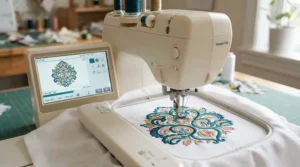
The Brother SE700 earns its premium spot on this list by doing two jobs at once: 103 built-in sewing stitches alongside 135 embroidery designs and ten embroidery fonts, all managed through a 3.2-inch colour LCD touchscreen that lets you preview and edit designs before a single stitch is sewn. The wireless design transfer is the feature that actually changes your workflow — instead of shuttling a USB stick back and forth, files move from computer to machine over your home network, and the companion app adds thousands more designs through Brother’s iBroidery library.
What the spec sheet won’t tell you, but the review data suggests, is that a 4″x4″ embroidery field is genuinely on the small side for anyone dreaming of full jacket-back designs, so this machine suits monogramming, appliqué, and smaller decorative work rather than large-scale embroidery projects. As a combination machine it sits at roughly half the price of a dedicated embroidery-only unit, which is precisely the value case it’s built on.
Pros:
- ✅ Genuine dual-purpose sewing and embroidery in one unit
- ✅ Wireless design transfer removes USB-stick faff entirely
- ✅ Touchscreen preview and editing before you commit a stitch
Cons:
- ❌ 4″x4″ embroidery field limits larger design ambitions
- ❌ Highest price point on this list by a clear margin
At around £550–£650, the Brother SE700 is the pick for anyone who wants to explore embroidery without buying a second machine entirely — a genuinely smart use of space and budget for a craft room.
Practical Usage Guide: Your First 30 Days
Unboxing a new machine is the easy part; the first month is where good habits get set or bad ones creep in. Start by threading the machine exactly as the manual describes, in order, rather than trusting muscle memory from an old model — computerised machines route thread through tension discs in ways that vary between brands, and a mis-threaded top thread is behind more “faulty machine” panic calls than actual mechanical faults. Sew a test line on scrap fabric every time you change thread weight, needle, or stitch type; it takes thirty seconds and catches tension problems before they ruin a seam on your actual project.
A common early mistake is ignoring needle type. A universal needle works for wovens, but stretch jersey needs a ballpoint needle to avoid skipped stitches, and denim needs a heavier needle to avoid snapping — mismatching these is one of the most frequent causes of “my new machine keeps jamming” complaints in the first fortnight. Get into the habit of changing your needle every 8–10 hours of sewing time, or immediately if you hear a popping sound while stitching, which usually means it’s bent or blunted.
On maintenance: brush out lint from the bobbin case after every project, not just when it looks dirty, since built-up fluff around the feed dogs is what causes uneven stitching on machines that are otherwise working perfectly. Oiling schedules vary by machine — check your manual, because over-oiling a modern computerised machine causes more damage than under-oiling ever did on old mechanical models. Finally, always switch the machine off at the power switch before changing needles or clearing a jam; computerised models keep some circuits live even when the foot pedal is idle, so treat the safety switch as non-negotiable rather than optional.
Real-World Scenarios: Matching the Machine to the Sewist
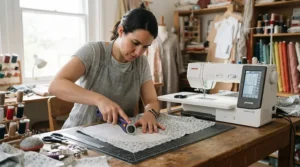
The Saturday Dressmaker. Someone squeezing garment-making into weekends, making one or two dresses a season alongside alterations and repairs, doesn’t need 600 stitches — they need reliability and a straightforward buttonhole. The Brother Innov-is A16 or Brother CS10s both fit this profile: fewer menus to navigate, consistent stitch quality, and a price that doesn’t sting if sewing turns out to be a passing hobby rather than a lifelong one.
The Patchwork Obsessive. Someone working through a quilt top most evenings, feeding thick, layered fabric through the machine for hours at a stretch, needs the feed-system quality and adjustable foot pressure of the Janome 5060QDC, or the broader stitch library and metal frame of the Janome JW8100 if budget is tighter. Both machines are built around consistent fabric handling rather than flashy extras, which is exactly what patchwork rewards.
The Craft-Room All-Rounder. Someone making gifts, personalising baby clothes, monogramming towels, and occasionally sewing a garment doesn’t fit neatly into “quilter” or “dressmaker” — they need versatility. The Brother CS7000X covers the sewing side generously for the price, while the Brother SE700 adds embroidery into the same footprint, useful if gift-making and personalisation are a recurring part of what you make.
How to Choose a Computerised Sewing Machine
- Match stitch count to your actual projects. More stitches sound impressive, but if you sew mainly straight seams and the occasional buttonhole, 40–60 stitches is plenty; quilters and decorative sewists benefit more from a bigger library.
- Check the feed system, not just the motor. A strong motor means nothing if the fabric feeds unevenly — look for multi-piece feed dog systems, especially for quilting.
- Prioritise automatic needle threading if your eyesight or patience is limited. It’s a small feature that saves genuine frustration every single session.
- Weigh screen size and interface against your comfort with tech. A small monochrome LCD is fine if you’re not chasing decorative stitches; a touchscreen earns its keep if you’re combining sewing and embroidery.
- Confirm an extension table is included, not sold separately, if you quilt. Some machines bundle this; others charge extra, which changes the real price comparison significantly.
- Look at warranty length and UK service network, not just headline specs. A machine with a strong warranty but no accessible repair network is a false economy if something goes wrong two years in.
- Buy one tier above what you think you need. Sewists reliably outgrow their first machine faster than expected — buying slightly ahead of your current skill level tends to save a second purchase within eighteen months.
For a broader, brand-by-brand look at reliability, Which?’s sewing machine testing is a useful independent cross-check against manufacturer claims.
Computerised vs Mechanical Sewing Machines
The core difference isn’t really about power — it’s about where control sits. A mechanical machine puts every decision in your hands: dials for stitch selection, foot pressure for speed, and nothing electronic to fail beyond the motor itself. That directness is exactly why some experienced sewists deliberately choose mechanical models even now; there’s simply less to go wrong, and repairs tend to be cheaper because the parts are mechanical rather than proprietary electronics.
Computerised machines trade some of that simplicity for consistency and speed. Stitch length and width presets mean you’re not eyeballing settings from memory, memory functions let you save custom stitch combinations, and automations like thread cutting and needle threading remove small repetitive tasks that add up over a long project. The trade-off is real, though: electronic components can fail in ways a mechanical dial simply can’t, and budget computerised models occasionally use proprietary parts that are harder to source for repairs, particularly outside major cities.
For most UK home sewists in 2026, computerised machines make sense specifically because most projects — dressmaking, patchwork, repairs, craft work — benefit more from precision and time-saving features than from the theoretical robustness of a dial-only design. The exception is genuinely heavy-duty work: upholstery, multiple layers of denim, or leather, where some sewists still prefer the brute simplicity of a mechanical, heavy-duty model. If your projects sit in that territory, it’s worth cross-shopping mechanical heavy-duty machines alongside anything on this list.
Computerised Sewing Machine for Quilting: What Actually Matters
Quilters have different priorities to dressmakers, and it shows in which specs matter. Bed size and workspace come first — an extension table isn’t a nice-to-have for quilting, it’s close to essential once you’re manoeuvring a queen-size quilt top through the machine. Both the Janome 5060QDC and Brother CS7000X include one as standard, which matters more for total cost than the headline machine price alone.
Feed system quality is the second priority, and it’s where quilting-focused machines genuinely differ from general-purpose ones. A multi-piece feed dog system, like the seven-piece mechanism in the Janome 5060QDC, keeps layered fabric moving evenly rather than shifting and puckering — the single biggest cause of wonky quilting lines isn’t operator error, it’s inconsistent feed. Adjustable presser foot pressure matters here too, since quilt sandwiches (top, wadding, backing) are considerably thicker than a single layer of dressmaking fabric and need more downward force to feed correctly.
Drop feed for free-motion quilting is worth checking specifically if you plan to move beyond straight-line quilting into free-motion stippling or decorative quilting patterns — every machine on this list includes it, but it’s not universal across cheaper models outside this guide. Finally, a walking foot (often included as a bonus accessory, as with the Janome 5060QDC) genuinely changes how well multiple fabric layers feed together, and it’s worth checking whether it’s bundled before assuming you’ll need to buy one separately.
Computerised Sewing Machine for Dressmaking: What Actually Matters
Dressmaking rewards a different set of priorities entirely. Stitch variety matters less than most people assume — a handful of reliable stretch stitches, a good buttonhole, and a clean straight stitch cover the vast majority of garment projects, which is exactly why the pared-back Brother Innov-is A16 performs so well despite its modest 16-stitch count. What matters more is needle position control, useful for topstitching and precise seam allowances, and a genuinely accurate one-step buttonhole, since a wonky buttonhole is one of the most visible mistakes on a finished garment.
Fabric range is the next consideration. If you’re working across cottons, jersey, and the occasional denim, check that your shortlisted machine handles a range of needle penetration power — thin machines struggle on multiple layers at a waistband or hem, exactly the point in a garment where strength matters most. A free arm is genuinely useful for dressmaking specifically, since it lets you sew cuffs, sleeves, and trouser hems without wrestling a flat bed around a tube of fabric.
Finally, automatic thread tension is worth prioritising more for dressmaking than for quilting, because garment fabrics vary enormously in weight and stretch within a single project — a lining fabric behaves nothing like the shell fabric it’s paired with — and machines like the Singer Quantum Stylist 9960 that adjust tension per stitch selection remove a genuine source of dressmaking frustration.
Mid-Range Computerised Machine: Finding the Sweet Spot
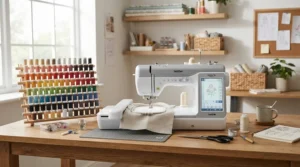
There’s a specific price band, roughly £280–£500 in this guide, where machines stop feeling like compromises and start feeling like genuine long-term purchases — and it’s worth understanding why. Below this range, machines tend to cut corners on the feed system or frame material to hit a price point; above it, you’re often paying for stitch counts or embroidery capability that many home sewists never fully use. A mid-range computerised machine, done well, gets the frame and feed mechanics right while keeping the electronics sensible rather than maximal.
The Janome JW8100 and Janome 5060QDC both sit in this zone and illustrate the trade-off clearly: neither has a touchscreen or a 600-stitch library, but both have metal-reinforced construction and multi-piece feed systems that genuinely outperform their price tag. The Brother Innov-is A16, at the lower end of this band, takes the opposite approach — stripping stitch count right back but keeping build quality high, which is arguably an even purer expression of “mid-range value” than machines that pile on features to justify a higher number on the box.
The lesson for buyers is that mid-range value isn’t about finding the machine with the most features for the least money — it’s about identifying which two or three specs actually matter for your projects and refusing to pay extra for the rest. A quilter chasing a mid-range machine should prioritise feed system and workspace over stitch count; a dressmaker should prioritise buttonhole accuracy and needle control over embroidery capability. Buying with that discipline is what separates a genuinely good mid-range purchase from an expensive compromise.
Sewing Machine Finance Options
Spreading the cost of a mid-range or premium computerised machine is increasingly common, and UK buyers generally have three routes: store credit cards, buy-now-pay-later schemes at checkout, and traditional 0% finance offered directly by specialist sewing retailers. Each comes with genuinely different consumer protections, and it’s worth understanding them before you commit rather than after.
Store credit and larger finance agreements over £100 are typically covered by Section 75 of the Consumer Credit Act, which gives you a right to claim against the credit provider if a machine arrives faulty or the retailer goes bust before delivery — a meaningful protection that’s easy to overlook when you’re focused on the monthly instalment figure rather than the fine print. Buy-now-pay-later schemes have historically sat outside these protections, though that’s changing: the sector is moving toward Financial Conduct Authority regulation specifically to close this gap. As Citizens Advice explains in its guide to buy now, pay later, providers must check affordability before lending and disclose instalment terms clearly, though it’s still worth checking a specific scheme’s rules on faulty goods before relying on it for a purchase this size.
Whichever route you choose, run the sums properly. A “12 months interest-free” offer only stays interest-free if every payment lands on time — miss one, and some schemes backdate interest to the full purchase price. For a mid-range machine in the £400–£550 bracket, that can turn a genuinely good deal into an expensive mistake within a single missed payment. If in doubt, a short call to the retailer’s finance provider to confirm exactly what happens on a late payment is thirty minutes well spent before you sign anything.
Value for Features: What You’re Actually Paying For
It’s tempting to judge value purely on stitch count divided by price, but that maths misses what actually costs money to build well. A metal internal frame, like the one in the Janome JW8100 and Singer Quantum Stylist 9960, costs more to manufacture than a plastic-reinforced frame, and it’s the single biggest factor in how a machine feels and performs after two or three years of regular use — long after the novelty of a big stitch library has worn off. Feed system engineering is similarly invisible on a spec sheet but expensive to get right, which is why the Janome 5060QDC commands a higher price than its modest 60-stitch count might otherwise suggest.
Software features, by contrast, are comparatively cheap to add once a machine has a digital interface at all — which is worth remembering when a spec sheet lists “600 stitches” as a headline feature. Many of those stitches are combinations and elongations of a smaller base library rather than genuinely distinct patterns, so a bigger number doesn’t always mean proportionally more usefulness. The Brother SE700‘s wireless transfer and touchscreen, meanwhile, sit closer to the “genuinely expensive to build well” end of the software spectrum, because they require dedicated hardware, not just firmware.
The practical takeaway: when two machines are similarly priced, put more weight on frame material and feed system than on stitch count or screen size. Those are the components that determine whether a machine still sews a clean, even seam in five years’ time, and they’re consistently the specs that budget marketing glosses over fastest.
Common Mistakes When Buying a Computerised Sewing Machine
The most frequent mistake is buying on stitch count alone, without checking whether an extension table, presser feet, or a hard case are included or sold separately — a machine that looks like the cheapest option on paper can end up costing more once the missing accessories are added. A close second is ignoring the feed system entirely; two machines with near-identical stitch libraries can produce very different quilting results because one has a two-piece feed dog and the other has seven.
Skipping the safety and compliance basics is a subtler but real risk, particularly when buying second-hand or from unfamiliar sellers. Any electrical sewing machine sold in Great Britain should carry the UKCA or CE conformity marking confirming it meets the Electrical Equipment (Safety) Regulations — a marking that’s easy to check for and worth checking, especially on older or grey-import machines where wiring standards may not match current UK requirements.
Finally, sewists frequently underestimate how much their skills and projects will grow in the first year, buying a machine that suits where they are now rather than where they’ll be in twelve months. Buying one genuine tier above your current comfort level — a Brother CS7000X instead of a Brother CS10s if you suspect quilting is in your future, for instance — tends to be cheaper in the long run than replacing an outgrown machine entirely.
Frequently Asked Questions
❓ What is a computerised sewing machine?
❓ Are computerised sewing machines better than mechanical ones for beginners?
❓ How much should I spend on a computerised sewing machine for quilting?
❓ Can I finance a sewing machine interest-free in the UK?
❓ Do computerised sewing machines need more maintenance than mechanical ones?
Conclusion
Choosing between these seven machines really comes down to being honest about what you actually sew, rather than what you might one day sew. If you’re picking up a needle for the first time, the Brother CS10s or Brother Innov-is A16 will get you stitching cleanly without a steep learning curve standing in the way. Quilters chasing consistent, professional-looking results should look hardest at the Janome 5060QDC, while anyone wanting maximum flexibility without blowing the budget will find real value in the Janome JW8100. For sewists who already know their craft and want room to grow, the Singer Quantum Stylist 9960 offers genuine depth, and the Brother SE700 opens the door to embroidery without a second machine purchase.
None of these are the “best” sewing machine in the abstract — there isn’t one. There’s only the machine that matches your fabric, your projects, and how much menu-diving you’re willing to do to get a stitch onto cloth. Match the machine to the sewing, not the other way around, and whichever one comes home with you should earn its place at the table for years, not months.
Recommended for You
- Computerised Sewing Machine: 7 Best Picks & Honest Verdicts (2026)
- Sewing Machine for Arthritis Automatic Threading: 7 Best Picks (2026)
- Automatic Threading Sewing Machine: 7 Best UK Picks (2026)
Disclaimer: This article contains affiliate links. As an Amazon Associate, I earn from qualifying purchases. If you purchase products through these links, we may earn a small commission at no additional cost to you.
✨ Found this helpful? Share it with your friends! 💬🤗
