
In This Article
A computerised sewing machine is an electronically controlled machine that uses a small processor, stepper motors and an LCD display to select stitches, set length and width, and automate jobs such as buttonholes and lock stitching. Where a dial-and-cam model relies on your memory, a computerised sewing machine remembers for you.
The idea has a long pedigree. The sewing machine itself dates back to the 1800s, and electronics crept into home models in the 1970s. What has changed by 2026 is the price of admission. A computerised sewing machine with built-in stitches now starts in the mid-£200s, while a full digital stitch library of several hundred patterns sits at around £600.
That spread is exactly why choosing one is tricky. Do you want 16 sensible stitches or 600 showy ones? Does an LCD screen sewing machine make you a better sewer, or is it just a tidy way to hide a stitch chart? And are programmable sewing functions like needle-down memory and lock stitch worth paying for?
I’ve compared seven real machines available to UK buyers. The comparison draws on published specifications, UK retailer information, magazine reviews and the patterns in reviewer feedback. I haven’t sewn on any of them, so you won’t find invented test-drive stories here. You’ll get honest analysis instead, translated from spec-sheet jargon into what happens at your sewing table. We’ll also settle the computerised sewing machine vs mechanical sewing machine debate, decode stitch counts, and walk through your first 30 days with a new machine.
Quick Comparison: Top 7 Computerised Sewing Machines at a Glance
| Machine | Built-in stitches | Standout | Price range | Best For |
|---|---|---|---|---|
| Jaguar 200SQ | 200 listed (incl. 100 letters/numbers) | Big library, big accessory bundle | £230-£280 | Budget quilters |
| Brother Innov-is A16 | 16 | One-action needle threader, jog dial | £250-£350 | Absolute beginners |
| Janome 230DC | 30 | Metal frame, classroom pedigree | £350-£450 | Learners wanting longevity |
| Janome 360DC | 60 | Six-level foot pressure, wide table | £450-£600 | Quilters and home-décor makers |
| Brother Innov-is A80 | 80 | Jog dial, eight buttonholes | Around £450 | Dressmakers stepping up |
| Singer Quantum Stylist 9960 | 600 | Huge library, thread trimmer | Around £600 | Creative customisers |
| Brother Innov-is F420 | 140 | Knee lift, My Custom Stitch | £600-£900 | Serious dressmakers and quilters |
Read the table sideways and a pattern emerges: stitch count and price don’t rise in lockstep. The Jaguar 200SQ offers the biggest library for the least money, while the Brother Innov-is A16 deliberately offers the fewest and is still a favourite with beginners. If you sew garments rather than decorative work, the middle of the table, the Janome 230DC and Janome 360DC, is where build quality per pound is strongest.
💬 Just one click — help others make better buying decisions too!😊
Top 7 Computerised Sewing Machines: Expert Analysis
Prices below are ranges from UK listings at the time of research and may vary, so check the current price before buying. Where I mention reviewer feedback, it’s a summary of what buyers and publications report, not my own testing.
1. Jaguar 200SQ — biggest stitch count for the money
If stitch counts were a sport, the Jaguar 200SQ would be the underdog that keeps winning on paper. Listings advertise 200 stitches, although that figure includes 100 letters and numbers, and some retailers quote a lower headline count. Read the small print before you buy.
The backlit LCD screen shows your chosen stitch, there are nine one-step buttonhole styles, and memorised needle up/down makes pivoting around quilt corners painless. Stitch length reaches 7 mm, but one supplier lists a maximum width of just 4.5 mm, narrower than the 7 mm on the Janome and Brother machines below. In practice, that means daintier decorative stitches.
Based on the spec comparison, this suits someone who wants lettering, quilting stitches and a generous accessory bundle without paying Janome money. Retailers list an extension table, a dozen presser feet and a carrying bag. What the spec sheet won’t tell you is how much after-sales cover you’re trading away: suppliers quote a 12-month return-to-base warranty, half the two years typical on the Janomes here.
Reviewers on retailer pages are upbeat about quick delivery, stitch quality and accessories, though independent write-ups are thin. One review suggests it copes with medium-weight fabrics and layered quilting but not very thick material. Treat the buzz as encouraging rather than conclusive.
Pros:
- ✅ Large library including letters and numbers
- ✅ Generous accessory bundle with extension table
- ✅ Lowest price range on this list
Cons:
- ❌ Shorter 12-month return-to-base warranty
- ❌ Stitch-count claims vary between retailers
Price range: roughly £230-£280, so check current price. Verdict: superb value for creative sewists who accept lighter warranty cover.
2. Brother Innov-is A16 — easiest first step into computerised sewing
The Brother Innov-is A16 is what you get when a computerised machine is designed by someone who remembers being a beginner. It offers 16 stitches, deliberately modest, including three one-step buttonholes.
An electronic jog dial picks the stitch, and the LCD screen displays length and width, which you can adjust up to 7 mm wide. The advanced needle threader works in one action, the drop-in bobbin is quick to set, and a slide control caps your speed. A seven-piece feed dog carries everything from silk to denim. Sixteen sounds meagre, but it covers straight, zigzag, blind hem, overedge and stretch stitches, which is the whole toolkit for garments and repairs.
Here’s what to weigh: this is a dressmaking and mending machine, not a decorative playground. Brother positions it for dressmaking, quilting and home furnishings rather than continuous heavy-duty work, which is honest and sensible.
UK reviewers are warm. One buyer’s guide names it the best single recommendation up to about £350, praising its stitch quality and reporting that it handles 4-ply denim and jersey when paired with a ballpoint needle. A purchaser on a UK dealer’s page likewise reports coping well with denim, and singles out the threader and jog dial for praise.
Pros:
- ✅ Genuinely beginner-friendly jog dial and threader
- ✅ Three one-step buttonhole styles
- ✅ Handles denim with the right needle
Cons:
- ❌ Very limited decorative stitch range
- ❌ Not designed for continuous heavy-duty sewing
Price range: around £250-£350. Verdict: the safest low-drama entry point to computerised sewing.
3. Janome 230DC — classroom-proven, metal-framed workhorse
The Janome 230DC is the first computerised model in Janome’s UK line-up. One dealer notes it shares its chassis with the machine used in their sewing classes, and that’s no small endorsement.
It offers 30 stitches including three buttonhole styles, an LCD screen, and speeds up to 820 stitches per minute. A metal internal frame and needle plate provide rigidity, and it comes with an extension table and hard cover. The start/stop button, maximum-speed limiter and lock stitch are the programmable sewing functions that matter most for newcomers. Adjustable foot pressure helps when you switch between delicate fabrics and bulky seams. At roughly 5.7 kg it’s also light enough for classes.
One UK dealer argues that a computerised machine like this acts as a helpful teacher, guarding against novice errors such as the wrong stitch width or sewing too fast. That guide also warns that buying from marketplace sellers based abroad can jeopardise your UK warranty. It’s useful advice for Amazon shoppers: check the seller’s name and confirm Janome’s UK two-year cover applies.
Pros:
- ✅ Metal internal frame and needle plate
- ✅ Speed limiter, lock stitch and start/stop
- ✅ Extension table and hard cover included
Cons:
- ❌ Modest decorative stitch selection
- ❌ Manual thread tension only
Price range: around £350-£450, with seasonal offers at the lower end. Verdict: excellent value for learners who want a machine to last.
4. Janome 360DC — the quilter-friendly step up
The Janome 360DC is billed as the big sister of the 230DC. It doubles the stitch count to 60, adds seven one-step buttonhole styles, and upgrades to a backlit LCD screen.
Under the lid you’ll find an aluminium die-cast body, six-level foot pressure adjustment, an automatic lock stitch, twin-needle capability and a slow start/stop function. The extension table is bigger too, at 16 by 11 inches. Arm space is about 170 mm, which is generous for garments and cushions but snug for bed-sized quilts. The extra needle penetration retailers mention suits multiple quilt layers.
On the analysis side, the extra 30 stitches are only part of the upgrade. The finer foot-pressure control and larger table are what quilters notice day to day. I couldn’t find a large independent pool of UK reviews for this model, so treat the enthusiastic dealer copy with healthy scepticism. The strongest signal is its lineage: it shares its design DNA with a machine trusted in teaching environments.
Pros:
- ✅ Backlit LCD and seven buttonhole styles
- ✅ Six-level foot pressure for fabric control
- ✅ Larger extension table than its sibling
Cons:
- ❌ Compact arm space for large quilts
- ❌ Priced close to richer-featured rivals
Price range: around £450-£600, depending on the retailer. Verdict: a sound choice if you’ll use the foot-pressure control, otherwise the cheaper sibling suffices.
5. Brother Innov-is A80 — jog-dial simplicity with 80 stitches
The Brother Innov-is A80 proves you don’t need a touchscreen to enjoy a broad stitch library. It offers 80 stitches, eight one-step buttonholes and an electronic jog dial, with the stitch chart printed on the front so you’re not hunting through manuals.
Its LCD screen measures about 62 by 23.5 mm and displays width, length and the presser foot you need. That foot prompt alone saves beginners countless trips to the instruction book. Twin-needle capability, automatic reinforcement at seam ends, a lock stitch button and fine tension control round out the programmable sewing functions, and a hard carry case is included. At around 6.5 kg it’s portable but stable.
Reviewers describe it as sturdy, intuitive and beginner-friendly, and one UK shop review calls it a good first “proper” machine. There are caveats. One write-up warns that heavy canvas or multi-layer denim will strain the motor and that the light body can vibrate at full speed on a flimsy table. A community sewing-library user also reported a damaged needle threader after other people forced the machine to sew with the threader lowered. It’s a reminder to treat that little hook gently.
Pros:
- ✅ Screen prompts the correct presser foot
- ✅ Eight buttonholes and twin-needle mode
- ✅ Stitch chart visible on the machine
Cons:
- ❌ Motor strains on very thick layers
- ❌ Can vibrate on a thin table
Price range: around £450. Verdict: a confident all-rounder for dressmakers who want variety without complexity.
6. Singer Quantum Stylist 9960 — 600-stitch digital stitch library
The Singer Quantum Stylist 9960 is the machine for people who see a blank sleeve and think “monogram”. It packs 600 stitches, five alphanumeric fonts and 13 one-step buttonholes into one body, making it the largest digital stitch library on this list by a mile.
The LCD screen recommends the right presser foot, and you can mirror-image and elongate many stitches, with editing and memory functions for building custom sequences. An automatic thread trimmer, automatic needle threader, push-button stitch selection and speeds up to 850 stitches per minute keep things brisk. An internal metal frame, extension table and hard cover come as standard.
Analytically, 600 stitches only matter if you use them, but the customisation tools are where this machine earns its keep. Sew Magazine’s listing gives an idea of how UK reviewers frame it. Its verdict is that novices adore the user-friendly options while improvers enjoy the time-savers. One independent tester praised its standout performance but cautioned that it may be too much machine for casual sewers. Another write-up notes it isn’t a heavy-duty model, so keep canvas-and-leather ambitions modest.
Pros:
- ✅ Enormous stitch library with five fonts
- ✅ Automatic thread trimmer saves time
- ✅ Mirror-image, elongation and stitch editing
Cons:
- ❌ Can overwhelm casual beginners
- ❌ Not a heavy-duty fabric machine
Price range: around £600, so check current price. Verdict: superb for personalisation, overkill if you only hem.
7. Brother Innov-is F420 — knee lift and My Custom Stitch designer
The Brother Innov-is F420 is the flagship here, and it earns the badge. It offers 140 stitches, ten buttonhole styles, five uppercase lettering styles and the My Custom Stitch designer for drawing your own patterns.
Its Square Feed Drive System feeds fabric from four points rather than relying on standard feed dogs, which matters on slippery satins and thick denim. A large LCD (about 73 by 40 mm), automatic thread cutter, advanced needle threader, memory function and an included knee lift complete a formidable set of programmable sewing functions. The knee lift raises the presser foot while your hands stay on the fabric, which quilters adore.
UK magazine Simply Sewing rates it as great value at a mid-range price point, and praises the on-screen information and time-saving features. Its drawbacks are weight, at around 8.5 kg, and a feature count that could daunt an absolute beginner who wants to keep things simple. Retail prices vary considerably between UK dealers, so shop around and buy from authorised sellers.
Pros:
- ✅ Four-point feed handles satin to denim
- ✅ Knee lift and automatic thread cutter
- ✅ My Custom Stitch designer for personalisation
Cons:
- ❌ Heavy at around 8.5 kg
- ❌ Feature-rich, so daunting for beginners
Price range: roughly £600-£900 depending on dealer. Verdict: the best choice here for serious dressmakers and quilters who’ll use every feature.
Side-by-Side: Programmable Features Compared
| Machine | Stitches | Buttonholes | Programmable functions | Best For |
|---|---|---|---|---|
| Jaguar 200SQ | 200 listed | 9 | Memorised needle up/down, lettering | Budget lettering fans |
| Brother Innov-is A16 | 16 | 3 | Needle up/down, speed slider | First-time sewers |
| Janome 230DC | 30 | 3 | Lock stitch, speed limiter, start/stop | Careful learners |
| Janome 360DC | 60 | 7 | Auto lock stitch, slow start/stop | Quilters |
| Brother Innov-is A80 | 80 | 8 | Lock stitch, auto reinforcement, twin-needle mode | Dressmakers |
| Singer Quantum Stylist 9960 | 600 | 13 | Stitch editing, mirror image, thread trimmer | Customisers |
| Brother Innov-is F420 | 140 | 10 | My Custom Stitch, memory, thread cutter | Advanced makers |
The table shows how buttonholes and programmable features scale differently from stitch count. The Brother Innov-is A16 has the fewest stitches but keeps the essentials, while the Singer Quantum Stylist 9960 leads on personalisation tools. If you sew clothes weekly, prioritise lock stitch and needle-down memory, as the Janome 230DC and Brother Innov-is A80 deliver them without the premium.
✨ Don’t Miss These Exclusive Deals!
🔍 Take your sewing to the next level with these carefully selected machines. Click on any highlighted item to check current pricing and availability. Whichever computerised sewing machine you choose, it will help you create authentic, beautifully finished projects your family will love!
How to Choose a Computerised Sewing Machine
To choose a computerised sewing machine, match its stitch library, feed system, screen and warranty to the projects you’ll actually sew, then set a budget that leaves room for needles and a service. Here are seven steps.
- Decide your real project mix. Hems, curtains and mending need very different stitches from tailored jackets or personalised quilts, so be honest about the next twelve months.
- Count useful stitches, not headline stitches. Around 30 to 80 will cover most dressmaking, while 140 to 600 is for people who love decoration and lettering.
- Check the screen and controls. A clear LCD screen sewing machine that shows width, length and the correct presser foot beats a fancy but cramped display.
- Prioritise the frame and feed system. Metal internal frames and seven-piece feed dogs make more difference to stitch quality than any menu.
- List the programmable sewing functions you’ll use daily. Needle up/down, lock stitch and a maximum-speed slider are the big three for beginners.
- Weigh weight and arm space. A portable machine suits classes, while a heavier model with a bigger table suits a permanent sewing corner.
- Verify warranty and seller. Confirm the UK warranty length and that the seller is an authorised dealer, as marketplace sellers based abroad can complicate cover.
Computerised Sewing Machine vs Mechanical Sewing Machine
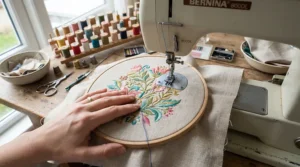
The computerised sewing machine vs mechanical sewing machine debate isn’t about which is “better”. It’s about which fits how you sew. Reference sources note that electric home machines date back to Singer in 1889, and that modern electronic models use computer technology to create buttonholes and decorative stitches. Mechanical models rely on dials, cams and your judgement.
| Computerised | Mechanical | |
|---|---|---|
| Stitch selection | Buttons or jog dial, LCD confirms | Dial, no on-screen prompts |
| Buttonholes | One step, auto-sized | Often four-step, manual |
| Learning curve | Menus to learn, fewer errors | Simple, but more to judge yourself |
| Longevity | Electronics may age sooner | Fewer parts to fail |
| Typical budget | Mid-£300s upwards | Under £300 |
| Best For | Regular sewers, variety | Occasional use, tight budgets |
Look at that table honestly and mechanical still wins on simplicity and long-term repairability. One UK dealer guide suggests budgeting roughly £180-£250 for a mechanical machine versus £380-£500 for a computerised one. It also stresses that a quality mechanical model beats a cheap computerised one. Machines such as the Janome J3-18 and Janome 423S exist precisely for buyers who prefer dial-and-slider control, with the latter aimed at long-term durability.
The break-even is regularity. If you sew weekly, automatic buttonholes and a needle-down setting save enough time to justify the premium. If you sew twice a year, save your money for good needles.
Computerised Sewing Machine with Built-In Stitches: How Many Do You Need?
Stitch counts are the most inflated number on any box, so let’s deflate it. A computerised sewing machine with built-in stitches divides roughly into three tiers, and each suits a different sewer.
16 to 30 stitches covers straight, zigzag, blind hem, overedge, stretch and a handful of buttonholes. The Brother Innov-is A16 and Janome 230DC live here, and it’s plenty for garments, hemming and home furnishings.
60 to 80 stitches adds quilting, appliqué and decorative options. The Janome 360DC and Brother Innov-is A80 sit in this tier, which is the sweet spot for most hobbyists because it gives variety without menu overload.
140 to 600 stitches is where a digital stitch library turns into a creative toolbox. You can combine patterns, mirror-image them, add lettering and, on the Brother Innov-is F420, draw your own. The Singer Quantum Stylist 9960 and Jaguar 200SQ target this appetite.
A practical test: how many of your last ten projects would have needed more than ten stitches? If the answer is “none”, buy quality over quantity. Also check whether the stitch chart is visible on the machine, as printed charts on the lid or front save you from constantly scrolling. Finally, remember that lettering is only useful if you’ll monogram, label or personalise things, and many sewists never touch it.
LCD Screen Sewing Machine Features That Matter (And Those That Don’t)
An LCD screen sewing machine is only as useful as the information it shows. Screens sound like marketing, but a few things genuinely change how you sew.
What matters:
- Foot recommendations. The Brother Innov-is A80 and Singer Quantum Stylist 9960 both tell you which presser foot to attach, which prevents broken needles and crooked seams.
- Width and length readouts. Seeing your exact settings makes results repeatable, which is the real point of a computerised machine.
- Backlighting. The Janome 360DC and Jaguar 200SQ offer backlit screens, which help in dim sewing corners or for tired eyes.
- Screen size. The Brother Innov-is F420‘s larger display shows more at once than the compact one on the Brother Innov-is A16, though bigger isn’t essential if you’re only choosing among a few stitches.
What doesn’t matter (much):
- Colour touchscreens. They add polish more than stitch quality, and none of these seven machines needs one.
- Enormous stitch menus. A beautiful screen with 600 stitches can still bury the three you use daily, which is why direct-access buttons for utility stitches matter.
The rule I’d apply: choose the screen that answers your questions fastest, not the one that looks most like a smartphone.
Programmable Sewing Functions: Your First 30 Days
Programmable sewing functions are the little automations that make a computerised machine feel clever. Here’s a first-month plan that squeezes the most out of them.
Week one: set up and test. Thread carefully following the guide marked on the machine, wind a bobbin, and sew test lines on scrap fabric of your typical project. Set the maximum-speed slider low. Beginners go faster than they realise.
Week two: automate the boring bits. Learn your needle up/down setting so the needle stays in the fabric when you pivot. Use the lock stitch or auto-reinforcement to secure seam ends and stop hand-tying threads.
Week three: explore the stitch library. Try one utility stitch per project, such as blind hem or stretch stitch, and note settings that worked. If your machine supports it, save combinations, mirror-image a stitch or add lettering to a label.
Week four: care and routine. Brush out lint after each project, change the needle regularly and check your manual for oiling instructions. Keep a swatch card recording settings, since fabric, needle and stitch combinations become a personal reference.
Common mistakes in the first 30 days: using the wrong needle (a ballpoint for jersey), forcing the needle threader, and sewing at full speed before you’ve mastered control.
Which Computerised Sewing Machine for Which Maker? Real-World Scenarios
These are illustrative profiles, not real customers. They show how the same budget can lead to different choices.
The student on a tight budget. She’s hemming trousers, altering charity-shop finds and making the occasional cosplay costume, sewing a couple of evenings a week on a shared desk. A Brother Innov-is A16 keeps things simple with one-step buttonholes and a stitch set that covers everything she needs. If she wants lettering for costume labels, the Jaguar 200SQ costs less, though she’d accept a shorter warranty.
The weekend quilter. He sews around six hours a week on a dedicated table with plenty of space. The Janome 360DC brings foot-pressure control and a wide extension table, which suit piecing and binding lap quilts. He’ll need to accept the compact arm for anything bed-sized. If his budget stretches further, the Brother Innov-is F420‘s knee lift keeps both hands on the quilt.
The gift-maker with a small craft business. She personalises baby blankets, tote bags and labels, and needs consistent lettering and decorative stitches fast. The Singer Quantum Stylist 9960‘s fonts, mirror-imaging and thread trimmer justify the outlay, and the Brother Innov-is F420‘s custom-stitch designer is the premium alternative.
The takeaway: match the machine to frequency and ambition, not to the longest feature list.
Problem → Solution: Fixing Common Computerised Sewing Machine Headaches
Skipped stitches on jersey. Stretch fabrics need the right needle. A ballpoint needle usually cures skipping on machines like the Brother Innov-is A16, as UK reviewers note.
Thread nesting or bunching underneath. Nine times out of ten it’s a threading slip. Raise the presser foot, rethread from scratch, and check the bobbin is seated correctly in machines with drop-in bobbins such as the Janome 230DC.
Sluggish screen or odd behaviour after a cold night. Electronics dislike temperature extremes. Some manuals specify an operating range and advise letting the machine warm up after moving it from a cold room, so check yours before sewing.
A bent needle threader. Forcing the machine to sew while the threader is lowered can damage it. On the Brother Innov-is A80, one library user reported exactly this, so make sure the needle is raised and the threader is fully retracted before you sew.
Uneven buttonholes. Use the correct buttonhole foot, add a stabiliser and always test on a scrap. The one-step function on the Janome 360DC sizes the hole to your button, but fabric thickness still matters.
Long-Term Cost & Maintenance of a Computerised Sewing Machine
Spread across years of use, a computerised sewing machine costs far less per session than the sticker price suggests. A machine in the mid-£400s used weekly for eight years works out at roughly £1 per session, before needles and thread. That figure is rough, but it helps to put a premium model such as the Brother Innov-is F420 into perspective.
Maintenance is straightforward but non-negotiable. Brush out lint after each project, replace needles regularly, and arrange a professional service every couple of years if you sew often. Because electronic models tend to age sooner than mechanical ones, surge protection and sensible storage away from damp or extreme cold are cheap insurance.
Warranty is where costs hide. Janome’s UK cover on the Janome 230DC and Janome 360DC is two years, which one dealer says can be extended up to five within 30 days of purchase. By contrast, the Jaguar 200SQ is typically listed with 12 months return-to-base. Factor that into the price gap. Also remember that a repair on a circuit board can cost more than a budget machine’s total value, so a longer warranty buys real peace of mind.
Safety, UKCA/CE Marks and Buying Safely in the UK
Every computerised sewing machine is mains-powered equipment, so check it carries the right conformity mark. According to GOV.UK guidance on UKCA and CE marked products, Great Britain now recognises the CE marking alongside the UKCA marking for many product types, giving manufacturers flexibility. Look for either mark on the rating plate, box or manual, and treat a machine with neither as a red flag.
Buy with care too. Choose sellers that are authorised UK dealers or clearly UK-based, because a cheap machine from an overseas marketplace seller can leave you without valid warranty. Check the seller name on the product page and confirm the warranty in writing.
At home, use a proper surge-protected socket, unplug when changing needles or cleaning under the needle plate, and keep fingers clear of the needle and threader. Keep the manual close, since it will give the operating conditions for your specific model, and read it before your first stitch.
FAQ
❓ Is a computerised sewing machine worth it for a beginner?
❓ Can a computerised sewing machine sew denim and thick fabric?
❓ How long does a computerised sewing machine last?
❓ Do I need to service a computerised sewing machine regularly?
❓ Which LCD screen sewing machine is best for dressmaking on a budget?
Conclusion
Choosing a computerised sewing machine in 2026 comes down to matching ambition to budget. For absolute beginners, the Brother Innov-is A16 is the least intimidating start. Learners who want longevity should look at the Janome 230DC, and quilters will appreciate the extra control on the Janome 360DC. Dressmakers wanting more variety without menu overload will be well served by the Brother Innov-is A80.
If personalisation is your passion, the Singer Quantum Stylist 9960 delivers the biggest digital stitch library here, while the Brother Innov-is F420 suits serious makers who’ll use its knee lift and custom-stitch designer. On a strict budget, the Jaguar 200SQ offers remarkable features for the money, provided you accept a shorter warranty and check its exact specification with your seller.
Whichever you choose, remember the honest truth from our computerised sewing machine vs mechanical sewing machine comparison: features only pay off when you use them. Choose the LCD screen sewing machine that answers your questions fastest, learn its programmable sewing functions in your first 30 days, and buy from an authorised UK seller.
Recommended for You
- Sewing Machine for Arthritis Automatic Threading: 7 Best Picks (2026)
- Automatic Threading Sewing Machine: 7 Best UK Picks (2026)
- Sewing Machine With Automatic Threading: 7 Best UK Picks (2026)
Disclaimer: This article contains affiliate links. As an Amazon Associate, I earn from qualifying purchases. If you purchase products through these links, we may earn a small commission at no additional cost to you.
✨ Found this helpful? Share it with your friends! 💬🤗
