
In This Article
Here’s a confession sewing shops don’t put on their shopfronts: the foot pedal is the single biggest reason so many beginners give up before they’ve finished their first cushion cover. You’re trying to watch the needle, guide the fabric, keep your seam allowance straight, and somehow your foot is also meant to behave like it’s driving a manual car up a hill. It’s a lot. A push-button sewing machine for beginners solves that particular headache by putting “start” and “stop” on a button beside the needle, so your hands stay in charge of the one thing that actually matters — the fabric.
What is a push-button sewing machine? In short, it’s a sewing machine with a start/stop button (and usually a speed slider) built into the body, letting you sew with or without the foot pedal plugged in. It’s a design that’s quietly become one of the smartest options for new sewers, for people easing into beginner dressmaking, and for anyone who finds a foot pedal genuinely uncomfortable or unmanageable, including many sewers managing arthritis or reduced hand and foot dexterity.
We’ve spent this guide digging into seven real machines from Brother, Janome, Necchi and Dekaim, cross-checking their specifications, and pulling together honest, aggregated impressions from UK retailers and sewing communities. You’ll find genuine comparisons, not just a features list lifted from a product page — because, frankly, you can get that from Amazon already. What follows is the analysis, the “so what does this actually mean for me” thinking, and the practical guidance that turns a spec sheet into a decision you can feel confident about. If you’re weighing up a push-button sewing machine for dressmaking, hunting for low dexterity sewing aids, or just want a machine that won’t fight you on day one, you’re in the right place. According to the Wikipedia entry on sewing machines, electronic and computerised models with programmable functions have become the dominant domestic type since the late twentieth century — and push-button control is very much part of that evolution.
Quick Comparison Table
| Category | Machine | Best For |
|---|---|---|
| Best Overall | Brother CS6000i | All-round beginners wanting value and a proper speed slider |
| Best Ultra-Budget | Dekaim Mini Portable Sewing Machine | Trying sewing out cheaply or sewing on the move |
| Simplest Controls | Brother Innov-is A16 | Total beginners who want the fewest buttons possible |
| Best for Arthritis-Friendly Use | Janome DKS30 SE | Fewer manual snips thanks to the auto thread cutter |
| Best for Dressmaking | Janome Sewist 740DC | Adjustable foot pressure across a range of dress fabrics |
| Most Feature-Rich | Brother Innov-is A150 | Beginners who expect to progress quickly |
Looking at the table, the pattern that jumps out is this: you don’t need to spend a fortune to get hands-free control. The Brother CS6000i and Dekaim Mini Portable Sewing Machine both prove that push-button convenience isn’t reserved for premium machines, while the Janome Sewist 740DC and Brother Innov-is A150 show what you gain — mainly consistency and finer control — once you’re ready to spend more. If low dexterity sewing aids are your priority, note that the auto thread cutter on the Janome DKS30 SE removes one of the fiddliest, most joint-taxing steps in the whole sewing process.
A quick tip before you scroll further — bookmark this page, because comparing specs side by side is far easier than flicking between seven separate listings.
Top 7 Push-Button Sewing Machines: Expert Analysis
1. Dekaim Mini Portable Sewing Machine — lightest option for small spaces and shaky confidence
The clue is in the name: this is a genuinely portable machine, and that lightness is exactly why it’s first on our list rather than an afterthought. With 12 built-in stitches covering straight, zigzag and buttonhole work, plus dual power via battery or a UK three-pin AC/DC adapter, it’s built for people who want to test the sewing waters without committing to a full-size machine on the kitchen table. Crucially for this guide, it offers two control options — a push button and a traditional foot pedal — so you can switch between the two while you find out which suits your hands better.
Based on the spec comparison with the rest of this list, its lower stitch count and lighter-duty motor mean it’s best suited to fabric scraps, simple mends and craft projects rather than heavy denim or multiple layers of quilting cotton.
Aggregated feedback across retailer listings and general sewing community chatter tends to praise its portability and beginner-friendly bundled accessories (a 97-piece tool kit, extension table and 11 presser feet), while a recurring theme is that the motor can feel underpowered on thicker fabric — exactly what you’d expect from an entry-level, travel-sized design.
Pros:
- ✅ Genuinely lightweight with a carrying handle for taking anywhere
- ✅ Dual power options via battery or UK mains adapter
- ✅ Comes with a generous accessory bundle for absolute beginners
Cons:
- ❌ Limited to lighter fabrics and simple projects
- ❌ Smaller motor means less consistent speed than computerised rivals
At under £60, this is pocket-money territory for a working sewing machine, and the value verdict is straightforward: brilliant as a low-stakes way to learn the basics before upgrading.
2. Brother Innov-is A16 — simplest push-button start for total beginners
The Brother Innov-is A16 strips things back on purpose, and that’s precisely its appeal. Sixteen built-in stitches sounds modest next to some of the machines further down this list, but here’s what most buyers overlook: for your entire first year of sewing, you’ll realistically use straight stitch, zigzag and a buttonhole, so sixteen options is plenty rather than a compromise. It pairs a start/stop button with drop feed dogs, a quick-set bobbin and an automatic needle threader, meaning the fiddliest parts of setting up — threading the needle, winding the bobbin — are largely taken care of for you.
What the spec sheet won’t tell you, but reviewers on retailer sites consistently note, is that the simple LCD screen and minimal button layout make this one of the least intimidating machines to sit down with for the first time, even if a handful of users wished the work area were slightly larger for bigger projects. This is a machine built for confidence, not showing off.
Pros:
- ✅ Minimal buttons keep the learning curve gentle
- ✅ Automatic needle threader saves fiddly close-up work
- ✅ Lightweight-ish build makes it easy to carry to classes
Cons:
- ❌ Only 16 stitches limits creative and decorative options
- ❌ Compact workspace can feel tight on larger projects
Sitting in the £250-£300 range at the time of research, the A16 earns its place as the machine we’d point a nervous first-timer toward, particularly one who wants push-button simplicity over bells and whistles.
3. Brother CS6000i — best value all-rounder with a proper speed slider
If you only read one product entry in this guide, make it this one, because the Brother CS6000i is the machine that keeps turning up, unprompted, across nearly every “best beginner sewing machine” list we researched — and for good reason. Sixty built-in stitches, including seven styles of one-step buttonhole, are selected via an LCD screen rather than fiddly dials, and the star feature for this guide is the combination of a start/stop button with a genuine electronic speed control slider. That slider matters more than it sounds: instead of hoping your foot presses gently enough, you set a maximum speed and the machine simply won’t go faster, which is a much steadier way to learn control.
Reviewers across retail platforms repeatedly flag the automatic needle threader and jam-resistant top-loading bobbin as genuine time-savers, while the most common criticism is that the throat space (the gap to the right of the needle) is narrow, making bulky quilts and heavier upholstery fabric awkward to manoeuvre. For dressmaking-weight cottons, jersey and linen, though, it copes comfortably.
Pros:
- ✅ Speed slider gives real, adjustable control over stitching pace
- ✅ Automatic needle threader and jam-resistant bobbin cut fiddly setup
- ✅ Wide accessory bundle including a walking foot for quilting
Cons:
- ❌ Narrow throat space limits large quilting or upholstery projects
- ❌ Lightweight build can feel less planted on thick fabric layers
Priced around £180-£230 depending on retailer promotions, this is the machine we’d call the smartest all-round buy on this list — genuinely excellent value for what it offers.
4. Necchi NE30 — best convenience-button cluster for dressmaking
Necchi has been building sewing machines since 1919, and the NE30 wears that heritage lightly, focusing on a genuinely thoughtful cluster of convenience buttons rather than chasing a huge stitch count. Thirty-one stitches, including seven buttonhole styles, sit alongside a start/stop button, a reverse button, a locking stitch button, a needle up/down button and — the real standout here — an automatic thread cutter. Here’s what that means in practice: every time you finish a seam on a dress bodice or a sleeve, you’re not reaching for scissors, which shaves genuine time and hand movements off every single project.
Based on the spec comparison, the top-loading full rotary hook bobbin system is also a more robust mechanism than the vertical oscillating hooks found on some ultra-budget machines, translating to fewer skipped stitches on medium-weight dressmaking fabrics.
Aggregated sewing-community sentiment tends to describe the NE30 as “quietly capable” rather than flashy, with the main gripe being that Necchi’s UK stockist network is smaller than Brother’s or Janome’s, so replacement parts can take a little longer to source.
Pros:
- ✅ Automatic thread cutter removes a fiddly, repetitive hand movement
- ✅ Full rotary hook bobbin is more robust than basic vertical hooks
- ✅ Full convenience-button cluster suits varied dressmaking tasks
Cons:
- ❌ Smaller UK stockist network than Brother or Janome
- ❌ 31 stitches is modest if you want heavy decorative variety
At around £280-£330, the value verdict is strong for anyone specifically hunting a push-button sewing machine for dressmaking rather than quilting or crafts.
5. Janome DKS30 SE — best auto-thread-cutter pick for tired fingers
Janome’s computerised machines have long had a reputation among sewing tutors for being some of the friendliest around for a start/stop, no-pedal workflow, and the DKS30 SE continues that tradition. Thirty built-in stitches and a 7mm maximum stitch width give you enough range for garments, home furnishings and simple quilting, but the headline feature for this guide is the automatic thread cutter paired with the start/stop button and speed control slider.
Reviewers consistently note that eliminating manual thread-snipping is one of the most genuinely useful low dexterity sewing aids hiding in plain sight on a modern machine — it isn’t marketed as an accessibility feature, but functionally, it removes one of the fiddliest, most grip-intensive actions in the entire sewing process.
Based on the spec comparison with the Brother machines on this list, Janome’s horizontal drop-in bobbin system is widely regarded as one of the easier bobbin styles to load without pinching thin thread between your fingertips repeatedly.
Pros:
- ✅ Automatic thread cutter reduces repetitive fine-motor snipping
- ✅ Horizontal drop-in bobbin is straightforward to load
- ✅ Speed control slider allows a genuinely gentle learning pace
Cons:
- ❌ Sits at a higher price point than similarly specced Brother models
- ❌ 30 stitches is on the lower side for this price bracket
Typically priced in the £550-£600 range, this is a premium ask for a beginner machine, but if reducing hand strain is your main goal, the value case holds up well.
6. Janome Sewist 740DC — best adjustable foot pressure for dressmaking fabrics
The Janome Sewist 740DC is the machine we’d recommend to someone who has decided sewing isn’t a passing phase and wants a machine that will genuinely grow with them into serious beginner dressmaking. Forty built-in stitches, twenty of which are direct-select via dedicated buttons, sit alongside a start/stop button, needle up/down control and a speed control slider — all fairly standard for this list by now. What sets the 740DC apart is six-level adjustable foot pressure, a feature that lets you fine-tune how firmly the presser foot grips the fabric, which matters enormously once you move from quilting cotton to slippery viscose, chiffon or a chunky wool coating fabric.
On paper this means one machine can competently handle a huge range of dressmaking projects without you fighting the fabric feed.
Aggregated feedback highlights the wide, stable work area and the auto-lock stitch (which secures your stitching at the touch of a button, rather like a manual backstitch) as genuinely useful for garment construction, while the most common note of caution is that, at 5.9kg with a wider footprint, it’s less pocket-friendly to store than the more compact Brother options above.
Pros:
- ✅ Six-level foot pressure adjustment suits varied dressmaking fabrics
- ✅ Auto-lock stitch button secures seams without manual backstitching
- ✅ Wide, stable work area helps with larger garment pieces
Cons:
- ❌ Bulkier footprint takes up more storage space
- ❌ Manual thread tension control has a steeper learning curve
Expect to pay somewhere in the £600-£650 range, and for anyone serious about beginner dressmaking, this is money well spent on genuine fabric versatility.
7. Brother Innov-is A150 — most feature-rich for beginners who plan to progress fast
Rounding out our list is the machine we’d point toward the beginner who suspects, deep down, that they’re going to fall properly in love with sewing. The Brother Innov-is A150 offers a genuinely substantial 150 built-in stitches, four lettering styles for labels and monograms, and ten styles of one-step automatic buttonhole — a huge jump from the 16-stitch A16 further up this list, built by the same manufacturer. Push-button essentials are all present: a start/stop button, a slide-type speed control, needle stop position up/down, and — a step up from cheaper machines here — an auto trim button that automatically cuts both the top and bobbin thread.
Based on the spec comparison, the LCD screen with on-screen stitch preview means you’re choosing stitches visually rather than by number, which meaningfully reduces the “which button does what” confusion that trips up a lot of first-time computerised-machine owners.
Reviewers and retailer feedback repeatedly describe it as a machine you “won’t outgrow within the first year,” with the main honest caveat being that 150 stitches is genuinely more than most beginners will use in their first twelve months, so you are, in part, paying for future-proofing.
Pros:
- ✅ Auto trim button cuts both top and bobbin thread automatically
- ✅ Visual on-screen stitch preview reduces beginner confusion
- ✅ 3-year warranty reflects Brother’s confidence in the build quality
Cons:
- ❌ Many features go unused in the first year of sewing
- ❌ Sits at the top of the beginner price bracket
At around £550-£650 depending on bundle and retailer, this is an investment buy — but a justifiable one if you already suspect this hobby is going to stick.
Top 7 Push-Button Sewing Machines: Full Comparison
| Machine | Built-In Stitches | Start/Stop Button | Auto Thread Cutter | Price Range | Best For |
|---|---|---|---|---|---|
| Dekaim Mini Portable Sewing Machine | 12 | Yes | No | Under £60 | Trying sewing cheaply, portability |
| Brother Innov-is A16 | 16 | Yes | No | £250-£300 | Simplest possible controls |
| Brother CS6000i | 60 | Yes | No | £180-£230 | Best overall value |
| Necchi NE30 | 31 | Yes | Yes | £280-£330 | Beginner dressmaking |
| Janome DKS30 SE | 30 | Yes | Yes | £550-£600 | Arthritis-friendly, low dexterity |
| Janome Sewist 740DC | 40 | Yes | No | £600-£650 | Dressmaking, varied fabrics |
| Brother Innov-is A150 | 150 | Yes | Yes | £550-£650 | Progressing quickly, future-proofing |
The clearest takeaway from this table is that an auto thread cutter, not raw stitch count, is the feature that most reliably signals a machine built with easy-to-use controls and hand strain in mind — it’s present on the Necchi NE30, Janome DKS30 SE and Brother Innov-is A150, and absent from the cheaper options. Meanwhile, stitch count scales almost independently of price sensitivity for arthritis-friendly use: the Janome DKS30 SE has fewer stitches than the far cheaper Brother CS6000i, but its price reflects the ease-of-use extras rather than raw pattern variety. If budget is your primary constraint, the Brother CS6000i remains the standout — genuinely excellent specification for the price.
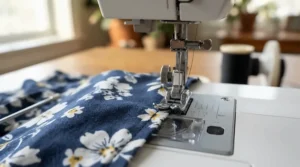
Practical Usage Guide: Setting Up Your Push-Button Machine for Success
Getting a new sewing machine out of the box is a bit like bringing home a flat-pack wardrobe — technically it works out of the box, but ten minutes of proper setup saves you weeks of frustration. Start by winding and inserting the bobbin exactly as the manual describes; on machines like the Brother CS6000i and Janome Sewist 740DC, the top-loading, drop-in bobbin system is designed to be nearly foolproof, but skipping the automatic bobbin winder in favour of guesswork is the single most common cause of jammed first stitches.
Before you touch fabric, run a few test lines on a scrap of the same material, adjusting tension and stitch length until the top and bottom threads lock evenly in the middle of the fabric, not visibly on either side. This is also the moment to get familiar with your machine’s speed slider: set it low, press the start/stop button rather than reaching for the foot pedal, and get a feel for how the needle responds before you’re under any pressure to finish a seam neatly.
In the first thirty days, the most common mistakes are threading the machine with the presser foot down (which skips the tension discs entirely), forgetting to raise the needle to its highest position before removing fabric, and letting lint build up around the bobbin case, which causes skipped stitches on machines like the Necchi NE30 and Janome DKS30 SE faster than you’d expect. A soft brush and five minutes after every few projects keeps things running sweetly.
Real-World Scenarios: Matching the Right Machine to Your Sewing Life
Picture Amy, a university student in a shared flat with barely enough desk space for a laptop, let alone a full-size machine — she needs something she can pack away between lectures. The Dekaim Mini Portable Sewing Machine or Brother Innov-is A16 fit that brief nicely: light, compact, and cheap enough that a mistake with a seam ripper doesn’t feel catastrophic.
Then there’s Margaret, recently diagnosed with osteoarthritis in her hands, who’s sewn on and off for forty years and isn’t about to stop now — she just needs her equipment to stop fighting her. For her, the Janome DKS30 SE‘s automatic thread cutter and gentle speed slider, paired with genuinely low dexterity sewing aids like foam-grip scissors and a needle threader tool, make far more difference than any amount of extra stitch patterns.
And finally, picture Priya, six months into a beginner dressmaking course, sewing her first fitted bodice from a medium-weight cotton poplin. She needs adjustable foot pressure and reliable feed on varied fabric weights, which is exactly where the Janome Sewist 740DC or Brother Innov-is A150 earn their higher price tags — machines built to grow alongside a genuinely developing skill, budget allowing, environment permitting, and used several evenings a week rather than gathering dust after one project.
Beginner Dressmaking: Getting Your First Makes Right
Beginner dressmaking projects fail for surprisingly predictable reasons, and most of them have nothing to do with talent. Problem one: using the wrong needle for the fabric — a universal needle on slippery jersey will skip stitches endlessly, whereas a ballpoint needle glides through. Problem two: skipping a tension test on scrap fabric, which is the single fastest route to puckered seams on a first garment.
Problem three is rushing the pinning stage; dressmaking fabric shifts far more than quilting cotton, and a few extra pins genuinely save a wonky hem. Problem four is ignoring seam allowances printed on a pattern, which throws off fit in ways that are hard to diagnose afterwards. And problem five, particularly relevant to this guide, is fighting a foot pedal on curved seams like necklines and armholes — this is precisely where a push-button start, combined with a low, steady speed setting on machines such as the Necchi NE30 or Janome Sewist 740DC, gives you the calm, hands-on control that curved dressmaking seams actually demand.
How to Choose a Push-Button Sewing Machine for Beginners
- Check for a genuine start/stop button, not just “electronic” branding. Some listings use “electronic” loosely; confirm the button sits on the machine body itself, as on the Brother CS6000i or Brother Innov-is A16.
- Look for a real speed control slider. This is what gives you consistent, hands-free control rather than simply removing the pedal without replacing its function.
- Prioritise easy-to-use controls over stitch count. A machine with 20 clearly labelled buttons is friendlier than one with 150 stitches buried in a menu.
- Consider an automatic thread cutter if hand strength or grip is a concern. As seen on the Necchi NE30 and Janome DKS30 SE, this genuinely reduces repetitive fine-motor tasks.
- Match the bobbin system to your patience level. Top-loading, drop-in bobbins are broadly easier to manage than front-loading systems for shaky or painful hands.
- Think about weight and portability honestly. If the machine will live in a cupboard between uses, a lighter model like the Dekaim Mini Portable Sewing Machine avoids awkward lifting.
- Set a realistic budget band before you shop, using price ranges rather than chasing the cheapest possible unit — reliability matters more than saving £20.
Push-Button Sewing Machines for Dressmaking
A push-button sewing machine for dressmaking earns its keep on exactly the projects where a foot pedal becomes a liability: darts, curved necklines, gathered sleeves and set-in zips, all of which demand your full attention on the fabric rather than your foot pressure. Feature-by-feature, what dressmaking actually rewards is adjustable foot pressure (present on the Janome Sewist 740DC), a wide range of stitch widths for finishing raw edges on woven and stretch fabrics, and a reliable one-step buttonhole function for cuffs, waistbands and plackets — all present across the Necchi NE30, Janome Sewist 740DC and Brother Innov-is A150.
Cost-per-use matters here too: a £600 machine used weekly for years of dressmaking works out considerably cheaper per project than a £150 machine replaced twice within eighteen months because it can’t cope with denim, wool coating or multiple fabric layers. If you’re planning to make garments regularly rather than the occasional cushion cover, the Janome Sewist 740DC‘s foot pressure adjustment and the Brother Innov-is A150‘s wider stitch library both represent genuinely better long-term value than their sticker price initially suggests.
Low Dexterity Sewing Aids and Arthritis-Friendly Features That Actually Matter
Marketing rarely uses the phrase “arthritis-friendly” on a sewing machine box, but functionally, several features do exactly that job. Push-button start and a speed slider remove the need for sustained, controlled pressure through the ankle and foot — helpful if arthritis affects your lower limbs as much as your hands. An automatic thread cutter, present on the Necchi NE30, Janome DKS30 SE and Brother Innov-is A150, removes repetitive scissor use, which the Versus Arthritis charity notes is exactly the kind of small, repeated fine-motor task that joint protection guidance recommends reducing wherever possible.
Beyond the machine itself, genuine low dexterity sewing aids are worth pairing with any of these picks: a magnetic pin cushion (no pinching pins from a pot), spring-loaded scissors that reopen themselves after each cut, and a stand-mounted needle threader that removes close, fiddly eye strain entirely. Reviewers in accessibility-focused sewing forums consistently mention that combining a push-button machine with even one or two of these low-cost aids makes a far bigger practical difference than upgrading to a pricier machine alone.
Push-Button vs Traditional Foot-Pedal-Only Sewing Machines
| Factor | Push-Button Machines | Foot-Pedal-Only Machines |
|---|---|---|
| Speed Consistency | Fixed via slider, very steady | Varies with foot pressure |
| Hands-Free Operation | Yes, foot pedal optional | No, pedal required |
| Learning Curve for Beginners | Generally gentler | Can feel jerky at first |
| Best For | Arthritis-friendly and dressmaking precision | Traditional, lower-cost mechanical machines |
The practical difference comes down to control versus tradition: push-button machines like the Brother CS6000i hand you a fixed, repeatable speed the moment you press start, which is precisely what beginners struggling with foot-pedal coordination need. Foot-pedal-only machines aren’t obsolete — many mechanical models remain sturdy and affordable — but they ask more of your coordination from day one. For anyone weighing up low dexterity sewing aids specifically, the push-button category is the clearer starting point.
Common Mistakes When Buying a Push-Button Sewing Machine
A surprisingly common mistake is assuming “computerised” automatically means “has a start/stop button” — plenty of computerised machines still rely solely on the foot pedal, so always confirm this specific feature before buying rather than after unboxing. Another frequent slip is prioritising stitch count over ergonomics, when in practice most beginners settle into using five or six stitches regardless of how many the machine offers.
Buyers also often skip checking bobbin type, only to discover a fiddly front-loading system that undoes much of the convenience a push-button start was meant to provide. Finally, don’t overlook weight if the machine needs lifting regularly from storage — a heavier premium model like the Janome Sewist 740DC is a poor match for someone who can’t comfortably lift six kilograms onto a table each session.
Long-Term Cost & Maintenance
Sewing machines aren’t a one-off purchase so much as a small ongoing relationship, and the total cost of ownership includes needles (replaced roughly every one to two projects, or sooner on denim), bobbins, the occasional professional service, and replacement presser feet for specialist tasks like zips or buttonholes. Budget machines like the Brother CS6000i and Dekaim Mini Portable Sewing Machine cost less upfront but may need servicing or replacing sooner under regular use, while the Janome Sewist 740DC and Brother Innov-is A150 are built with heavier-duty internals that typically justify a professional service every twelve to eighteen months rather than more frequent troubleshooting.
Cost-per-use tells a clearer story than sticker price alone: a £600 machine sewn on weekly for five years works out at roughly £2.30 per week, while a £150 machine replaced after eighteen months of heavy use costs more per week in the long run, even before factoring in the frustration of an unreliable feed. Keep your machine covered when not in use, oil it as the manual specifies (never household oil), and change needles more often than feels necessary — a blunt needle is responsible for more skipped stitches than any machine fault.
Safety, Regulations & Compliance for UK Sewers
Any electrical sewing machine sold in Great Britain must comply with the Electrical Equipment (Safety) Regulations, and manufacturers are required to demonstrate conformity through either CE or UKCA marking, depending on when and how the product was placed on the market. You can check the current requirements directly via the UK government’s UKCA marking guidance, which explains which product categories, including household electrical goods, fall under this framework.
In practical terms for a beginner, this means checking that any machine you buy — whether it’s the budget Dekaim Mini Portable Sewing Machine or the premium Brother Innov-is A150 — carries a valid UK-compliant safety marking, comes with a UK three-pin plug or compatible adapter, and includes a proper instruction manual in English. Beyond the paperwork, basic safety habits matter too: always unplug the machine before changing needles or clearing jams, keep fingers well clear of the needle area when using the push-button start (since it can begin stitching the instant you press it), and never leave a machine running unattended, even briefly.
Frequently Asked Questions
❓ What is a push-button sewing machine?
❓ Can you sew without a foot pedal on a push-button machine?
❓ Are push-button sewing machines good for arthritis or low dexterity?
❓ What is the best push-button sewing machine for a complete beginner?
❓ Do push-button sewing machines still come with a foot pedal?
Conclusion
If there’s one thing worth taking away from this guide, it’s that a push-button sewing machine for beginners isn’t a gimmick or a luxury extra — it’s a genuinely practical design choice that removes one of the biggest early barriers to learning to sew. Whether you’re drawn to the pocket-friendly Dekaim Mini Portable Sewing Machine, the brilliantly balanced Brother CS6000i, or a dressmaking-ready option like the Janome Sewist 740DC, the common thread across every recommendation here is control: control over speed, control over your hands, and ultimately, control over how confidently you approach your first (and fiftieth) project.
For anyone specifically weighing up low dexterity sewing aids or arthritis-friendly features, the Janome DKS30 SE‘s automatic thread cutter deserves particular attention, while dressmakers-in-training should look hard at the Janome Sewist 740DC‘s adjustable foot pressure. There’s no single “best” machine here, only the best match for your fabric, your budget and, most importantly, your hands. According to Which?’s independent sewing machine testing, ease of setup and consistent fabric handling consistently separate the machines beginners stick with from the ones that end up back in their box within a month — which is precisely the ground this guide has tried to cover.
✨ Ready to get started?
Check today’s prices on your favourite pick from this list and take the first genuine step toward your next handmade project! 🧵
Recommended for You
- Push-Button Sewing Machine: 7 Best UK Picks for Easy Stitching (2026)
- Electronic Sewing Machine for Beginners: 7 Best Picks (2026)
- Electronic Sewing Machines: 7 Best UK Picks & Buying Guide (2026)
Disclaimer: This article contains affiliate links. As an Amazon Associate, I earn from qualifying purchases. If you purchase products through these links, we may earn a small commission at no additional cost to you.
✨ Found this helpful? Share it with your friends! 💬🤗
