
In This Article
A sewing machine for arthritis automatic threading is a machine built or selected specifically to reduce hand strain, using a built-in mechanism that pulls thread through the needle eye at the press of a lever so you never have to pinch, squint, and stab at a needle’s eye with swollen fingers. If you’ve ever stood over a machine at midnight, thread wedged between your teeth, cursing a needle eye the size of a full stop, you already know why this matters more than stitch count or fancy embroidery fonts ever will.
Here’s the thing nobody tells you at the fabric shop: most sewing machine marketing talks about speed and stitch libraries, while the feature that actually determines whether you’ll use the machine at all — threading — gets a single bullet point buried under “165 built-in stitches!” For anyone with arthritis in the fingers, thumbs, or wrists, that bullet point is the whole ball game. Fumbling thread through a 1mm eye with joints that ache on a good day isn’t a minor inconvenience; it’s often the exact reason a sewing machine ends up gathering dust in a cupboard.
This guide cuts through the noise. We’ve researched seven real, currently available machines from Brother, Singer, and Janome — spanning budget, mid-range, and premium — and weighed each one specifically against what matters for painful or reduced-dexterity hands: threading mechanism reliability, grip pressure needed for controls, weight (because lugging a 9kg machine off a shelf shouldn’t be part of your workout), and genuine owner feedback rather than marketing fluff. We’ll also walk through setup, common mistakes, and the features that are worth paying for versus the ones that are just noise on a spec sheet.
Quick Comparison Table
Before we dive deep into all seven, here’s the fast version for anyone who wants the headline verdict without scrolling.
| Machine | Type | Threading Ease | Weight | Best For |
|---|---|---|---|---|
| Brother Innov-is A16 | Computerised entry | One-touch lever | ~6.3kg | Tightest budget, first-timers |
| Singer Simple 3232 | Mechanical | Automatic, simple lever | ~6.5kg | Straightforward, no-fuss sewing |
| Brother CS6000i | Computerised | One-touch lever | ~7kg | Variety without complexity |
| Janome Jem Gold 660 | Compact mechanical | Semi-automatic | ~4kg | Lightest lift, travel/mending |
| Brother Innov-is A50 | Computerised mid-range | One-touch, jog dial | ~7.4kg | Fine motor-friendly dial control |
| Janome Magnolia 7318 | Premium mechanical | Automatic | ~8kg | Quietest motor, soft-grip dials |
| Brother Innov-is A150 | Premium computerised | Advanced auto-threader | ~7.8kg | Most hands-off automation |
Reading this table, a pattern jumps out fast: weight and threading mechanism matter just as much as price bracket. The Janome Jem Gold 660 proves that “budget” and “arthritis-friendly” aren’t the same axis — it’s mid-priced but the lightest machine here by some margin, which counts for a lot if you’re lifting it on and off a shelf every session. Meanwhile, the Brother Innov-is A150 shows that spending more buys you automation depth (thread cutting, tension, threading) rather than just more stitches, which is exactly the kind of spend that pays off for painful hands.
💬 Found one that looks right already? Tap through to check today’s price before it changes.
Top 7 Sewing Machines for Arthritis and Automatic Threading: Expert Analysis
We picked these seven specifically to cover every situation: the person testing the water with their first machine, the seasoned dressmaker whose hands have changed over the years, and everyone parked in between. Budget, mid-range, and premium are all represented, along with a genuinely compact option for anyone who wants to sew on a kitchen table rather than commit a whole room to it.
1. Brother Innov-is A16 — easiest one-touch threader under £200
The standout here is blunt simplicity: press the lever, and the thread is through the eye in one motion, no squinting required. Brother’s “one-action” threader on the A-series works by guiding thread along a printed path (there are literally numbered arrows on the machine body) before a small hook does the threading itself, which matters enormously when your fingers won’t cooperate with fiddly manual guides.
Specs-wise, you’re getting 25 built-in stitches, an automatic buttonhole function, a jog dial for stitch selection instead of a row of tiny buttons, and a drop-in bobbin system that avoids the fiddly bobbin-case juggling of older machines. In practice, that jog dial is doing more accessibility work than the threader alone — turning a smooth dial with your palm is far less punishing on thumb joints than pinching a small toggle switch repeatedly.
Based on the spec comparison against other entry machines in this bracket, the A16 earns its place through restraint rather than showing off: it doesn’t try to be everything, so there’s less to fight with. It’s aimed squarely at beginners and returning sewists who want reliability over a stitch catalogue, and that focus tends to serve arthritic hands well because there’s simply less menu-diving involved.
Reviewers consistently note that the threading mechanism holds up well over time compared with cheaper unbranded machines, though a recurring theme in aggregated feedback is that the plastic outer casing feels less substantial than older all-metal Brothers — a fair trade-off for the lower weight, but worth knowing before you buy.
Pros:
- ✅ One-lever threading with almost no fine motor input
- ✅ Jog dial is gentler on thumb joints than button rows
- ✅ Drop-in bobbin skips fiddly bobbin-case handling
Cons:
- ❌ Fewer stitches than mid-range Brother models
- ❌ Plastic housing feels lighter-duty than metal-frame machines
Price sits in the under-£200 range, and for a first machine or a returning-to-sewing purchase, that’s genuinely good value — you’re not paying for stitch libraries you’ll never open, just for the one mechanism that actually determines whether you’ll enjoy using it.
2. Singer Simple 3232 — lightest touch for first-time dressmakers
Singer Simple 3232‘s standout feature is exactly what the name promises: it strips sewing back to essentials, and its automatic needle threader uses a straightforward hook-and-pull motion that Singer has refined across several generations of “Simple” machines. If you want a machine that doesn’t ask you to think, this is it.
The 32 built-in stitches cover the genuine essentials — straight, zigzag, stretch, buttonhole — without drowning you in decorative options you’ll never use. A built-in needle threader, adjustable stitch length and width via simple dials (not buttons), and a free arm for cuffs and sleeves round out a spec sheet that reads like a “what actually matters” checklist rather than a marketing wishlist.
What most buyers overlook about this model is that its mechanical simplicity is itself an accessibility feature — there’s no LCD menu to navigate with a stylus-like precision your fingers might not have anymore, just physical dials you can turn with a flat palm. That’s a genuinely different interaction model to a touchscreen computerised machine, and for many people with arthritis in the fingertips specifically, dial-turning is far less painful than tapping small buttons.
Aggregated review sentiment across UK and US retailers points consistently to the threader’s reliability being the standout praised feature, alongside the machine’s light foot-pedal pressure requirement — useful if ankle or foot joints are also affected.
Pros:
- ✅ Physical dials avoid fiddly touchscreen or button navigation
- ✅ Light foot pedal pressure suits sensitive joints
- ✅ Straightforward stitch selection with no learning curve
Cons:
- ❌ Limited to core stitches, no decorative or quilting extras
- ❌ Basic bobbin winding requires a couple of manual steps
Expect this one in the budget bracket, similar to the A16 — and the value verdict is strong if your priority is dependable everyday mending and simple dressmaking rather than creative embroidery.
3. Brother CS6000i — most stitch variety for the price
The Brother CS6000i‘s standout is breadth: 60 built-in stitches, a wide extension table, and an LCD screen that displays stitch width and length without you needing to consult a manual every five minutes. For dressmaking specifically — hems, seams, buttonholes, stretch fabrics — that range genuinely gets used, unlike some higher-stitch-count machines where half the library is decorative filler.
The automatic needle threader here works on the same one-touch principle as the A16, but paired with a wider table and sturdier frame, which in practice means less wrestling with fabric bulk — a real consideration if grip strength for holding and guiding heavier fabric is part of your arthritis picture, not just threading. The auto-declutch bobbin winding is a small but genuinely thoughtful touch: it stops the needle moving while you wind a bobbin, removing a step where fingers often get too close to a moving needle.
Here’s what the spec sheet won’t tell you, but user reports suggest: the automatic thread cutter (a button that trims both top and bobbin threads at once) is arguably as valuable as the needle threader itself for arthritic hands, because it removes the “reach for scissors, pinch, snip” sequence at the end of every seam — a repetitive fine-motor task that adds up over a long sewing session.
A common complaint in user reviews is that the automatic threader can occasionally misalign after the machine has been jostled in transport, requiring a quick recalibration — annoying, but a five-minute fix rather than a dealbreaker.
Pros:
- ✅ Wide stitch range covers dressmaking and quilting alike
- ✅ Auto thread cutter removes repetitive scissor-snipping
- ✅ Auto-declutch bobbin winding keeps fingers away from the needle
Cons:
- ❌ Heavier and bulkier than pure entry-level machines
- ❌ Threader can need realignment after being moved around
This sits comfortably in the mid-range price band, and the value case is strong precisely because the CS6000i’s extra features (auto-cutter, declutch winding) tackle hand strain at multiple points in the sewing process, not just at threading.
4. Janome Jem Gold 660 — lightest machine you can lift one-handed
The Janome Jem Gold 660‘s standout advantage is sheer portability — at around 4kg, it’s roughly half the weight of most full-size machines, which sounds like a minor spec until you’re the one lifting a machine off a high shelf with a wrist that doesn’t love bearing weight.
Don’t mistake “compact” for “toy,” though. It’s a genuine mechanical workhorse with 12 stitches covering the essentials, a semi-automatic threader (you guide the thread to a loading point and a lever does the rest), and a free arm ideal for cuffs, trouser hems, and smaller mending jobs. Janome has built a reputation on smooth, low-vibration motors, and that translates directly into less jarring feedback through the hands during long seams.
Based on the spec comparison with bulkier machines on this list, the trade-off is honest: fewer stitches, smaller throat space for large projects like duvet covers. But what most buyers overlook is that weight itself is an accessibility feature that never appears on a spec sheet as such — carrying a lighter machine to a table by a window with better light, or packing it for a class, is a task that a 4kg machine handles and an 8kg machine turns into a small ordeal.
Reviewers consistently describe this as their “grab-and-go” machine — the one that comes out for a quick mend rather than sitting permanently set up, precisely because setup and pack-away don’t require any real exertion.
Pros:
- ✅ About half the weight of full-size sewing machines
- ✅ Smooth, low-vibration motor reduces hand fatigue over long sessions
- ✅ Simple 12-stitch layout with no overwhelming menu
Cons:
- ❌ Smaller throat space limits bulky projects like duvets
- ❌ Fewer stitch options than full-size mid-range machines
Priced in the mid-range bracket despite its compact size, the value verdict depends entirely on your projects: for garment repairs, hemming, and light dressmaking, it’s arguably the single most arthritis-considerate machine on this list.
5. Brother Innov-is A50 — best jog-dial control for stiff fingers
The Brother Innov-is A50 stands out for pairing Brother’s one-touch threader with the most refined jog-dial stitch selector in this price bracket — a genuinely different interaction model from button-based machines that rewards hands with reduced fine motor precision.
With 50 built-in stitches, an LCD display showing stitch width, length, and the correct presser foot for your selection, and a slide-based speed control (rather than a foot-pedal-only setup), the A50 gives you more ways to control the machine that don’t rely on pinch-grip strength. The slide speed control specifically means you can dial the machine down to a crawl using a flat thumb push rather than modulating pressure through a foot pedal, which is genuinely useful on days when foot or ankle joints are also flaring.
What most buyers overlook about jog-dial machines generally is how much they reduce cumulative micro-strain compared to touchscreens — a dial rotation uses larger muscle groups in the hand and wrist rather than the fingertip-only tapping a touchscreen demands, and that difference compounds significantly over a multi-hour project.
Aggregated feedback across retailers highlights the central controls as unusually intuitive for a computerised machine, with the main criticism being that the stitch library, while broad, leans more decorative than some dressmakers want.
Pros:
- ✅ Jog dial uses whole-hand movement, not fingertip precision
- ✅ Slide speed control avoids relying on foot-pedal modulation
- ✅ LCD shows the correct presser foot per stitch automatically
Cons:
- ❌ Stitch library skews decorative over purely functional
- ❌ Sits at a higher price point than the CS6000i for similar core function
This lands in the mid-to-premium range. The value case rests on control ergonomics rather than raw stitch count — if dial-turning genuinely feels easier than button-pressing for you, this is worth the jump over the CS6000i.
6. Janome Magnolia 7318 — quietest motor with soft-grip dials
The Janome Magnolia 7318‘s calling card is a mechanical build with a notably quiet, smooth-running motor and large soft-grip control dials, engineered from the ground up with senior and low-dexterity users in mind rather than accessibility bolted on afterward.
This is a fully mechanical machine — no computer chip deciding things for you — with an automatic needle threader, 18 built-in stitches, a one-step buttonhole, and drop-feed for free-motion work. The soft-grip dials are the genuine differentiator: rather than small hard plastic knobs, they’re oversized and rubberised, meaning you turn them with a loose palm grip instead of pinching between finger and thumb.
Here’s what the spec sheet won’t tell you: motor noise and vibration aren’t just comfort issues, they’re a proxy for how much feedback travels back up through the fabric and into your hands during a long seam. A quieter, smoother motor generally means less accumulated micro-jolting, which several occupational therapists who work with arthritic hands specifically recommend screening for when choosing sewing equipment. On that front, the Magnolia’s mechanical simplicity (fewer moving computerised parts, sturdier gearing) tends to translate into steadier, calmer operation session after session.
A recurring theme in aggregated owner sentiment is that this machine “just works” reliably across years of use, with the main trade-off being that the smaller stitch library means it’s less suited to anyone chasing decorative embroidery variety.
Pros:
- ✅ Oversized soft-grip dials replace small pinch-grip knobs
- ✅ Notably quiet, low-vibration mechanical motor
- ✅ Reliable one-step buttonhole with minimal setup fuss
Cons:
- ❌ Smaller stitch library than computerised competitors
- ❌ Costs more than mechanical machines with similar stitch counts
Sitting at the premium end of mechanical machines, the value verdict is that you’re paying specifically for ergonomics and longevity rather than features — a fair trade if daily comfort matters more to you than stitch variety.
7. Brother Innov-is A150 — most automation for tired hands
The Brother Innov-is A150 tops this list for automation depth: alongside the one-touch threader, it adds automatic thread cutting, automatic tension adjustment, and a large backlit LCD, meaning fewer manual micro-adjustments across an entire sewing session, not just at the threading stage.
With 50+ stitches, a wide table, needle up/down positioning at the touch of a button (handy for pivoting fabric without manually cranking a handwheel), and Brother’s most refined threader mechanism to date, this is the machine built for someone who’s sewn for decades and whose hands simply need the machine to absorb more of the physical workload than it used to.
Based on the spec comparison with the rest of this list, the auto-tension feature deserves special mention: manually adjusting thread tension via a small dial is a genuinely fiddly, trial-and-error task that computerised auto-tension removes almost entirely, which matters because tension troubleshooting is one of the more frustrating fine-motor tasks in sewing generally.
Reviewers consistently note that the combination of auto-threading, auto-cutting, and auto-tension together — rather than any single feature — is what makes daily use feel meaningfully easier, though a fair few mention that the sheer number of automated functions means a slightly longer learning curve up front.
Pros:
- ✅ Automatic tension removes fiddly manual dial adjustments
- ✅ Needle up/down button avoids manual handwheel cranking
- ✅ Most refined threader combined with automatic thread cutting
Cons:
- ❌ Highest price point on this list
- ❌ More automated functions mean more to learn initially
This sits in the premium bracket. The value verdict: if your hands tire across a session rather than just at threading, this is the one machine here engineered to reduce fine-motor demands at multiple points, not just one.
Practical Usage Guide: Setting Up Your New Machine for Pain-Free Sewing
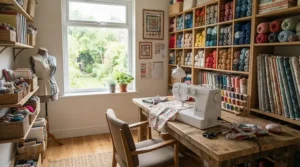
Getting a new machine home is only half the job — how you set it up in the first week determines whether it becomes a joint-friendly companion or another source of frustration. Start by positioning the machine on a stable table at a height where your elbows sit at roughly 90 degrees when your hands rest on the bed plate; hunching or reaching up strains wrists and shoulders in ways that compound any existing joint pain. A slightly raised chair, or a small platform under the machine, can make more difference than any feature on the spec sheet.
Before your first project, spend ten minutes just practising the threading lever and bobbin-loading mechanism on scrap fabric, with no pressure to actually sew anything. Muscle memory for a new mechanism takes a few repetitions to settle, and doing this without the added stress of a “real” project lets you build confidence gently. Most first-30-day mistakes happen not because the machine is faulty, but because the thread path was skipped or done out of order — always follow the printed numbered guides on the machine body exactly, since threading paths that look “close enough” often aren’t.
Maintenance-wise, a light oiling every few months (check your manual — some computerised machines are self-lubricating and shouldn’t be oiled manually) and a soft-brush clean of the bobbin area after every few projects prevents the small mechanical snags that make threading feel harder than it should. If the automatic threader starts missing the needle eye, it’s very often simply due to the needle being slightly bent or the wrong size for your thread — a five-minute needle swap solves more “faulty threader” complaints than people expect.
Real-World Scenarios: Which Machine Suits Your Sewing Life?
Picture Margaret, 68, recently diagnosed with osteoarthritis in both thumbs, who used to sew constantly but stopped two years ago when threading became genuinely painful. For her, a machine like the Janome Magnolia 7318 makes sense — the oversized dials and reliable mechanical threader mean fewer fine-motor demands throughout a session, and the quiet motor suits someone easing back into longer stretches at the machine after a break.
Then there’s David, 74, who sews occasionally — mostly repairs and the odd cushion cover — and lives in a small flat where storage space is tight. The Janome Jem Gold 660‘s low weight and compact footprint mean it can live in a cupboard and come out for twenty minutes without becoming a production, which matters more to him than stitch variety ever will.
Finally, consider Priya, 55, who dressmakes seriously — dresses, alterations, the works — but developed rheumatoid arthritis in her hands five years ago and has had to relearn how she works. For her, the Brother Innov-is A150‘s combination of auto-threading, auto-cutting, and auto-tension addresses the cumulative fatigue across a full afternoon of sewing, not just the single threading step, which is exactly the kind of full-session automation her hands now need.
Problem → Solution: Common Threading and Grip Struggles Solved
Problem: The needle eye keeps missing the thread even with an automatic threader. This is almost always down to needle size or a slightly bent needle rather than the threader itself — swap to a fresh needle matched to your thread weight, and the issue typically resolves immediately.
Problem: Turning small dials or pressing tiny buttons hurts. Look specifically for jog-dial machines like the Brother Innov-is A50, or oversized soft-grip dial machines like the Janome Magnolia 7318 — both let you use a whole-hand rotation instead of a pinch grip.
Problem: The foot pedal requires too much pressure to control speed. Machines with a slide-based speed control, such as the Brother Innov-is A50, let you set maximum speed with a thumb push rather than relying entirely on foot pressure — genuinely useful if ankle or foot joints are also affected.
Problem: Snipping thread at the end of every seam is painful. An automatic thread cutter, found on the Brother CS6000i and Brother Innov-is A150, removes the repetitive scissor-pinch motion almost entirely.
Problem: The machine is too heavy to get out and put away regularly. This is where the Janome Jem Gold 660 genuinely earns its keep — at roughly half the weight of a full-size machine, it removes the barrier to actually using it.
How to Choose a Sewing Machine for Arthritis and Automatic Threading
- Test the threading lever’s resistance, not just its presence. Not all “automatic” threaders require equal force — some need a firm, decisive push while others glide. If you can try before buying, do.
- Weigh the machine, literally. A machine you’ll lift regularly should ideally sit under 7kg unless it stays permanently set up on a dedicated table.
- Check control type: dials versus buttons versus touchscreen. Dials generally demand less fine motor precision than small buttons or touchscreen taps.
- Look for an automatic thread cutter. It removes a genuinely painful repetitive task most buyers don’t think to check for.
- Prioritise a drop-in bobbin over a front-loading bobbin case. Drop-in systems avoid fiddly case insertion entirely.
- Consider motor smoothness and noise, not just power. A jarring, buzzy motor translates into more hand fatigue over a long session.
- Match stitch count to your actual projects, not aspirational ones. More stitches often means more small buttons to navigate — only pay for what you’ll genuinely use.
Common Mistakes When Buying a Sewing Machine for Arthritis
The single biggest mistake is buying based on stitch count alone. A 200-stitch machine with fiddly button navigation can be objectively harder to live with than a 20-stitch machine with generous dials — more options rarely means more comfort. A close second is skipping the weight spec entirely; buyers focus on the machine’s footprint on a desk and completely forget they’ll be lifting it regularly, sometimes daily.
Another frequent misstep is assuming “automatic needle threader” is a single standardised feature across brands — it isn’t. Mechanisms vary meaningfully in the force required and the number of steps involved, which is exactly why this guide treats it as a spectrum rather than a tick-box. Finally, many buyers skip testing the foot pedal pressure, only to discover weeks later that ankle or foot joints struggle with it just as much as their hands struggled with the old needle — a slide speed control sidesteps this entirely.
Automatic Threading Sewing Machine for Home Dressmaking
For anyone dressmaking regularly at home rather than doing occasional repairs, the calculus shifts slightly. An automatic threading sewing machine for home dressmaking needs to handle re-threading multiple times per garment — colour changes, top-stitching, basting — so threader reliability under repeated daily use matters more here than for occasional mending.
The Brother CS6000i and Brother Innov-is A50 both suit this use case particularly well, since their wider stitch libraries cover the buttonholes, stretch stitches, and decorative topstitching that dressmaking regularly demands, while their one-touch threaders hold up to repeated re-threading without the mechanism loosening or misaligning quickly. If your dressmaking involves frequent colour changes — say, contrast topstitching — the automatic thread cutter on the CS6000i earns its keep many times over across a single garment.
Top Automatic Needle Threader Sewing Machines: What Actually Matters
When people search specifically for the top automatic needle threader sewing machines, they’re usually asking one question underneath the phrasing: which mechanism is most reliable over hundreds of uses, not just in a showroom demo? Reliability here comes down to build quality of the small hook mechanism itself — metal-reinforced hooks (found on Brother’s Innov-is range) tend to hold calibration longer than lighter plastic equivalents.
Across the seven machines reviewed here, the Brother Innov-is A150 and Brother Innov-is A50 represent the most refined versions of Brother’s one-touch system, while the Janome Magnolia 7318 offers the sturdiest mechanical alternative for anyone who prefers to avoid computerised machines altogether. What the spec sheet won’t tell you is that threader reliability tends to degrade faster on machines that get knocked around in transport — if you sew at different locations (classes, a relative’s house), a slightly firmer mechanism is worth prioritising over a gentler but more delicate one.
Dexterity-Friendly Sewing Aids Beyond the Machine Itself
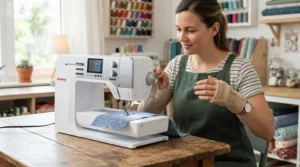
The machine is only one piece of the puzzle. Dexterity-friendly sewing aids — separate from the machine — can meaningfully extend what a painful hand can manage comfortably. A magnetic pincushion removes the pinch-grip needed to retrieve pins from a traditional cushion. Spring-loaded, ergonomic-handled scissors need far less grip force than standard shears, since the spring does the reopening work your hand would otherwise do. Seam rippers with a thicker, cushioned grip reduce strain during unpicking, which is arguably one of sewing’s most joint-punishing tasks.
A simple sewing machine extension table — even a basic snap-on one — also counts as a dexterity aid in practice, since it supports the weight of fabric that would otherwise pull against your wrist as you guide it through the machine. None of these cost much individually, but stacked together with the right machine, they meaningfully lower the daily physical cost of sewing.
Ease of Use for Seniors: What to Expect Day-to-Day
Ease of use for seniors isn’t a single feature — it’s the sum of dozens of small interactions across a session, most of which don’t show up on a spec sheet at all. Expect, on a well-chosen machine, threading that takes seconds rather than minutes, bobbin winding that doesn’t require holding a small spool steady with one hand while threading with the other, and controls readable without reaching for reading glasses (large LCD text, or high-contrast physical dials, both help here).
What genuinely differs day-to-day between machines is cumulative fatigue rather than any single dramatic difficulty. A machine like the Janome Magnolia 7318, with its soft-grip dials and quiet motor, tends to feel roughly the same in hour three of a session as it did in minute five — whereas a machine with small hard buttons and a buzzy motor can start to feel noticeably harder to manage as a session goes on, even though nothing about the machine itself has changed.
Ergonomic Sewing Machine Features That Actually Matter
Marketing copy loves to bundle “ergonomic” onto anything with a slightly rounded edge, so it’s worth being specific about which ergonomic sewing machine features genuinely reduce strain and which are cosmetic. Genuinely useful: oversized dials over small buttons, a slide speed control as an alternative to foot-pedal-only operation, an automatic thread cutter, a drop-in bobbin, and a needle up/down button that avoids manual handwheel cranking.
Largely cosmetic for arthritis purposes, despite being marketed heavily: touchscreen interfaces (often demand more fingertip precision than physical dials, not less), an enormous stitch library (more menu navigation, not less), and machine colour or styling. The Brother Innov-is A50‘s slide speed control plus jog dial is a good real-world example of the “actually matters” category done well, while a flashy touchscreen on a competing machine can look impressive in a shop but add friction at home.
Long-Term Cost & Maintenance: The Real Cost of Ownership
Sticker price is only the opening bid in what a sewing machine actually costs over its lifetime. Servicing (typically recommended annually for regular use), needles, bobbins, and the occasional presser foot add up, but the genuinely underweighted cost for arthritic hands is time and physical effort — a machine that takes longer to thread or requires more force to operate effectively “costs” more in daily wear on your joints, even if the sticker price was lower.
Mechanical machines like the Janome Magnolia 7318 and Singer Simple 3232 tend to have lower long-term servicing costs since there’s less electronics to fail, while computerised machines like the Brother Innov-is A150 carry a higher repair cost if something in the circuitry goes wrong, though they’re also less likely to need mechanical adjustment in the interim. Weighed against the genuine time and pain saved daily by better automation, most buyers researching this category find the extra £50-150 for the right threading and control mechanism pays for itself in reduced frustration within the first few months, regardless of raw repair-cost maths.
Safety, Regulations & Compliance for UK Buyers
All seven machines featured here are designed to meet UK product safety requirements, which in Great Britain means either UKCA or, during the current transitional recognition period, CE marking — both indicate the machine has been assessed against electrical and mechanical safety standards before sale. You can read the official UK government guidance on UKCA marking if you want to understand exactly what that conformity marking covers before buying.
Beyond marking compliance, a few practical safety habits matter specifically for arthritic hands: always use the needle up/down function or handwheel (never your fingers) to check needle position, keep the automatic thread cutter blade guard in place, and unplug the machine before any bobbin-area cleaning rather than relying on the power switch alone — a small habit that removes any risk if a switch is accidentally nudged mid-clean.
Sewing Machine vs Hand Sewing: Which Protects Your Joints Better?
It’s tempting to assume hand sewing is gentler on arthritic hands simply because it’s slower and quieter, but the opposite is often true. Hand sewing demands a sustained, repetitive pinch grip on both needle and fabric for every single stitch, which is precisely the kind of prolonged tight gripping that hand therapists generally advise against for arthritic joints. A machine, by contrast, does the repetitive pinching mechanically — your hands mainly guide fabric, a far lighter and more varied motion.
That said, hand sewing still has its place for small, occasional tasks — a single button, a tiny repair — where setting up a machine would be overkill. The genuinely balanced approach most occupational therapists suggest is machine-first for anything beyond a couple of stitches, reserving hand sewing for the smallest jobs, and always using an ergonomic-handled needle or a hands-free threading tool rather than a bare needle for those occasional hand-sewn tasks. For a deeper look at how joint protection principles apply to repetitive hand tasks generally, the NHS guidance on osteoarthritis treatment and supportive devices is a genuinely useful starting point, and if you want tailored, one-to-one advice, Versus Arthritis’s guide to hand therapists explains how a referral can help you adapt specific tasks, sewing included.
If you’re weighing up machines side by side rather than models within a single brand, it’s also worth reading independently tested comparisons — Which?’s guide to buying a sewing machine tests ease of use across brands including Brother, Singer, and Janome, which is a useful sanity check alongside the arthritis-specific analysis in this guide.
FAQ
❓ What is the best sewing machine for someone with severe arthritis in their hands?
❓ Do automatic needle threaders actually work reliably?
❓ How much should I expect to pay for an arthritis-friendly sewing machine?
❓ Is a lighter sewing machine always better for arthritic hands?
❓ Can I add an automatic threader to a machine that doesn't already have one?
Conclusion
Choosing a sewing machine for arthritis automatic threading isn’t about chasing the longest stitch list or the shiniest touchscreen — it’s about identifying, honestly, which physical tasks your hands genuinely struggle with, and picking a machine engineered specifically around those pressure points. For some, that’s threading alone, easily solved by any of the seven machines above. For others, it’s the accumulated toll of buttons, bobbins, foot pedals, and thread-snipping across a full session, which is where machines like the Brother Innov-is A150 or Janome Magnolia 7318 earn their higher price tags.
Whichever you land on, the seven machines here — from the budget-friendly Brother Innov-is A16 and Singer Simple 3232, through the versatile Brother CS6000i and featherweight Janome Jem Gold 660, up to the refined Brother Innov-is A50, soft-grip Janome Magnolia 7318, and fully automated Brother Innov-is A150 — represent genuinely different answers to the same underlying question: how do we get thread through a needle eye without asking painful joints to do work they shouldn’t have to. Pick the one that matches your actual hands, not your aspirational stitch count, and sewing can stay a source of genuine pleasure rather than a fight you have to psych yourself up for.
Recommended for You
- Automatic Threading Sewing Machine: 7 Best UK Picks (2026)
- Sewing Machine With Automatic Threading: 7 Best UK Picks (2026)
- Push-Button Sewing Machine for Beginners: 7 Best Easy Picks (2026)
Disclaimer: This article contains affiliate links. As an Amazon Associate, I earn from qualifying purchases. If you purchase products through these links, we may earn a small commission at no additional cost to you.
✨ Found this helpful? Share it with your friends! 💬🤗
