
In This Article
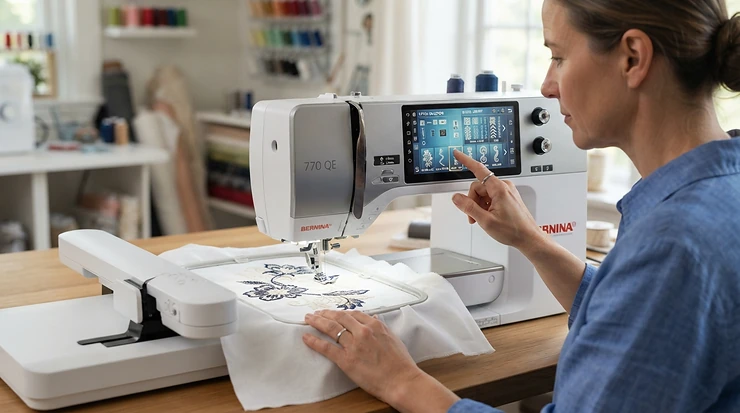
A sewing quilting machine for advanced quilters is a domestic machine built for demanding patchwork and quilting: generous space to the right of the needle, accurate feeding through thick layers, dependable speed control, and features that support free-motion quilting, ruler work and precise ¼-inch piecing. It trades beginner simplicity for precision, capacity and control.
Here’s the truth nobody mentions in the shop. The machine that carried you through twenty cot quilts will sulk the moment you try to wrestle a king-size quilt sandwich through a seven-inch gap. Quilting has always been about stitching layers together. Today’s expectations are dense free-motion fills, ruler work and perfectly matched points, and they put real strain on a basic machine. Skill outgrows hardware faster than most of us admit.
So this 2026 guide to the sewing quilting machine for advanced quilters compares seven real machines. They run from a speedy straight-stitch workhorse in the £1,000-£1,250 range to a combination flagship from around £13,500. I’ve worked from manufacturer specifications, UK dealer listings and published reviews, and I haven’t test-driven any of them. Everything here is analysis, not personal anecdote, and where review evidence is thin I’ll say so.
You’ll find a quick comparison table, seven in-depth profiles, and practical sections on choosing a sewing and quilting machine for large projects, large quilt handling, free-motion quilting and patchwork piecing accuracy. Prices are ranges captured at the time of research, so check the current price before you buy.
Quick Comparison: 7 Machines at a Glance
Throat space, the gap to the right of the needle, is the headline number, but it isn’t the whole story. Here’s how the seven machines line up on the figures that matter most to a sewing quilting machine for advanced quilters. Measurements follow each maker’s own specification, and dealers don’t always measure identically.
| Machine | Space right of needle | Max speed | Stitch regulation | Price range | Best For |
|---|---|---|---|---|---|
| Brother PQ1600S | About 8.5 in | 1,500 spm | None | £1,000-£1,250 | Fast, budget-friendly piecing |
| Juki TL-2200QVP Mini | About 8.5 in (23 in with table) | 1,500 spm | None (speed slider) | £1,300-£1,700 | Straight-line and free-motion purists |
| Janome Horizon Memory Craft 9480QCP | 11 in | About 1,060 spm | Janome ASR system | £3,500-£3,700 | Ruler work and all-round quilting |
| Bernina 770 QE PRO | 10 in | 1,000 spm | BSR included | £4,000-£5,500 | Precision-led free-motion work |
| Pfaff Performance Icon | 12.2 in | 1,050 spm | Not specified in sources | Mid-£4,000s | Bulky, heavily layered quilts |
| Janome Continental M7 Professional | 13.5 in | 1,300 spm | None built in | £4,800-£5,300 | Large quilts and maximum space |
| Brother Luminaire XP3 | 13.1 in | 1,050 spm | None | From around £13,500 | Sew, embroider and quilt in one |
Looking at the table, the Janome Continental M7 Professional and Brother Luminaire XP3 offer the biggest arms. The Bernina 770 QE PRO and Janome Horizon Memory Craft 9480QCP are the two with stitch regulation built into their ecosystems. Budget-minded piecers should note that the Brother PQ1600S and Juki TL-2200QVP Mini trade space and stitch variety for raw speed and simple mechanics. If you can’t decide between size and regulation, the Janome Horizon Memory Craft 9480QCP sits neatly in the middle.
💬 Just one click — help others make better buying decisions too!😊
Top 7 Sewing Quilting Machine for Advanced Quilters: Expert Analysis
Seven machines, one honest verdict each. I’ve ordered them roughly from most affordable to most extravagant, because the right answer depends as much on your bank balance as on your quilts.
1. Brother PQ1600S — fastest straight-stitch piecing on a budget
Speed is this machine’s whole personality. The Brother PQ1600S is a straight-stitch-only model that reaches 1,500 stitches per minute, close to double what many standard domestic machines manage.
The workspace is roughly 8.5 inches to the right of the needle and 5.7 inches high, helped along by a wide extension table of about 11 by 23 inches. In practice that suits lap and throw quilts comfortably, while bed-size quilting becomes a rolling-and-tugging exercise. A pin-feed mechanism can stand in for the feed dogs to move every layer together. UK listings also mention a push-button thread cutter, four feed-dog height settings and a knee lift.
Based on the spec comparison, this is a piecing engine rather than an all-rounder. Chain-piece hundreds of half-square triangles and the speed pays for itself. Go hunting for zigzag, built-in dual feed or a stitch regulator and you’ll hit a wall, because Brother’s own specification confirms there’s no regulator.
Published round-ups present it as the fast straight-stitch pick for piecing, and one UK dealer pitches it at free-motion enthusiasts thanks to the large arm and included foot. Independent UK owner reviews were too sparse to verify a consensus, so treat that as editorial sentiment.
Pros:
- ✅ 1,500 spm speed suits chain piecing
- ✅ Pin feed helps move all layers together
- ✅ Wide extension table included
Cons:
- ❌ Straight stitch only, no zigzag or decorative stitches
- ❌ Modest arm space for king-size quilts
At around £1,000-£1,250 at the time of research, it’s strong value for a dedicated piecer, so check the current price.
2. Juki TL-2200QVP Mini — industrial-style workhorse for straight lines
Think of the Juki TL-2200QVP Mini as an industrial machine taught to behave in a living room. Its arm and bed are die-cast aluminium, and it does exactly one job, straight stitch, at up to 1,500 stitches per minute.
A slide control caps top speed anywhere between 200 and 1,500 stitches per minute, which matters more than it sounds. In free-motion quilting, a speed ceiling stops enthusiastic ankles outrunning the hands. The throat is around 8.5 inches, though the supplied auxiliary table stretches the work area to roughly 23 inches. Add a drop feed, automatic thread trimming, a needle threader and a knee lifter, and the 11.5kg frame stays planted.
On paper, this suits the quilter who knows exactly how long a stitch should be and wants a machine that doesn’t second-guess them. There’s no stitch regulator, so consistency lives in your hands. One caution: a US dealer lists the model as discontinued, so confirm UK stock and warranty before committing.
Dealers describe it as a quilter’s workhorse, and one UK retailer says it’s the machine their in-house tutor reaches for most. I couldn’t verify a robust pool of independent owner reviews.
Pros:
- ✅ Industrial-style build with 1,500 spm top speed
- ✅ Adjustable speed ceiling helps free-motion control
- ✅ Automatic thread trimmer and knee lifter
Cons:
- ❌ Straight stitch only
- ❌ Roughly 8.5-inch arm limits bulky quilts
Expect the £1,300-£1,700 range, which makes it best value as a specialist second machine.
3. Janome Horizon Memory Craft 9480QCP — stitch regulation plus ruler work
Janome’s Accurate Stitch Regulator (ASR) meets an 11-inch arm in the Janome Horizon Memory Craft 9480QCP, and that pairing is rarer than it should be.
The workspace measures 11 by 4.7 inches, with an extension table, a five-inch touchscreen, 400 stitches up to 9mm wide and a top speed around 1,060 stitches per minute. UK listings show four ASR feet, including a ruler-work foot, supplied with the machine, but confirm that at purchase. Janome’s UK demonstrator explains that the regulator’s sensors adjust stitch length to match fabric movement, so you can concentrate on guiding the quilt. The AcuFeed Flex upper feed keeps layers moving together. The HP needle plate and foot are designed for accurate ¼-inch seams.
Here’s my read: this is the most balanced machine in the guide. You get regulated free-motion quilting, upper-feed piecing and a proper decorative stitch library without paying flagship money. The 4.7-inch arm height is tighter than on Janome’s flagship, so very bulky quilts demand good rolling technique.
Janome’s own site carries only two owner reviews. Both are enthusiastic about stitch variety and the regulator, but that’s too few to call a consensus.
Pros:
- ✅ ASR system with a ruler-work foot
- ✅ AcuFeed Flex keeps layers feeding evenly
- ✅ 11-inch space plus extension table
Cons:
- ❌ 4.7-inch arm height trails the flagship
- ❌ Top speed trails straight-stitch specialists
Around £3,500-£3,700 including VAT at the time of research, it’s fair value for the feature set.
4. Bernina 770 QE PRO — Swiss precision, regulator in the box
The Bernina 770 QE PRO answers a question many free-motion quilters ask: what if the stitch regulator simply came with the machine? It does. Bernina’s BSR is included and keeps stitches even at any speed.
Space to the right of the needle is 10 inches (254mm). You also get Bernina Dual Feed, 30 LED lights, a 1,000 stitches-per-minute top speed, a pinpoint laser and adaptive thread tension. Retail copy credits a redesigned mechanism with reducing vibration and noise.
Based on the spec comparison, you’re paying for refinement rather than size. One dealer docks a star on quilting purely because 10 inches trails the 13-inch machines. If you quilt bed-size quilts in one piece, weigh that carefully. If you favour dense, regulated work on throws and wall hangings, the BSR matters more than an extra inch of arm. The same dealer notes that fewer feet come in the box than rivals supply.
A UK magazine-site review of the sibling 770 QE Plus praised the spacious, well-lit throat and Bernina’s stitch quality while noting it’s a big machine. I couldn’t verify equivalent user reviews for the PRO itself.
Pros:
- ✅ Stitch regulator included in the box
- ✅ Built-in dual feed for layered quilts
- ✅ Quiet, low-vibration mechanism
Cons:
- ❌ 10-inch arm trails the largest rivals
- ❌ Fewer included feet than competitors
Ex-demonstration stock appeared in the low-£4,000s, while new machines likely sit around £4,000-£5,500 depending on version and dealer.
5. Pfaff Performance Icon — integrated dual feed with a roomy arm
The Pfaff Performance Icon is Pfaff’s sewing-only flagship: embroidery is stripped out so the engineering goes into piecing and quilting.
The sewing space is 310mm wide by 140mm high, with a 10.1-inch touchscreen, a top speed of 1,050 stitches per minute and an extra-large bobbin. Pfaff’s Enhanced Original IDT feeds fabric from above and below, and retailers claim nearly twice the needle-piercing power of earlier models. For quilters, that translates into batting-plus-backing layers that travel together without the shuffle you can get from a clip-on walking foot.
I’d call this the machine for people who quilt bulky bed-size projects and want feeding handled by the machine rather than an accessory. One US quilting guide even names it best for bulky quilts, while warning that its large footprint demands a substantial sewing desk. A sewing-only design also means you aren’t funding an embroidery unit you’ll never touch. Whether it includes any stitch-regulation tech wasn’t specified in the sources I reviewed, so ask a dealer.
I couldn’t verify a meaningful pool of independent owner reviews, so the sentiment here is editorial rather than a consensus.
Pros:
- ✅ 310mm-wide arm for bulky quilts
- ✅ Built-in IDT feeding system
- ✅ Large 10.1-inch touchscreen
Cons:
- ❌ Large footprint needs a sturdy desk
- ❌ Premium price without embroidery
Listed in the mid-£4,000s at the time of research, it’s good value if feeding power is your priority.
6. Janome Continental M7 Professional — biggest throat space in its class
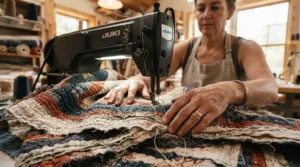
The Janome Continental M7 Professional is the machine people mean when they say “huge arm”: 13.5 inches to the right of the needle and 5.5 inches of height, which Janome bills as the largest workspace on any household machine.
Speed reaches 1,300 stitches per minute, a record for a drop-in bobbin machine according to Janome. AcuFeed Flex Plus has its own motor and on-screen adjustments, and the extension table measures about 26.8 by 15.7 inches. A feed-dog system that stays lowered until the fabric is positioned gives control when you’re lining up seams. You also get three free-motion feet, a ruler-work mode and a Quilt Block Advisor that does the cutting arithmetic. At 17.3kg it’s no featherweight.
If large-quilt capacity tops your list, this is the answer on the spec sheet. There’s no built-in stitch regulator, so free-motion quilting relies on speed control, variable zigzag and your own rhythm. A UK quilting blogger who reviewed it praised the throat, the AcuFeed foot and ruler work, while readers commented that the price put it out of reach. A tech reviewer called it the Rolls-Royce of sewing machines, with the price to match.
Pros:
- ✅ Largest throat space at 13.5 inches
- ✅ AcuFeed Flex Plus with its own motor
- ✅ Fast 1,300 spm drop-in bobbin sewing
Cons:
- ❌ No built-in stitch regulator
- ❌ Heavy at 17.3kg and expensive
Expect £4,800-£5,300, which is steep but defensible for daily large-quilt work.
7. Brother Luminaire XP3 — edge-to-edge quilting from your sewing room
The Brother Luminaire XP3 is the combination option: a sewing, quilting and embroidery machine whose edge-to-edge tools aim to replace a trip to the longarm studio.
The arm measures 13.1 inches (332mm), top speed is 1,050 stitches per minute, and a 10-inch touchscreen drives everything. The embroidery area is 408 by 272mm. A projector and guideline tools help line up stitches and ¼-inch seams. Edge-to-edge mode splits a design across multiple hoopings, and the sewing side includes free-motion, echo and open-toe quilting feet plus a digital dual-feed foot.
This is the machine for a sewing quilting combo for patchwork: embroidered blocks, sashing and appliqué sitting alongside conventional piecing. You’re paying heavily for features beyond sewing, though, and Brother’s home machines don’t offer a stitch regulator. One owner-blogger who bought the earlier XP2 (later upgraded) loves the machine and its quilting perks. She also notes that Brother’s home machines lack a stitch regulator and that her extension table wasn’t included.
Pros:
- ✅ 13.1-inch arm for large quilts
- ✅ Edge-to-edge and quiltbroidery tools
- ✅ Projected guides help with ¼-inch seams
Cons:
- ❌ Very high price
- ❌ No stitch regulator for free-motion work
Listed from around £13,500, it only makes sense if you’ll use the embroidery side often.
Head-to-Head: Feed Systems, Regulators and Real-World Trade-Offs
Spec sheets love big numbers, but accuracy lives in the details: how layers are fed, how stitch length is controlled, and what helps you hit a true ¼ inch. This table lines those details up.
| Machine | Feeding approach | Stitch regulation | Precision aids for piecing | Best For |
|---|---|---|---|---|
| Brother PQ1600S | Pin feed alternative to feed dogs | None | Single-hole straight-stitch design, ¼-inch foot | Chain piecing at speed |
| Juki TL-2200QVP Mini | Drop feed, upper-feed foot in UK listing | None (speed slider) | ¼-inch and 1/5-inch quilting feet | Straight-line quilting |
| Janome Horizon Memory Craft 9480QCP | AcuFeed Flex | ASR | HP needle plate and foot | Ruler work and hybrid piecing |
| Bernina 770 QE PRO | Bernina Dual Feed | BSR included | Pinpoint laser, adaptive thread tension | Regulated free-motion work |
| Pfaff Performance Icon | Enhanced IDT | Not specified | ¼-inch quilting foot for IDT | Bulky, layered quilts |
| Janome Continental M7 Professional | AcuFeed Flex Plus | None built in | HP/HP2 feet, Quilt Block Advisor | Large quilts with accuracy |
| Brother Luminaire XP3 | Digital dual-feed foot | None | Projected guides, ¼-inch foot with guide | Combo patchwork and edge-to-edge |
The table shows the real split: regulated machines (Bernina 770 QE PRO, Janome Horizon Memory Craft 9480QCP) versus space-first machines (Janome Continental M7 Professional, Brother Luminaire XP3). Most quilters will feel one of those two benefits more strongly than the other. Straight-stitch specialists like the Brother PQ1600S and Juki TL-2200QVP Mini sidestep the question by being fast, simple and honest about what they don’t do.
How to Choose a Sewing Quilting Machine for Advanced Quilters
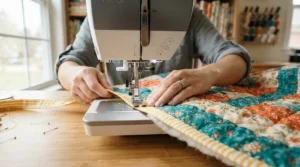
Choose by working backwards from your biggest quilt and your preferred quilting style, then match feeding, stitch control and support to both. Here’s the sequence I’d follow.
- Measure your biggest quilt, not your average one. Space to the right of the needle decides how much bulk you can roll through. Small gaps punish bed-size projects.
- Name your quilting style. Dense free-motion fills, ruler work and straight-line walking-foot quilting each reward different features.
- Decide how stitch length will be controlled. A regulator (BSR or ASR) automates it, a speed slider caps your speed, and skill does the rest.
- Prioritise feeding. Built-in dual feed or an upper-feed system reduces layer creep on thick sandwiches.
- Check piecing aids. Look for a ¼-inch foot, a straight-stitch or HP plate, and a needle-down setting.
- Check compliance, warranty and support. Look for UKCA or CE marking (the gov.uk guidance explains how UKCA works in Great Britain), read the warranty terms, and find a dealer who services what they sell.
- Try before you buy. Bring a real quilt sandwich if the dealer allows it.
Sewing and Quilting Machine for Large Projects: How Much Space Is Enough?
A sewing and quilting machine for large projects needs more than a big throat. It needs a big, well-supported workspace around it.
From this guide, the throat ladder runs roughly like this:
- About 8.5 inches: Brother PQ1600S and Juki TL-2200QVP Mini
- 10 inches: Bernina 770 QE PRO
- 11 inches: Janome Horizon Memory Craft 9480QCP
- 12.2 inches: Pfaff Performance Icon
- 13.1-13.5 inches: Brother Luminaire XP3 and Janome Continental M7 Professional
Each extra inch matters less than the height of the arm and the quality of your table setup. A larger gap helps you roll the quilt more loosely, which reduces drag and distortion. Tabletop quilting frames typically want at least around nine inches of throat for sizeable designs, so the two 8.5-inch machines are borderline there.
Practical rule: if your regular quilts are lap size, 8.5 inches is workable. For queen and king, I’d start at 11 inches and put the budget into extension tables. A 13-inch arm will not make a king-size quilt weigh less, but it will make rolling less cramped.
Large Quilt Handling: Tables, Rolling and Support
Large quilt handling is where bad habits cost the most. Gravity pulls on a hanging quilt, and that pull distorts stitches and tires your shoulders. Here’s a problem-and-solution guide.
Problem: drag from hanging weight. Solution: put the machine in a table or extension setup so the bed is flush, and add a second table behind and to the left to carry the quilt’s weight. The Janome Continental M7 Professional includes a table of about 26.8 by 15.7 inches, and the Brother PQ1600S ships with a wide table of its own.
Problem: bulk jamming in the arm. Solution: roll the quilt snugly from both sides, secure it with clips, and feed it through the arm in a gentle S-shape rather than a tight tube.
Problem: layers creeping out of alignment. Solution: use built-in dual feed or an upper-feed system (the Pfaff Performance Icon, Bernina 770 QE PRO and Janome Horizon Memory Craft 9480QCP all offer one), and start your quilting from the centre outwards.
Problem: sore shoulders. Solution: sit high enough that your forearms are level, and take a break every 20-30 minutes.
Free-Motion Quilting: Setting Up Your Machine for Smooth Results
Free-motion quilting is a rhythm game: your hands steer, your foot sets the pace, and the machine’s job is to stay out of the way. Setup is where most quilters win or lose.
- Drop the feed dogs. The Juki TL-2200QVP Mini has a drop feed, and the Brother Luminaire XP3 has a free-motion mode that lowers the feed dogs and adjusts foot height automatically.
- Fit the right foot. Open-toe and clear-view feet help you see your path. The Janome Horizon Memory Craft 9480QCP supplies ASR feet, including a ruler-work foot.
- Set your speed. On the Juki TL-2200QVP Mini or Brother PQ1600S, a moderate ceiling stops accidental sprints.
- Consider regulation. The Bernina 770 QE PRO with BSR keeps stitch length even whatever your pace.
- Test on a scrap sandwich. Match fabric, batting and thread before you touch the real thing.
Common mistakes in the first 30 days include racing the needle while moving slowly, stopping mid-curve without a plan, and ignoring thread tension. Use a fresh needle for each project, and keep practising on small samples before the big one.
Patchwork Piecing Accuracy: Getting Seams Right Every Time
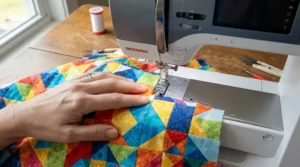
Patchwork piecing accuracy comes down to one number: a consistent ¼-inch seam. A hair off, repeated across a hundred blocks, becomes a quilt top that won’t lie flat.
Start with the hardware. Janome describes its HP needle plate and foot as designed for accurate ¼-inch seams. A straight-stitch plate keeps thin cottons from being pulled into the needle hole, and a needle-down setting lets you pivot cleanly. The Brother Luminaire XP3 adds projected guides and a ¼-inch foot with guide. The Janome Continental M7 Professional adds a Quilt Block Advisor to take the sums out of block sizes.
Test, then trust. Sew three 2½-inch strips together, press, and measure across the finished piece. It should read 6½ inches. If it doesn’t, adjust the needle position or seam guide and test again.
Feeding matters too. Upper-feed or dual-feed systems keep two layers from shifting, which protects points and matching seams. The Brother PQ1600S and Juki TL-2200QVP Mini show that straight-stitch machines can be excellent here: one stitch type and one needle hole mean fewer variables.
Sewing Quilting Combo for Patchwork: Is Embroidery Worth It?
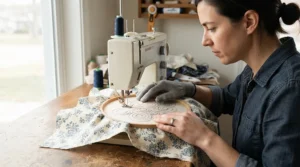
A sewing quilting combo for patchwork adds an embroidery unit to the sewing machine. Whether that’s worth paying for depends on how you’ll use it.
The Brother Luminaire XP3 is the clearest example here. Its quiltbroidery tools can embroider blocks, sashing and borders, and its edge-to-edge mode can split a continuous design across several hoopings. The Bernina 770 QE PRO can take an optional embroidery module later, while the Pfaff Performance Icon is the sewing-only sibling of an embroidery combo, so you only pay for what you use.
My rule of thumb: if you embroider quilt blocks, labels or appliqué regularly, a combo earns its money. If you mostly piece and quilt, the same budget buys a bigger arm, better feeding or a stitch regulator. A combo also brings a steeper learning curve and more software to maintain.
Domestic Machine vs Longarm and Frame Setups
Sooner or later every advanced quilter wonders whether to stay domestic or move up to a frame or longarm. A domestic machine keeps cost, space and noise manageable, while longarm setups give faster, more consistent large-quilt quilting at a much higher cost.
| Option | Space needed | Control for free-motion work | Typical cost | Best For |
|---|---|---|---|---|
| Advanced domestic machine, such as the Janome Continental M7 Professional | A sturdy desk | Hands move the quilt | Wide range, from around £1,000 to £13,500+ in this guide | Quilters who piece and quilt at home |
| Tabletop frame plus a roomy machine | A table plus frame | Machine moves over the quilt | Machine plus frame cost | Quilters wanting less shoulder strain |
| Longarm machine | A dedicated room | Highest control and speed | Typically far higher than a domestic machine | High-volume or professional quilting |
| Hiring a longarm service | None | Handled by the professional | Pay per quilt | Occasional very large quilts |
The table shows domestic machines winning on flexibility and cost, while longarm setups win on speed and scale. If you quilt a few big quilts a year, paying a service may beat buying a frame. If you quilt weekly, a roomy domestic machine such as the Janome Continental M7 Professional or Pfaff Performance Icon gives you control without a spare room.
Real-World Scenarios: Matching Machines to Quilters
Three profiles, matched to machines with the reasoning shown.
The chain piecer. She pieces three or four hours a week in a spare-room corner, with about £1,000-£1,500 to spend. The Brother PQ1600S or Juki TL-2200QVP Mini gives fast, accurate straight-stitch piecing, and she keeps an older machine for decorative work.
The show-quilt free-motion enthusiast. She quilts weekly in a dedicated sewing room with £3,500-£5,500 to spend. The Bernina 770 QE PRO or Janome Horizon Memory Craft 9480QCP offers stitch regulation, plus upper feed for layered quilts.
The king-size maker. She works daily with £5,000 or more to spend. The Janome Continental M7 Professional or Pfaff Performance Icon delivers a large arm and strong feeding. If she also embroiders blocks, the Brother Luminaire XP3 justifies its premium.
Before spending, try machines in person. The Quilters’ Guild works with Twisted Thread on the Festival of Quilts at the NEC in Birmingham, where specialist suppliers gather.
✨ Ready to Upgrade Your Quilting Room?
🔍 Take your large quilts to the next level with these carefully selected machines. Click on any highlighted machine name to check current pricing and availability. These tools will help you create crisp, flat, beautifully quilted pieces your family will treasure!
Long-Term Cost and Maintenance
Price tags tell only half the story. Spread the cost across a decade and the numbers look different: a machine in the £1,000-£1,250 range works out at roughly £100-£125 a year, a mid-£4,000s machine at around £450 a year, and a £13,500 flagship at about £1,350 a year, before servicing.
Servicing is part of the deal. Some makers tie warranty terms to it: one UK retailer says Bernina’s seven-year cover depends on servicing every three years with a specialist dealer. Check the terms for any machine you consider, since dealers quote different warranty lengths for the same model.
Running costs stay small but add up: needles, thread, a spare bobbin set, and an extension table if one isn’t included. Also consider support. A dealer who offers classes, as one of the commenters on a throat-space guide pointed out, can be worth more than a small discount.
For community and inspiration, the Quilters’ Guild has roughly 7,000 members, and a local group is a good place to try machines and hear honest experiences.
FAQ
❓ What needle should I use for free-motion quilting?
❓ Is buying a second-hand sewing quilting machine for advanced quilters a good idea?
❓ How fast should I stitch during free-motion quilting?
❓ Does an advanced quilting machine need regular servicing?
❓ Where can I try a sewing and quilting machine for large projects before buying?
Conclusion
Choosing a sewing quilting machine for advanced quilters comes down to matching space, stitch control and feeding to the way you actually quilt. If speed and straight-line piecing matter most, the Brother PQ1600S and Juki TL-2200QVP Mini are the focused, affordable options. For regulated free-motion work, the Bernina 770 QE PRO and Janome Horizon Memory Craft 9480QCP offer the strongest stitch-control stories. If your quilts are huge, the Janome Continental M7 Professional and Pfaff Performance Icon give you the room and feeding to handle them. The Brother Luminaire XP3 only makes sense if embroidery will be a regular part of your patchwork.
Whichever you choose, measure your biggest quilt first, check warranty and servicing terms, and try the machine with your own materials where you can. Remember that this guide is built on specifications, dealer listings and published reviews rather than hands-on testing, so treat it as a shortlist and confirm details with a dealer.
Recommended for You
- Sewing Quilting Machine: 7 Proven Picks For UK Quilters (2026)
- Sewing And Quilting Machine: 7 Best Picks For UK Quilters (2026)
- Sewing Embroidery Machine For Small Business: 7 Honest Picks (2026)
Disclaimer: This article contains affiliate links. As an Amazon Associate, I earn from qualifying purchases. If you purchase products through these links, we may earn a small commission at no additional cost to you.
✨ Found this helpful? Share it with your friends! 💬🤗
