
In This Article
Here’s a confession most quilters make eventually: the fabric was the easy bit. Choosing the sewing quilting machine that will wrestle it into a finished quilt? That’s the decision that keeps people up at night.
Quilting is an ancient craft, layering fabric and wadding and stitching through the lot, but the modern UK buyer faces a very modern problem. There are hundreds of models, wildly different price tags, and spec sheets that boast about 400 stitches while saying nothing about whether a bed-sized quilt will fit under the arm.
This guide cuts through that. I’ve compared genuine, current specifications for seven real machines, from around £100 to well over £4,000, and translated every spec into what it means at your sewing table. Whether you want an affordable quilting machine for a first patchwork cushion or a long-term investment, there’s a match here.
What Is a Sewing Quilting Machine?
A sewing quilting machine is a domestic sewing machine built or equipped to handle the thick sandwich of top fabric, wadding and backing. It usually pairs everyday dressmaking stitches with quilting-friendly extras: generous workspace right of the needle, adjustable presser foot pressure, drop feed dogs for free-motion work, and often a walking foot or extension table.
Sewing Quilting Machine Quick Comparison: 7 Picks at a Glance
| Machine | Type | Stitches | Standout quilting feature | Price range | Best for |
|---|---|---|---|---|---|
| Brother L14S | Mechanical | 14 | 6 in workspace, jam-resistant drop-in bobbin | Around £100-£150 | Tight budgets, first machine |
| Janome Sewist 725S | Mechanical | 25 | Extra-high presser foot lift | £330-£400 range | Beginners wanting room to grow |
| Brother Innov-is A50 | Electronic | 50 | Free hand quilting setting, start/stop button | Mid-£400s | Confident beginners |
| Janome 5060 QDC | Computerised | 60 | Walking foot and extension table in the box | £480-£560 range | Piecing and quilting from day one |
| Brother Innov-is VQ2 | Computerised | 473 | 285mm workspace | £2,200-£2,500 range | Large and king-size quilts |
| Janome HD9 QC Professional | Straight stitch only | 1 (straight) | Up to 1,650 stitches per minute | £1,450-£1,700 range | Dedicated piecing and quilting |
| BERNINA 770 QE PRO | Computerised | 1,858 | Stitch regulator included | Upper £4,000s | Serious free-motion quilters |
Reading across the table, the Janome 5060 QDC looks like the sweet spot for most people. It’s the only mid-priced option that arrives with a walking foot and an extension table. If budget is your main concern, the Brother L14S gets you stitching for a fraction of the cost, though its smaller arm space limits quilt size. Anyone eyeing the premium end should note that the Brother Innov-is VQ2 and BERNINA 770 QE PRO are paying for workspace and precision, not better basic stitching.
💬 Just one click — help others make better buying decisions too!😊
Top 7 Sewing Quilting Machine Picks: Expert Analysis
Every machine below is analysed from real manufacturer-listed specifications and UK retailer and editorial guidance. I haven’t tested any of them myself, so I won’t pretend otherwise. Where independent review data was thin, I say so instead of inventing ratings.
1. Brother L14S — pocket-friendly first machine
The Brother L14S is the sensible pair of trainers of the sewing world: unglamorous, dependable, and exactly right for getting started. Its 14 stitches are chosen on a single dial, which sounds limiting until you realise that straight stitch and zigzag do nearly all the work when piecing a quilt top. The jam-resistant top-loading bobbin shows your thread level at a glance, and the metal chassis (about 6.4kg) stops the machine skittering about when you speed up.
Here’s the honest analysis: the 6 inch workspace to the right of the needle is its ceiling. Cot quilts, table runners and cushion covers sit comfortably in that gap, while a double-bed quilt sandwich will fight you every inch. On the spec comparison alone, this is a piecing machine first and a quilting machine second.
On customer feedback, I couldn’t verify a large pool of independent reviews for this exact model, so there are no invented star ratings here. What is verifiable is that a UK buying guide from Gathered lists it among its entry-level quilting picks, and The Sewing Studio files it under budget machines with metal construction.
Pros:
- ✅ Single-dial stitch selection keeps learning simple
- ✅ Metal chassis feels steadier than plastic rivals
- ✅ Top-loading bobbin resists jamming
Cons:
- ❌ 6 inch workspace limits larger quilts
- ❌ Only 14 stitches, no creative extras
Price range: around £100-£150 at the time of research, which is superb value for testing the hobby before you commit.
2. Janome Sewist 725S — extra-high lift for bulky seams
The Janome Sewist 725S is a mechanical machine that quietly punches above its price, and its best trick is clearance. The extra-high presser foot lift gives thick quilted seams room to slide under the foot, while adjustable presser foot pressure lets you ease off so the machine doesn’t stall or skip.
That pairing matters more than it sounds. Quilts are at their bulkiest where several seams meet, and that’s exactly where cheaper machines choke. Add 25 stitches, a built-in needle threader, a top-loading bobbin and drop feed for free-motion experiments, and you have a machine you won’t outgrow in six months. At 6.7kg with a hard cover it also travels well to classes.
The 725S has the strongest editorial backing of the seven. Expert Reviews named it the best all-round sewing machine in its UK roundup, and The Sewing Studio recommends it for beginners wanting something reliable and easy to use. I couldn’t verify a large body of individual owner reviews, so I’m not quoting a rating.
Pros:
- ✅ Extra-high presser foot lift handles bulky seams
- ✅ Adjustable pressure suits wadding and fine cotton alike
- ✅ Portable with a hard cover included
Cons:
- ❌ No automatic thread cutter listed
- ❌ Mechanical, so no electronic speed control
Price range: roughly £330-£400, which is fair for a machine that suits both everyday sewing and first quilts.
3. Brother Innov-is A50 — start/stop button, no pedal needed
The Brother Innov-is A50 is built for the person who has outgrown a basic dial machine but isn’t ready to remortgage. Its headline trick is the start/stop button: press once and it sews, press again and it stops. Combined with the electronic speed slider, that’s a quiet blessing on a long quilting line, when a heavy foot on the pedal can leave your ankle complaining.
Look at the numbers. Fifty stitches include five buttonhole styles, a backlit LCD and jog dial make stitch changes painless, and there’s a dedicated free hand quilting setting with manual drop feed for when you fancy trying free-motion work. The 16cm workspace sits in the comfortable range for general sewing, although The Sewing Studio suggests 25cm or more for bed-sized quilts. Lap quilts and throws? Fine. Super-king? Not here.
I couldn’t verify enough independent owner reviews to quote sentiment, so I’ll stay with what’s confirmed: The Sewing Studio calls it an excellent all-rounder and good value, and places it as the top step of its beginner trio.
Pros:
- ✅ Start/stop button spares your foot on long seams
- ✅ Dedicated free hand quilting setting
- ✅ Light at around 6.5kg for carrying to classes
Cons:
- ❌ No automatic thread cutter
- ❌ 16cm arm space is tight for large quilts
Price range: in the mid-£400s, a fair price for a machine that grows with you.
4. Janome 5060 QDC — quilting kit in the box
The Janome 5060 QDC earns its place by solving the “what else do I need to buy?” problem. In the box you get a walking foot, a quarter-inch seam foot, an open-toe free-motion foot and an extension table. The Sewing Studio lists exactly those items as quilting essentials, so you can piece and quilt from the day it arrives.
The rest of the spec backs that up. Sixty stitches include six one-step buttonholes, and there’s an automatic thread cutter and a start/stop button. A seven-piece feed dog system with six levels of presser foot pressure helps layers travel together instead of creeping apart. The 170mm arm space is similar to the Brother Innov-is A50, so it’s a lap-quilt machine rather than a king-size one.
On sentiment, I couldn’t verify a pool of independent reviews, but The Sewing Studio says it has appeared on the Sewing Bee for several series and is among its best sellers. That’s a retailer’s view, not a customer survey, so weigh it accordingly.
Pros:
- ✅ Walking foot and extension table included
- ✅ Automatic thread cutter saves constant scissor reaching
- ✅ Six-level pressure control suits varied wadding
Cons:
- ❌ Arm space still tight for bed-sized quilts
- ❌ Costs more than mechanical starters
Price range: about £480-£560, which is strong value once you count the accessories you’d otherwise buy separately.
5. Brother Innov-is VQ2 — 11¼ inches of arm space
The Brother Innov-is VQ2 is what happens when a sewing machine decides to become a quilting machine. The headline number is 285mm (11¼ inches) of workspace right of the needle, enough, according to The Sewing Studio, to manage a king-size quilt without constant refolding.
The supporting cast earns its keep too. The ICAPS system adjusts presser foot pressure automatically as fabric thickness changes, keeping stitch length steady across bulky seam intersections. The pivot function lifts the foot when you stop so you can turn corners without reaching for the lever, and a knee lifter frees both hands for guiding fabric. Add 473 stitches and a 7 inch colour touchscreen, and it’s a feature-rich machine.
The trade-off is heft. At 15.3kg it’s a permanent resident of your sewing table, not a class-day companion. What most buyers overlook is that you pay for this workspace in both pounds and kilograms. I couldn’t verify independent reviews, so I’m relying on The Sewing Studio’s listing of it as its long-arm pick for ambitious quilters.
Pros:
- ✅ Huge 285mm workspace for large quilts
- ✅ ICAPS adjusts pressure over bulky seams
- ✅ Knee lifter keeps both hands free
Cons:
- ❌ Heavy at 15.3kg, not portable
- ❌ Premium price and a learning curve
Price range: around £2,200-£2,500, and it’s worth it only if you regularly make big quilts.
6. Janome HD9 QC Professional — 1,650 stitches per minute, straight only
The Janome HD9 QC Professional is a specialist, and it’s proud of it. It sews straight stitch only, at up to 1,650 stitches per minute, and that single-mindedness is the point. For piecing hundreds of seams and straight-line quilting, speed and consistency matter far more than a library of decorative stitches.
The engineering explains the price. A 14.5kg painted aluminium body and eight enclosed ball bearings keep it planted at speed. The side-loading jumbo bobbin holds 1.4 times more thread than a standard one, so long quilting lines get interrupted less. Then there’s the Floating Function, which lifts the presser foot very slightly to reduce drag, a feature The Sewing Studio says helps stop the top layer shifting against the one below, which is where puckering often starts.
The catch is stated plainly by the retailer: no buttonhole function and no decorative stitches, so most owners keep a second machine. Independent owner reviews weren’t verifiable in my research, so I’m only relaying the manufacturer-listed specifications and the retailer’s guidance.
Pros:
- ✅ Blistering 1,650 stitches per minute
- ✅ Jumbo bobbin means fewer refills
- ✅ Floating Function reduces layer drag
Cons:
- ❌ No buttonholes or decorative stitches
- ❌ Heavy and expensive for a specialist
Price range: roughly £1,450-£1,700, which makes sense only for committed quilters who’ll use the speed daily.
7. BERNINA 770 QE PRO — stitch regulator included
The BERNINA 770 QE PRO is the luxury end of the market, and its star feature is one quilters covet. The BERNINA Stitch Regulator comes included rather than as a costly add-on. During free-motion quilting it measures how fast you move the fabric and adjusts to match, so stitch length stays even whether you’re crawling round a tight curve or sprinting across open space.
The remaining specs are vast: 1,858 stitches including 76 dedicated quilting stitches, 254mm of workspace, 11 needle positions and BERNINA Dual Feed. A 7 inch colour touchscreen, 30 LEDs around the needle, Pinpoint Laser Placement and a jumbo bobbin holding up to 70% more thread complete the picture. An embroidery module is optional.
Who needs this? Mostly people who free-motion quilt seriously and often. For piecing and straight-line quilting, much cheaper machines get you most of the way. I couldn’t verify independent owner feedback, but The Sewing Studio highlights the stitch regulator as the feature that most often persuades quilters to switch to BERNINA.
Pros:
- ✅ Stitch regulator included for even free-motion
- ✅ 76 dedicated quilting stitches built in
- ✅ Bright, shadow-free needle lighting
Cons:
- ❌ Very high price for hobby use
- ❌ Overkill if you only piece and straight-stitch
Price range: in the upper £4,000s, an investment piece best justified by heavy free-motion use.
Specs That Separate Them: Weight and Workspace
| Machine | Weight | Workspace (right of needle) | Best for |
|---|---|---|---|
| Brother L14S | About 6.4kg | 6 in (about 15cm) | Small projects on a budget |
| Janome Sewist 725S | About 6.7kg | Not stated in sources | Beginners, classes |
| Brother Innov-is A50 | About 6.5kg | 16cm | Lap quilts and throws |
| Janome 5060 QDC | About 6.4kg | 170mm | All-round piecing and quilting |
| Brother Innov-is VQ2 | About 15.3kg | 285mm | King-size quilts |
| Janome HD9 QC Professional | About 14.5kg | 9 in (about 23cm) | Fast, precise straight stitching |
| BERNINA 770 QE PRO | Not stated in sources | 254mm | Serious free-motion work |
The pattern is clear: portable machines cluster around 6.5kg with 15-17cm of arm space, while the big-throat models roughly double the weight. The Brother Innov-is VQ2 gives you the most room, but the BERNINA 770 QE PRO gets you stitch regulation in a smaller throat. If you have to carry your machine anywhere, the first four are the realistic choices.
How to Choose a Sewing Quilting Machine: 7 Steps
The short answer: match workspace to quilt size, then budget, then features. Here’s the sequence I’d use.
- Decide your biggest quilt. Cushions and runners need little; bed quilts demand serious arm space, roughly 25cm or more according to The Sewing Studio.
- Set a realistic budget. Most people sewing generally are well served between £300 and £600, per the same retailer. Above that you mainly pay for space and automation.
- Check the feed system. More contact points grip fabric longer, keeping layers moving together.
- Confirm the quilting feet. A walking foot, quarter-inch foot and free-motion foot are essential, so check whether they’re included.
- Look at presser foot control. Adjustable pressure and a high lift help with bulk.
- Weigh portability. Classes and retreats favour sub-7kg machines.
- Try before you buy. Two machines can look identical on paper and feel completely different at the needle.
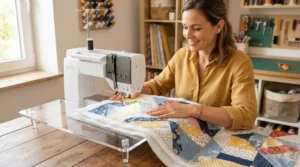
Features That Actually Matter (And Those That Don’t)
Stitch count is the number everyone fixates on, and it’s rarely the one that matters. Most quilters rely on straight stitch, a little zigzag and perhaps a decorative stitch for borders. A machine with 25 well-formed stitches that feeds layers evenly beats one with 400 that struggles.
What actually matters? Workspace comes first, because it decides whether your quilt sits happily or bunches against the machine body. Feed system quality comes second, since uneven feeding is what causes drifting seams and puckers. Third, presser foot pressure: the ability to ease off on thick wadding is gold.
Then there are the quality-of-life extras. An automatic thread cutter saves hundreds of scissor trips over a quilt. A start/stop button, as on the Brother Innov-is A50, gives your foot a rest. Needle-down is invaluable for pivoting at corners.
Features you can happily ignore? Hundreds of decorative stitches you’ll never sew, and big alphabets unless you label every quilt. The BERNINA 770 QE PRO has 1,858 stitches, but its stitch regulator is what quilters actually talk about.
Top Sewing and Quilting Machines for Beginners: Where to Start
New to all this? The best beginner path is a simple, reliable machine with room to grow, not the fanciest one in the shop. Gathered’s UK buying guide is a useful independent starting point, and several of the machines it covers overlap with this list.
For the top sewing and quilting machines for beginners, I’d think in three rungs. The bottom rung is the Brother L14S: cheap, simple, and perfect for learning how fabric and thread behave. The middle rung is the Janome Sewist 725S, whose high presser foot lift handles bulky seams as your projects grow. The top rung is the Brother Innov-is A50, with its start/stop button and quilting setting.
Here’s what many beginners overlook: the second machine you’d buy after outgrowing the first is the expensive mistake. If you’re even slightly serious, skipping straight to the middle rung can save money overall. If you’re simply testing the hobby, the bottom rung is a joyful low-risk start.
Whichever you choose, take a class. Several retailers offer them, and a few hours with an instructor beats a month of YouTube trial and error.
Sewing Quilting Combo for Home Studio: Space, Light and Layout
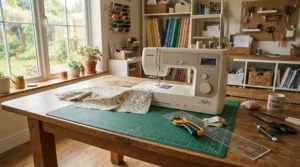
Choosing a sewing quilting combo for home studio use is as much about the room as the machine. A dedicated corner changes how often you actually sew: if you must unpack and repack every time, you’ll sew less.
Start with table height. Quilts hang off the edge, so the machine should sit flush in a table or beside an extension table, as the Janome 5060 QDC supplies. That flat surface stops the quilt’s weight dragging the stitches out of line.
Next, light. Machine lamps are small and cast shadows, so add a daylight lamp over the bed. Then think workflow: a cutting mat, rotary cutter and ironing board within a swivel of your chair save hundreds of steps per quilt.
Weight matters here too. A 15kg machine like the Brother Innov-is VQ2 or the Janome HD9 QC Professional is happiest left permanently on its table, while a 6.5kg model can live in a cupboard. If you have space for a permanent station, the heavy machines make sense. If your “studio” is the dining table, stay light.
Affordable Quilting Machine: What Your Budget Really Buys
An affordable quilting machine doesn’t have to mean a compromised one. The trick is knowing where the money goes. Below roughly £300, according to The Sewing Studio, you get capable machines for mending and simple makes. Between £300 and £600 you start getting automation and better feeding, and above £600 you’re mainly paying for workspace and stitch libraries rather than better basic stitching.
| Budget tier | Example | What you gain | Best for |
|---|---|---|---|
| Under about £150 | Brother L14S | Sturdy basics, simple use | Testing the hobby |
| £330-£400 | Janome Sewist 725S | High lift, adjustable pressure | Beginners who’ll keep going |
| £400-£560 | Brother Innov-is A50, Janome 5060 QDC | Electronic control, quilting feet | Regular quilters |
| £1,400-£2,500 | Janome HD9 QC Professional, Brother Innov-is VQ2 | Speed or huge workspace | Committed, high-volume quilters |
| £4,000+ | BERNINA 770 QE PRO | Stitch regulation, precision | Serious free-motion work |
The big jump in value comes between the first and third tiers. The Janome 5060 QDC gives you quilting feet you’d otherwise buy separately, so its true cost is lower than the sticker suggests. Beyond £600, you’re buying space and refinement, so only pay it if your quilt size or ambitions demand it.
✨ Ready to Find Your Match?
🔍 Take your quilting to the next level with the machines above. Click on any highlighted product name to check current pricing and availability, then pick the one that fits your quilt size, space and budget. Your first finished quilt is closer than you think!
Sewing Quilting Machine vs Alternatives: Which Route Suits You?
A sewing quilting machine isn’t your only path to a finished quilt. Here’s how it compares with the main alternatives.
| Option | Strengths | Trade-offs | Best for |
|---|---|---|---|
| Combo sewing quilting machine (e.g. Janome 5060 QDC) | Does piecing, quilting and everyday sewing | Limited arm space on mid-range models | Most home quilters |
| Straight-stitch specialist (e.g. Janome HD9 QC Professional) | Speed, precision, robust build | No zigzag or buttonholes | Dedicated quilters with a second machine |
| Long-arm machine and frame | Huge quilting space | Dedicated space and a larger investment | Volume quilters |
| Hand quilting | Portable, quiet, no machine needed | Slow | Relaxed, small projects |
The combo machine wins for flexibility. One purchase covers piecing a quilt, hemming curtains and mending jeans, which is why most people start here. A specialist like the Janome HD9 QC Professional shines once you’re quilting often enough to want speed, though you’ll want a second machine for buttonholes. Long-arm setups, such as the frames and machines UK dealers supply, suit people quilting at scale, and they’re a different budget conversation entirely.
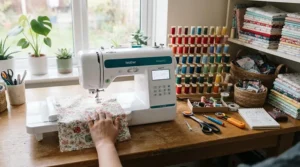
Home Quilting Setup: First-Use Guide and Maintenance Schedule
A good home quilting setup starts before the first stitch. Here’s a first-use routine that pays off.
Unbox and thread properly. Raise the presser foot before threading so the thread seats between the tension discs. Skipping that step causes more tangles than any other beginner mistake.
Fit a fresh needle. Use one suited to your thread and fabric, and replace it regularly. A blunt needle shows up as skipped stitches and snagged cotton.
Test on a scrap sandwich. Layer top, wadding and backing exactly as your quilt will be, and adjust stitch length and pressure there, not on the real thing. The Sewing Studio’s guide to quilting on a sewing machine is a handy companion.
Establish a rhythm. After every project, brush out lint around the bobbin area. Check your manual before oiling, since some machines don’t need it. Book a service roughly once a year with regular use, or every two years if you sew occasionally, as The Sewing Studio advises.
Avoid first-30-day mistakes: skipping the scrap test, forcing bulky seams through without adjusting pressure, and ignoring thread-and-needle matching. Fix those three and most “my machine is broken” moments vanish.
Beginner Quilting Projects: Matching Machines to Makes
The best beginner quilting projects are small, forgiving and finishable. Three profiles show how machine and project fit together.
The cautious starter. Budget: tight. Environment: a kitchen table, used a couple of times a month. Project: a patchwork table runner and a set of coasters. The Brother L14S suits this well, since its 6 inch workspace handles small items comfortably and the low cost limits your risk.
The weekend lap-quilt maker. Budget: mid-range. Environment: a spare-room corner, used weekly. Project: a lap quilt from jelly roll strips. The Janome 5060 QDC shines here, because the walking foot and extension table keep layers aligned, and the automatic thread cutter saves time on straight lines.
The heirloom maker. Budget: generous. Environment: a dedicated studio, used several times a week. Project: a king-size patchwork quilt. The Brother Innov-is VQ2 earns its premium, as 285mm of arm space and ICAPS pressure control make wrestling a large quilt far less exhausting.
Each profile starts with the project and works back to the machine, which is the right order. Buy for the quilts you’ll make, not the ones you imagine making in some far-off decade.
Sewing Quilting Machine Problems and Solutions
Even the best sewing quilting machine misbehaves sometimes. Here are four common problems and how to fix them.
Puckered or shifting layers. Fit a walking foot (included with the Janome 5060 QDC) and reduce presser foot pressure if your machine allows it. Baste or pin the sandwich generously.
Skipped stitches. Change the needle first, then check it suits your thread. Nine times out of ten that solves it.
Birdnesting underneath. Raise the presser foot, remove the thread entirely and rethread carefully. Threading with the foot down stops the thread seating in the tension discs.
Machine stalling on thick seams. Slow down and use a machine with a high lift, like the Janome Sewist 725S. Press seams open or flat to reduce bulk where several meet.
None of these needs a repair shop. They’re technique and setup issues, and understanding them early saves you both money and frustration.
Long-Term Cost & Maintenance of a Sewing Quilting Machine
The sticker price is only the opening bid. Total cost of ownership includes servicing, needles, thread, accessories and, eventually, upgrading.
Take cost per use. A machine in the £500 range used for 100 hours a year over five years works out at roughly £1 per hour of sewing. Spend more on a premium machine used 200 hours a year for ten years, and it’s still around £1.15 an hour. Heavy users get the most value from expensive machines, while occasional sewers rarely do.
Servicing is the hidden cost. Plan for a clean-and-check roughly annually with regular use. Warranty is worth comparing too: The Sewing Studio states that Brother machines carry a three-year domestic warranty, which gives the Brother L14S, Brother Innov-is A50 and Brother Innov-is VQ2 a useful safety net.
Finally, think resale and part exchange. Some UK retailers, including The Sewing Studio, offer part exchange, so a machine you outgrow needn’t be dead money.
FAQs
❓ Is a sewing quilting machine worth buying over a standard machine?
❓ How much should I pay for an affordable quilting machine in the UK?
❓ Do I need a walking foot on a sewing quilting machine?
❓ What is the best sewing quilting combo for home studio use?
❓ How often should a sewing quilting machine be serviced?
Conclusion
The right sewing quilting machine isn’t the most expensive or the one with the longest stitch list. It’s the one that fits your quilts, your space and your budget.
If you’re starting out, the Brother L14S is a low-risk first step, and the Janome Sewist 725S gives you more room to grow. The Brother Innov-is A50 adds electronic comfort, and the Janome 5060 QDC is my pick for most people thanks to its included quilting kit. If you quilt big and often, the Brother Innov-is VQ2 delivers the space, the Janome HD9 QC Professional the speed, and the BERNINA 770 QE PRO the free-motion precision.
Remember the fundamentals: match workspace to your biggest quilt, check which feet are included, and take a class. A good machine and a scrap-sandwich test will do more for your quilting than any amount of fancy features.
Recommended for You
- Sewing And Quilting Machine: 7 Best Picks For UK Quilters (2026)
- Sewing Embroidery Machine For Small Business: 7 Honest Picks (2026)
- Sewing Embroidery Combo: 7 Best Machines For UK Crafters (2026)
Disclaimer: This article contains affiliate links. As an Amazon Associate, I earn from qualifying purchases. If you purchase products through these links, we may earn a small commission at no additional cost to you.
✨ Found this helpful? Share it with your friends! 💬🤗
