
In This Article
A sewing and quilting machine is a domestic sewing machine tuned for quilting. It keeps the everyday stitches you’d expect, then adds quilter-friendly extras: a roomier arm, an extension table, adjustable foot pressure, a walking foot or dual feed, and a drop-feed setting for free-motion work.
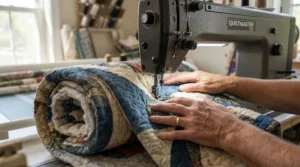
Here’s the problem it solves. Quilting means stitching through at least three layers (top, wadding and backing), and a double-bed quilt sandwich weighs about as much as a sulking toddler. Shove that through a cramped little machine and every seam turns into an argument. The right sewing and quilting machine gives all that bulk somewhere to go. 🧵
This guide is built around the questions that actually decide a purchase. How much quilting throat space is enough? Will walking foot compatibility catch you out? Is a sewing quilting combo with extended table all you need, and how does an extended sewing table differ from a bolt-on extra? And is sewing quilting combo vs dedicated quilting machine a fair fight? Each question gets its own section below.
The seven machines span budget to premium. Specs come from manufacturer and UK dealer listings. Review sentiment is reported only where I could verify it, and where I couldn’t, I say so rather than papering over the gap. Every price is a range, so check current price on the day you buy.
Sewing and Quilting Machine Quick Comparison
| Machine | Throat space | Walking foot / feed | Extension table | Price range | Best For |
|---|---|---|---|---|---|
| Janome M100QDC | About 6″ (verify on listing) | Walking foot included | Included | £600–£800 | First quilts on a budget |
| Janome M200QDC | 6″ | Walking foot and quilt guide included | Included | £650–£900 | Mixed dressmaking and quilting |
| Brother Innov-is NV1800Q | 8.3″ | Walking foot included | Wide table included | £800–£1,100 | Feature-rich mid-range quilting |
| Brother PQ1600S | 8.7″ | Pin feed foot (straight stitch only) | 11.1″ x 23.3″ wide table | £600–£900 | Fast piecing as a second machine |
| Janome Memory Craft 6700P | 10″ | Built-in AcuFeed Flex dual feed | Extra-wide table | £1,500–£2,200 | Serious bed-quilt makers |
| Juki TL-2200QVP Mini | 8.5″ | Straight stitch only; industrial-style feet | Auxiliary table | £1,200–£1,700 | Dedicated piecing and free-motion |
| Janome Horizon Memory Craft 8200QCP SE | 11″ | Built-in AcuFeed Flex dual feed | 24″ x 16″ | £2,000–£2,900 | Large quilts, premium all-rounder |
Prices were gathered at the time of research and may vary by retailer. Reading the table, the Janome M200QDC looks like the sensible floor for anyone who wants a walking foot and a table without raiding the savings account. The Brother Innov-is NV1800Q buys roughly 38% more arm space (8.3″ against 6″) plus automatic foot pressure. If your quilting is mostly straight lines, the Brother PQ1600S and Juki TL-2200QVP Mini trade stitch variety for velocity, while the Janome Horizon Memory Craft 8200QCP SE offers the most arm space here.
💬 Just one click — help others make better buying decisions too!😊
Top 7 Sewing and Quilting Machine Picks: Expert Analysis
1. Janome M100QDC — lightest route into walking foot quilting
The Janome M100QDC earns its slot by being the machine you can carry to a class and still find a proper walking foot in the box.
It’s a lightweight portable with an aluminium frame, a built-in needle threader and six levels of presser foot pressure. That pressure dial is the unglamorous hero: ease it off for puffy wadding so the layers aren’t squashed and creeping. The bundle adds an even feed foot with quilting guide, a ditch quilting foot, a quarter-inch seam foot, a darning foot and an extension table. You can start a quilt without a shopping spree on accessories.
Based on the spec sheet, this suits beginners making cot quilts, lap quilts and table runners. Be realistic about quilting throat space, though. Janome’s M-series sits in the roughly six-inch class (confirmed for the M200QDC, so check the Janome M100QDC listing before buying), which means anything bigger than a throw involves rolling, scrunching and patience.
Review sentiment: I couldn’t verify a meaningful pool of independent customer reviews for this exact model, so I won’t pretend to summarise one. What’s checkable is the retailer’s spec list.
Pros:
- ✅ Walking foot and extension table included
- ✅ Light enough to carry to classes
- ✅ Six-level presser foot pressure control
Cons:
- ❌ Compact arm limits bed-sized quilts
- ❌ Simpler feature set than the Janome M200QDC
Roughly £600–£800 at the time of research. Strong value if portability matters, but check current price.
2. Janome M200QDC — the sensible all-rounder with 200 stitches
Where the Janome M200QDC wins is balance: enough stitch variety for dressmaking, enough quilting kit for a first proper quilt.
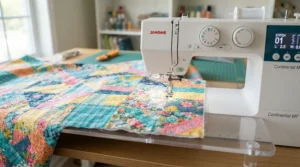
It offers 200 built-in stitches including an alphabet and a generous run of one-step buttonholes, a top speed of 820 stitches per minute, a seven-piece feed dog and six levels of foot pressure. That seven-piece feed dog matters in practice, because more points of contact means steadier feeding across thick seam intersections. Janome bundles a walking foot with quilt guide, a ditch quilting foot, a quarter-inch seam foot, a darning foot and an extension table. At about 6.4 kg it stays carry-friendly.
On paper, that makes it the logical step up from the Janome M100QDC for anyone who sews clothes and quilts in equal measure. The six-inch workspace is its ceiling, and the reason I’d steer bed-quilt makers upward.
Review sentiment: independent customer reviews weren’t verifiable for this model. UK sewing media and dealer write-ups describe it as a mid-range computerised machine carrying more accessories than average. That matches the spec list but says nothing about long-term durability.
Pros:
- ✅ Walking foot, quilt guide and table in the box
- ✅ 200 stitches cover dressmaking and decoration
- ✅ Seven-piece feed dog for steady feeding
Cons:
- ❌ Six-inch workspace is tight for large quilts
- ❌ 820 stitches per minute is modest for long straight runs
Around £650–£900 at the time of research. It’s the best-value pick for mixed sewers, so check current price.
3. Brother Innov-is NV1800Q — extra arm space plus automatic foot pressure
The Brother Innov-is NV1800Q is the one that stops you fiddling.
The work space to the right of the needle is 8.3 inches (210 mm), a clear step beyond the six-inch class. The box includes a wide extension table with a measurement guide, a walking foot, a quarter-inch piecing foot and free-motion feet (echo, mini and standard). UK dealer listings quote 232 built-in stitches and 850 stitches per minute. Some regions advertise 290 stitches, so confirm the UK spec. The headline feature is ICAPS, a sensor system that adjusts foot pressure automatically as fabric thickness changes. You also get a knee lift, automatic thread cutter, needle threader and a pivot function for neat corners.
Here’s what to weigh. Automatic pressure sensing earns its keep at bulky seam junctions, where manual-dial machines need you to intervene. At 9.7 kg it’s heavier than the Janome pair, and UK specs list a monochrome screen with no touchscreen or USB.
Reviewer sentiment: buyer comments on retailer pages (mostly Australian listings, so a small and regional sample) praise the wide table and automatic functions. One buyer upgrading from a 20-year-old Brother was pleased with the jump.
Pros:
- ✅ 8.3-inch arm space for bigger quilts
- ✅ Walking foot and wide table included
- ✅ Automatic foot pressure via ICAPS
Cons:
- ❌ Heavier at about 9.7 kg
- ❌ Monochrome screen, no USB or touchscreen
Roughly £800–£1,100 at the time of research. Strong mid-range value, but check current price.
4. Brother PQ1600S — straight-stitch speed with a huge table
The Brother PQ1600S does one thing, straight stitch, at 1,500 stitches per minute, and it does it on an 11.1 x 23.3 inch wide table.
Needle-to-arm space is listed at 8.7 inches. You also get push-button thread cutting, a programmable needle stop position, a built-in cone thread stand, a knee lifter, colour-coded foot pressure and feed dog adjustments, and stitch lengths up to 7 mm. In plain English, long piecing seams and straight-line quilting go roughly twice as fast as on a typical home machine, and the cone stand lets you buy thread more cheaply by the cone.
Know what you’re buying. There’s no zigzag, so no buttonholes, no appliqué satin stitch and nothing decorative. On feed, Brother’s own accessory list names a pin feed foot rather than a walking foot, so don’t assume one is included, whatever a marketplace listing claims. One UK dealer listing also contradicts itself on whether the table is included, so confirm before ordering.
Review sentiment: I couldn’t verify customer reviews for this model (one UK import listing showed zero ratings). The case for it rests on spec and use-case reasoning, not crowd verdicts.
Pros:
- ✅ 1,500 stitches per minute for fast piecing
- ✅ Huge wide table for quilt support
- ✅ Automatic thread cutter and needle stop
Cons:
- ❌ Straight stitch only
- ❌ Walking foot not confirmed in the box
Roughly £600–£900 at the time of research. A great second machine but a risky only machine, so check current price.
5. Janome Memory Craft 6700P — ten inches and built-in dual feed
The Janome Memory Craft 6700P is where a sewing and quilting machine starts feeling semi-professional.
You get a 10-inch (255 mm) all-metal flatbed and 1,200 stitches per minute. AcuFeed Flex, Janome’s detachable walking foot technology, feeds the top layer in step with the feed dogs. Add an HP professional needle plate and foot, 200 stitches, 20 memory banks, a 3.6-inch LCD and an extra-wide extension table. In practice, layer creep is handled by the machine rather than by an add-on foot you must match to your shank, which sidesteps walking foot compatibility worries altogether.
The analytical take: this suits serious piecers and bed-quilt makers who still want garment stitches. One quirk is that it has no free arm, so cuffs and trouser hems are awkward. A UK dealer lists a two-year parts-and-labour warranty for domestic use.
Review sentiment: I couldn’t verify a substantial UK customer review pool. One independent long-form review credits the flatbed, speed, AcuFeed Flex and table as its strongest combination, but that’s editorial opinion rather than crowd sentiment.
Pros:
- ✅ 10-inch workspace handles big quilts
- ✅ Built-in AcuFeed Flex dual feed
- ✅ 1,200 stitches per minute
Cons:
- ❌ No free arm for cuffs and hems
- ❌ Premium price for hobby use
Roughly £1,500–£2,200 at the time of research. It’s worth it if you quilt weekly, so check current price.
6. Juki TL-2200QVP Mini — straight-stitch specialist built like a tank
The Juki TL-2200QVP Mini is what quilters mean when they say “dedicated machine”.
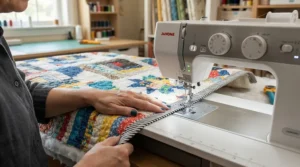
It has an aluminium die-cast arm and bed, a fixed needle, an 8.5-inch throat and a slide-controlled speed range up to 1,500 stitches per minute. Automatic thread trimming, an automatic needle threader, a drop feed dog, a knee lifter and quarter-inch, one-fifth-inch and open-toe quilting feet complete the kit. Juki’s own brochure lists an auxiliary table that expands the work area to 23 inches. At around 11.5 kg, the mass damps vibration at speed, and with no swinging needle to deflect off pins or thick seams, piecing stays accurate.
Who is it for? Quilters who already own a zigzag machine for garments and want a precision tool for piecing and free-motion work. Retailers note that industrial-style presser feet can be fitted, and one UK retailer says Juki machines ship directly from the supplier and should be registered on the Juki UK site.
Review sentiment: I couldn’t find verifiable customer reviews. A UK retailer describes it as the machine Debbie Shore uses most, but that’s a retailer statement, not aggregated feedback.
Pros:
- ✅ Industrial-style straight stitch quality
- ✅ Auto trimmer and needle threader
- ✅ 8.5-inch throat plus auxiliary table
Cons:
- ❌ No zigzag or decorative stitches
- ❌ Heavy at roughly 11.5 kg
Roughly £1,200–£1,700 at the time of research. Superb as a specialist, so check current price.
7. Janome Horizon Memory Craft 8200QCP SE — eleven inches of room to roam
The Janome Horizon Memory Craft 8200QCP SE is the big-quilt answer for people who refuse to give up garment stitches.
It has an 11-inch (280 mm) workspace, 4.7 inches high, plus a detachable AcuFeed Flex system, a top speed of 1,000 stitches per minute and a seven-piece feed dog. Five LED lamps, 91 needle positions, around 170 stitches and an included 24 x 16 inch extension table finish the picture. That’s nearly double the space of the six-inch class, so king-size sandwiches stop fighting back.
My honest analysis: the ceiling here is price, not capability. Mid-range owners rarely need eleven inches, but if you routinely quilt bed-sized pieces on a domestic machine, it removes the main source of frustration. Check availability and parts support, because one US retailer review notes the manufacturer has discontinued it in that market.
Review sentiment: buyer comments on US retailer pages are tiny in number but uniformly positive, describing smooth, quiet stitching. Treat that as encouraging rather than conclusive.
Pros:
- ✅ 11-inch arm for bed-sized quilts
- ✅ Built-in AcuFeed Flex dual feed
- ✅ Oversized extension table included
Cons:
- ❌ Highest price in this round-up
- ❌ Discontinued in some markets
Roughly £2,000–£2,900 at the time of research. Hard to beat for large quilts, but check current price.
Side-by-Side Spec Check
| Machine | Max speed | Weight | Stitch type | Best For |
|---|---|---|---|---|
| Janome M100QDC | Check listing | Lightweight portable | Sewing and quilting | Beginners, class-goers |
| Janome M200QDC | 820 spm | About 6.4 kg | 200 stitches | All-rounders |
| Brother Innov-is NV1800Q | 850 spm | About 9.7 kg | 232 stitches (UK listings) | Mid-range quilters |
| Brother PQ1600S | 1,500 spm | About 10.8–12 kg (listings vary) | Straight only | Fast piecing |
| Janome Memory Craft 6700P | 1,200 spm | Check listing | 200 stitches | Serious quilters |
| Juki TL-2200QVP Mini | Up to 1,500 spm | About 11.5 kg | Straight only | Precision specialists |
| Janome Horizon Memory Craft 8200QCP SE | 1,000 spm | About 12 kg | Around 170 stitches | Large quilts |
The pattern is stark: speed climbs as stitch variety falls. The two straight-stitch machines are fastest, but only the Brother Innov-is NV1800Q and the Janome pair double as proper garment machines at a gentler pace. Weight tells a story too, because heavier machines such as the Juki TL-2200QVP Mini feel steadier at speed but are a chore to carry to classes.
Setting Up Your Sewing and Quilting Machine: A 30-Day Practical Guide
Unboxing is the easy bit. Week one is about getting the basics right. Fit a fresh needle suited to layered fabric, wind several bobbins, and lower the foot pressure a notch for thick wadding. Then attach the walking foot and sew a 12-inch test sandwich before touching a real quilt.
When you layer, follow the Quilters’ Guild layering guidance. It advises trimming wadding and backing at least two inches bigger all round than the top, giving the layers room to settle as you stitch.
Week two is piecing. Use the quarter-inch foot, then sew two strips and measure the seam, because a seam allowance that drifts by a millimetre compounds across a whole quilt. Week three is straight-line quilting with the walking foot, starting from the centre and working outwards. Week four is free-motion: drop the feed dogs, fit the darning foot and practise loops on scrap sandwiches.
Common first-month mistakes include skipping test sandwiches, letting the quilt hang off the table (a heavy quilt dragging on the needle line is a classic cause of wonky stitches), and ignoring lint. Brush out the bobbin area weekly, and oil only if your manual says to.
Real-World Scenarios: Matching a Sewing and Quilting Machine to Your Life
These are illustrative profiles, not real customers, built to show how budget, space and frequency should steer your choice.
Priya, 24, shares a flat, sews twice a month, budget around £700. She quilts on the kitchen table and stores the machine in a cupboard. The Janome M100QDC or Janome M200QDC fits: light, with walking foot and table included. She’ll make lap quilts happily, and a six-inch arm won’t hamper anything smaller than a throw.
Margaret, 68, guild member, quilts weekly, makes king-size quilts for family, budget £2,000 or more. Arm space is her pain point. The Janome Memory Craft 6700P or Janome Horizon Memory Craft 8200QCP SE keeps her from wrestling bulk, and built-in dual feed spares her a walking foot compatibility hunt.
Dan, makes patchwork bags and quilts, owns a zigzag machine already, budget around £1,000. He needs speed on long straight seams. The Brother PQ1600S or Juki TL-2200QVP Mini suits him, because he doesn’t need a second set of decorative stitches.
✨ Don’t Miss These Hand-Picked Machines!
🔍 Take your quilting to the next level with these carefully selected picks. Click on any highlighted item to check current pricing and availability. The right sewing and quilting machine will help you create quilts your family will treasure!
Problem → Solution: Fixing Five Common Quilting Headaches
Backing puckers. Layers are creeping at different speeds. Fit a walking foot (the Janome M200QDC and Brother Innov-is NV1800Q include one) or engage dual feed on the Janome Memory Craft 6700P, and ease off the foot pressure.
The quilt drags off the line. Gravity is winning. Use the extension table, keep the quilt supported behind and to your left, and roll the bulk neatly rather than letting it dangle.
Skipped stitches in thick layers. A tired needle is the usual culprit. Fit a fresh one, slow down, and check foot pressure.
Seam allowance drifts. Sew a test pair with the quarter-inch foot and measure. The Juki TL-2200QVP Mini includes quarter-inch and one-fifth-inch quilting feet, handy for exactness.
Thread nests under the quilt in free-motion. Make sure the presser foot lever is down so the tension discs engage, even with the feed dogs dropped, and keep your hand speed steady.
How to Choose a Sewing and Quilting Machine
The best sewing and quilting machine is the one whose arm space, feed system and table match the biggest quilt you realistically make. Here’s the checklist, in order:
- Measure your biggest quilt. A cot quilt and a king-size sandwich need very different machines.
- Check the arm space and height. Anything over six inches helps; 8–11 inches transforms bed-quilt handling.
- Confirm the feed solution. Is a walking foot included, or is dual feed built in?
- Decide combo or dedicated. If you also sew garments, a combo avoids buying two machines.
- Check the table. An included wide table beats a flimsy afterthought.
- Verify warranty and UK compliance. Buy from a UK dealer, check for UKCA or CE marking, and set a budget range before you browse.
Quilting Throat Space: How Much Do You Really Need?
Throat space (also called harp space) is the distance from the needle to the right side of the machine body. It’s where your rolled-up quilt lives while you stitch.
Numbers help. The Janome M200QDC offers about 6 inches. The Brother Innov-is NV1800Q has 8.3, around 38% more. The Janome Memory Craft 6700P sits at 10, and the Janome Horizon Memory Craft 8200QCP SE reaches 11, nearly double the six-inch class. One buyer’s guide suggests more than six inches lets you stuff a rolled quilt through without bunching, which matches what the specs imply.
But don’t fixate on width alone. Height matters too (the 8200QCP SE lists 4.7 inches), and throat space can’t hold up the weight of a quilt, which is a table’s job. For lap quilts and throws, six inches is workable. For bed quilts you’ll thank yourself for eight or more. A longarm-style sit-down such as Juki’s TL-2200QVP offers 18 inches by 10, but that’s a different category of machine and price.
Walking Foot Compatibility: Shank Types, Dual Feed and Snap-On Fit
A walking foot (even-feed foot) moves the top layer in step with the feed dogs so multiple layers travel together. The catch is walking foot compatibility: there’s no universal fit.
Everything hinges on shank type. Low shank machines (most domestic models) take certain feet, high shank machines need others, and slant shank (mostly older Singers) are different again. Guides measure shank height slightly differently, so follow your manual. One dealer guide estimates around 90% of home machines are low shank, and another says almost all Brothers are. Bernina and a few premium brands use proprietary clip systems, so they need adapters for generic feet. Also check whether yours is snap-on or screw-on.
The shortcuts: the Janome M100QDC, Janome M200QDC and Brother Innov-is NV1800Q include a matched walking foot, so there’s nothing to compatibility-check. The Janome Memory Craft 6700P and Janome Horizon Memory Craft 8200QCP SE have built-in AcuFeed Flex, which bypasses the issue. For anything else, buy the manufacturer-recommended foot and check its compatible-model list before ordering.
Sewing Quilting Combo with Extended Table: What Comes in the Box
A sewing quilting combo with extended table is the sweet spot for most people, because it bundles the three things quilters need most: a walking foot, adjustable foot pressure and a table to support the weight.
Compare what’s included. The Janome M100QDC and Janome M200QDC both ship with an extension table. The Brother Innov-is NV1800Q adds a wide table with a measurement guide. The Janome Memory Craft 6700P includes an extra-wide table, and the Janome Horizon Memory Craft 8200QCP SE comes with 24 x 16 inches.
Why does this matter? Accessories bought à la carte add up fast, and a combo gives you matched, tested parts. Look for a table that sits flush with the bed, and for storage that doesn’t eat desk space. Many combos let you remove the table (or slide-off bed) to convert to free-arm for cuffs and hems, which is where a combo beats a pure flatbed.
Extended Sewing Table: Wide Table, Flatbed or Custom Cut-Out?
An extended sewing table does more than “add space”. It supports the quilt so gravity stops tugging on your stitches. There are three routes.
Bundled wide tables (like the Brother PQ1600S at 11.1 x 23.3 inches) are matched to the machine and are the simplest answer. Optional add-on leaves, such as Juki’s separate extension for the sit-down TL-2200QVP (15.7 x 33.7 inches each), suit stationary setups. Custom cut-outs or inset tables let you sink the machine flush with a work surface, which is the gold standard for large quilts but needs space and a bit of DIY.
Whatever you pick, match the table to your model’s bed height and free-arm design, or you’ll get a ridge under the needle. Support the quilt on the left and behind as well, and position the foot pedal where your knee and chair still allow natural posture.
Sewing Quilting Combo vs Dedicated Quilting Machine
The sewing quilting combo vs dedicated quilting machine debate boils down to versatility against velocity. A combo like the Janome M200QDC or Brother Innov-is NV1800Q does garments, decorative stitching and quilting. A dedicated machine like the Brother PQ1600S or Juki TL-2200QVP Mini only sews straight but does it quickly and accurately.
| Factor | Combo (e.g. Janome M200QDC, Brother Innov-is NV1800Q) | Dedicated (e.g. Brother PQ1600S, Juki TL-2200QVP Mini) |
|---|---|---|
| Stitch variety | Hundreds of stitches | Straight stitch only |
| Speed | 820–850 spm | Up to 1,500 spm |
| Arm space | About 6″–8.3″ | About 8.5″–8.7″ |
| Feed system | Walking foot included | Pin feed foot or industrial-style feet |
| Garment sewing | Yes | Limited |
| Best For | One-machine households | Dedicated piecers with a second machine |
The takeaway is clear. If you can only afford one machine, a combo is the safer bet. If you already own a zigzag machine, a dedicated machine such as the Brother PQ1600S adds speed and arm space for less than the cost of a high-end combo. And if you eventually crave an 18-inch throat, Juki’s sit-down TL-2200QVP shows where the dedicated path ends up.
Long-Term Cost and Maintenance
The sticker price isn’t the full cost. Budget for needles, thread, bobbins, an annual or biennial service, and the occasional accessory.
Warranty helps. UK dealers list three-year coverage for the Brother Innov-is NV1800Q and Brother PQ1600S, and a two-year domestic warranty for the Janome Memory Craft 6700P. Check current terms for the rest.
Think in cost per quilt. As an illustration, a £900 machine used for ten quilts over five years costs £90 per quilt in machine outlay. A £2,500 machine used for the same ten works out at £250 each. That doesn’t make the pricier machine wrong, but it does mean you should only pay for arm space you’ll actually use.
Maintenance is simple: brush out lint weekly, change needles often, oil only if the manual says to, and keep the dust cover on. Book a service if tension starts misbehaving despite a fresh needle and correct threading.
Safety, Regulations and Buying Legally in the UK
Mains-powered sewing machines fall under the Electrical Equipment (Safety) Regulations 2016. The gov.uk guidance explains that manufacturers must meet safety objectives and mark products with UKCA or CE to show compliance. The guidance has been updated to reflect continued recognition of CE marking on the GB market.
In practice, buy from a UK dealer, check the rating label and UK three-pin plug, and be cautious with grey imports. Some marketplace sellers ship non-UK-spec machines that may not carry a UK warranty. Unplug before changing needles, keep fingers clear of the needle area, and keep children and pets away from the foot pedal.
FAQ
❓ Is a sewing and quilting machine worth it over a basic model?
❓ How much does a sewing and quilting machine cost in the UK?
❓ Do sewing and quilting machines include a walking foot?
❓ Can I add an extended sewing table to any machine?
❓ Is it safe to buy a sewing and quilting machine from a third-party seller?
Conclusion
Picking a sewing and quilting machine comes down to matching your biggest quilt to the right arm space, feed system and table. If you want a first proper quilting setup without a huge outlay, the Janome M100QDC and Janome M200QDC put a walking foot and extension table in the box. The Brother Innov-is NV1800Q adds 8.3 inches of space and automatic foot pressure for roughly £800–£1,100. If speed on straight seams is your priority and you own a second machine, the Brother PQ1600S or Juki TL-2200QVP Mini are focused, quick tools. And if bed-sized quilts are your thing, the Janome Memory Craft 6700P and Janome Horizon Memory Craft 8200QCP SE give you ten to eleven inches of breathing room.
Whatever you choose, double-check walking foot compatibility, confirm the table is included, and buy from a UK seller with a clear warranty. Measure your biggest quilt, decide whether you want combo versatility or dedicated speed, then pick the machine that fits both your budget and your ambition. Happy quilting!
✨ Ready to Start Your Next Quilt?
🔍 Click any highlighted machine above to check current pricing and availability. Your perfect sewing and quilting machine is waiting to help you create something you’ll be proud of!
Recommended for You
- Sewing Embroidery Machine For Small Business: 7 Honest Picks (2026)
- Sewing Embroidery Combo: 7 Best Machines For UK Crafters (2026)
- Sewing And Embroidery Machine: 7 Best Buys (Avoid Mistakes) 2026
Disclaimer: This article contains affiliate links. As an Amazon Associate, I earn from qualifying purchases. If you purchase products through these links, we may earn a small commission at no additional cost to you.
✨ Found this helpful? Share it with your friends! 💬🤗
