
In This Article
A sewing and embroidery machine is a single computerised machine that handles everyday sewing, from seams and hems to buttonholes. Once its detachable embroidery unit is attached, it also stitches digitised designs automatically inside a hoop. Think of it as a dressmaker and a monogramming studio sharing one desk, and one plug socket.
That pitch is seductive, and in 2026 the UK market is full of it. Here’s the catch the box never mentions. Two machines can look nearly identical and still differ hugely in the one number that decides what you can make: the embroidery hoop size. A 100 x 100 mm hoop gives you pocket logos. A 300 x 200 mm hoop gives you a jacket back. Same category, entirely different hobby.
This guide compares seven genuine machines, from roughly £800 to £3,500, using published specifications, UK retailer listings and the review sentiment I could verify. We’ll also settle the questions that keep buyers up at night. Is a sewing embroidery combo vs separate machines the smarter spend? What exactly are digitised designs? Does a dual-purpose sewing machine compromise on either job?
Some context helps. Machine embroidery is essentially computer-controlled manufacturing. The University of Geneva’s EduTech Wiki frames modern computerised embroidery as a branch of CAD/CAM, a cousin of laser cutting and 3D printing rather than of grandma’s tapestry frame. That’s why file formats, hoop geometry and software matter as much as motor power.
Quick Comparison: 7 Sewing and Embroidery Machines at a Glance
Before the deep dives, here’s the lay of the land. Embroidery areas are shown in millimetres. Prices are approximate UK ranges at the time of research and vary by retailer and bundle, so check current price before buying.
| Machine | Embroidery area | Typical price range | Best For |
|---|---|---|---|
| Brother Innov-is M380D | 100 x 100 mm | around £800-£1,000 | First-time embroiderers |
| Singer SE9185 | 170 x 100 mm | around £700-£1,000 | Tight budgets, big stitch menu |
| Brother Innov-is F580 | 180 x 130 mm | around £1,600-£1,700 | Beginners who want room to grow |
| Janome Atelier 9 | 170 x 200 mm | around £2,300-£3,000 | Dressmakers and quilters |
| Husqvarna Viking Designer Topaz 40 | 240 x 150 mm | around £2,450-£2,700 | Guided, low-fuss sewing |
| Brother Innov-is NV2700 | 260 x 160 mm | around £2,000-£2,500 | All-rounders upgrading |
| Brother Innov-is V5LE | 300 x 200 mm | around £3,300-£3,500 | Large designs and quilting |
Looking at the table, the Brother Innov-is NV2700 is the standout on cost per square millimetre of hoop. It delivers a 260 x 160 mm area for a few hundred pounds less than the Brother Innov-is V5LE, which charges extra mainly for its 300 x 200 mm hoop and longer arm. Budget buyers should note that the Singer SE9185 has a wider hoop than the Brother Innov-is M380D, but it is only 100 mm tall. Shape matters as much as size. If a sewing and embroidery combo with large hoop is your priority, the table makes the price of that ambition plain.
💬 Just one click — help others make better buying decisions too!😊
Top 7 Sewing and Embroidery Machines: Expert Analysis
I’ve ordered these from entry-level to premium. Each entry interprets the specs rather than just listing them, and each review summary is flagged as aggregated sentiment. Where I couldn’t verify a meaningful pool of owner reviews, I say so rather than fill the gap.
1. Brother Innov-is M380D — best gentle on-ramp for beginners
The appeal of the Brother Innov-is M380D is restraint: compact, wireless and priced so that trying embroidery doesn’t feel like a second mortgage. Its 100 x 100 mm hoop is the smallest here. Monograms, pocket logos and baby-clothes motifs fit happily, but a jacket-back design won’t. The sewing side is generous: 181 stitches including 10 buttonholes, a 160 mm workspace and 850 stitches per minute. That covers everyday dressmaking and mending. Embroidery runs at up to 400 stitches per minute, a sensible pace on a small machine.
Brother quotes around 200 built-in designs, 65 of them Disney, plus wireless access to its Artspira app. On paper, this is a “learn the ropes” machine: light at around 9 kg, forgiving, and easy to put away. It is the friendliest sewing and embroidery machine on this list for a first purchase, provided your designs stay small.
Amazon UK’s listing showed roughly 4.3 out of 5 from a few dozen ratings at the time of research. That suggests broadly happy beginners, though a sample that size is a snapshot, not a verdict.
Pros:
- ✅ Compact, light and easy to store
- ✅ Wi-Fi and Artspira app support
- ✅ Strong sewing stitch count for the money
Cons:
- ❌ 100 x 100 mm hoop limits design size
- ❌ Slower embroidery speed than larger models
Expect around £800 (£800-£1,000 range depending on retailer). Verdict: excellent value if you embroider small.
2. Singer SE9185 — widest stitch menu under £1,000
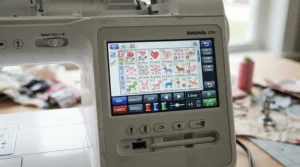
The Singer SE9185 wins on breadth: 250-plus sewing stitches, 150 embroidery designs and 10 fonts, all driven from a 7-inch colour touchscreen. The embroidery area is 170 x 100 mm, and that shape matters. It is wide but short, so a long slogan or border fits where a tall motif won’t. Sewing speed reaches about 800 stitches per minute (450 in embroidery). With 165 mm between needle and tower, it suits dresses and cushions but feels snug for bulky quilts.
Wi-Fi through mySewnet lets you send files and monitor progress, though the wider design library sits behind a subscription. On paper, this suits someone who wants the biggest stitch menu for the lowest outlay and accepts a modest hoop. As a dual-purpose sewing machine it looks very capable at the price, but the hoop is the compromise.
Amazon UK’s listing showed an average in the mid-3s out of 5 from only around ten ratings. That is too small to generalise, and I couldn’t verify a deep pool of independent UK owner reviews. Treat it as a promising spec sheet that deserves a demo before you commit.
Pros:
- ✅ 250-plus stitches and 150 built-in designs
- ✅ Large 7-inch colour touchscreen
- ✅ Wi-Fi progress tracking via mySewnet
Cons:
- ❌ 100 mm hoop height limits tall motifs
- ❌ Thin verified review pool so far
Pricing sits around £700-£1,000 depending on retailer. Verdict: strong on paper, but try before you buy.
3. Brother Innov-is F580 — sideways sewing and room to grow
The Brother Innov-is F580 is distinguished by its Square Feed Drive System, which moves fabric in four directions so decorative stitches stay crisp. It offers 241 stitches including 10 one-step buttonholes, a 190 mm (7.4-inch) workspace, a knee lift and an automatic thread cutter. On the embroidery side you get 193 designs, 13 fonts and a 180 x 130 mm hoop.
That extra 30 mm of height over the entry-level machines is the difference between a lettering line and a proper bag or cushion motif. Brother also lists an optional 180 x 100 mm magnetic frame. The knee lift is an underrated luxury: it frees both hands when you’re steering layered fabric. Based on the spec comparison, this is the sewing and embroidery machine for people who don’t want to outgrow their purchase in three months but aren’t ready for premium money.
I couldn’t find a large body of independent UK owner reviews for the F580. The Sewing Studio’s write-up is favourable, but that is a retailer’s view rather than a customer sample.
Pros:
- ✅ Four-direction feed for neat decorative stitches
- ✅ Knee lift and automatic thread cutter
- ✅ Three-year Brother warranty on UK listings
Cons:
- ❌ 180 x 130 mm hoop still too small for jacket backs
- ❌ Costs far more than entry combos
Expect around £1,600-£1,700. Verdict: fair value for a confident beginner, with a hoop that will limit larger ambitions.
4. Janome Atelier 9 — best for sewing-first makers
Janome built the Janome Atelier 9 as the flagship of its Atelier range, and the sewing half shows it. You get 300 built-in stitches, a 9 mm stitch width, up to 1,000 stitches per minute, AcuFeed Flex fabric feeding, an 8.3-inch workspace and 22 standard feet. The embroidery half offers 250 designs, 10 fonts and a 170 x 200 mm main hoop, with jump-thread trimming. That hoop is taller than anything from Brother or Singer at lower prices, and it reads Janome’s own .jef files natively.
What the spec sheet won’t tell you is that the 9 mm stitch width and generous feed system suit quilters and dressmakers who handle thick or slippery fabrics. A UK quilting reviewer described it as the best of both worlds for anyone dipping into machine embroidery without paying many thousands for a dedicated machine. That is one voice rather than a statistical sample, but it matches the spec-sheet logic.
Pros:
- ✅ Excellent sewing: 1,000 spm and AcuFeed Flex
- ✅ 170 x 200 mm hoop is tall for the money
- ✅ 22 presser feet included
Cons:
- ❌ Heavy at around 12 kg before the embroidery unit
- ❌ Warranty length varies by dealer
Pricing runs from roughly £2,300 to £3,000. Verdict: superb if sewing leads and embroidery is the bonus.
5. Husqvarna Viking Designer Topaz 40 — built-in assistance for guided sewing
The Husqvarna Viking Designer Topaz 40 leans on Husqvarna’s Sewing Advisor and sensor system, which are designed to suggest settings and sense fabric thickness so you fiddle less. The Jewel hoop gives 240 x 150 mm of embroidery area, with a 200 mm sewing space and 7 mm stitch width. A colour touchscreen supports on-screen editing: resize, rotate, mirror and combine designs without a computer.
Note the library. UK dealer listings show 100 built-in designs with automatic jump-stitch trims and a single font in three sizes. Some overseas listings quote 150 designs, so always check the UK specification. In practice, the Husqvarna Viking Designer Topaz 40 is best for people who plan to download or create their own digitised designs rather than rely on the built-ins.
I couldn’t verify a robust pool of aggregated UK owner reviews, so ask your dealer for a hands-on demo before buying.
Pros:
- ✅ Sewing Advisor and sensors reduce guesswork
- ✅ 240 x 150 mm hoop at a mid-range price
- ✅ On-screen editing without a computer
Cons:
- ❌ Only one built-in font on UK listings
- ❌ Smaller built-in design library
Expect around £2,450-£2,700. Verdict: worth it if guided sewing appeals more than a huge built-in library.
6. Brother Innov-is NV2700 — best all-rounder balance
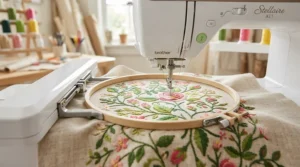
The Brother Innov-is NV2700 is all about balance. It pairs a 260 x 160 mm hoop with 291 sewing stitches, an 8.3-inch workspace and 850 stitches per minute. It detects fabric thickness and adjusts tension automatically, and an automatic height adjuster saves fiddling when you hit bulky seams. Embroidery adds 258 built-in designs, 13 fonts, a pivot function, a droplight positioning marker and colour sorting, all on a 4.9-inch touchscreen. Sideways feed handles decorative stitches up to 40 mm wide.
For many buyers, it is the practical answer to the sewing and embroidery combo with large hoop question. A 260 x 160 mm area handles substantial designs in a single hooping, so you skip the fiddly re-hooping of smaller machines. Trade-offs: it’s heavy (around 16-17 kg per the dealer spec), so it suits a permanent desk rather than class-hopping. Wireless transfer works via a free Windows-only app, with USB as the fallback.
A retailer review rates the embroidery side as high-end for a domestic machine at this price. As with others here, I couldn’t verify a large independent owner-review sample.
Pros:
- ✅ 260 x 160 mm hoop plus 291 stitches
- ✅ Automatic tension and height adjustment
- ✅ 258 designs and 13 fonts built in
Cons:
- ❌ Heavy to carry to classes
- ❌ Wireless transfer is Windows-only
Pricing sits around £2,000-£2,500. Verdict: the best balance of hoop, stitches and money in this list.
7. Brother Innov-is V5LE — largest hoop with a long arm
The Brother Innov-is V5LE is the headline act: a 300 x 200 mm hoop, an 11¼-inch (285 mm) arm and speeds up to 1,050 stitches per minute. Add 17 fonts, over 200 built-in designs, 500-plus sewing stitches, an LED pointer foot, a knee lift and Brother’s feed and pressure systems, and you have a serious studio machine. The included hoops are 300 x 200 mm and 100 x 100 mm.
Do the arithmetic: that hoop is about six times the stitching area of the Brother Innov-is M380D and roughly 44% more than the Brother Innov-is NV2700. It is the sewing and embroidery combo with large hoop for jacket backs, tablecloths and big quilt blocks. The long arm also eases quilting, where bulk rolls through the machine.
A UK buying guide from Fabric Mouse concludes that its premium price is earned through sheer versatility. That is editorial judgement, not an aggregated owner sample, and I couldn’t verify a large pool of customer reviews.
Pros:
- ✅ 300 x 200 mm hoop is the largest here
- ✅ Long 285 mm arm suits quilting
- ✅ Up to 1,050 stitches per minute
Cons:
- ❌ Most expensive machine in this list
- ❌ Bulky, so it needs a permanent desk
Expect around £3,300-£3,500. Verdict: worth it only if you will genuinely use the extra hoop.
Spec Showdown: Workspace, Designs and Connectivity
| Machine | Embroidery area | Workspace right of needle | Built-in designs | Connectivity | Best For |
|---|---|---|---|---|---|
| Brother Innov-is M380D | 100 x 100 mm | 160 mm | around 200 | Wi-Fi, USB, Artspira | Starters |
| Singer SE9185 | 170 x 100 mm | 165 mm | 150 | Wi-Fi, mySewnet | Wide stitch menu |
| Brother Innov-is F580 | 180 x 130 mm | 190 mm | 193 | Wi-Fi, USB, Artspira | Growing beginners |
| Janome Atelier 9 | 170 x 200 mm | about 210 mm (8.3 in) | 250 | Wi-Fi, USB | Sewing-first makers |
| Husqvarna Viking Designer Topaz 40 | 240 x 150 mm | 200 mm | 100 (UK listing) | USB, online updates | Guided sewing |
| Brother Innov-is NV2700 | 260 x 160 mm | about 210 mm (8.3 in) | 258 | USB, Wi-Fi app (Windows), Artspira | All-rounders |
| Brother Innov-is V5LE | 300 x 200 mm | 285 mm | 200+ | USB | Big designs, quilting |
Workspace tells a different story from hoop size. The Brother Innov-is V5LE‘s 285 mm arm is far roomier than the Brother Innov-is M380D‘s 160 mm, which matters if you quilt. Don’t be dazzled by design counts either: the Husqvarna Viking Designer Topaz 40 lists fewer built-ins than the Brother Innov-is NV2700, but a machine with 100 designs and a big hoop can still outperform one with 250 designs and a small one if you digitise your own.
Your First 30 Days: Setup, Stabiliser and Maintenance Plan
The first month decides whether your sewing and embroidery machine becomes a joy or a drawer-filler. Here’s a practical plan that Amazon listings don’t give you.
Week one: sew before you stitch. Thread, wind a bobbin and run plain seams on scrap cotton. Learn the touchscreen, the needle threader and the thread cutter while the stakes are low.
Week two: attach the embroidery unit and stitch a small built-in design. Use a fresh embroidery needle (a ball-point 75/11 is typical), a lighter 60-weight embroidery bobbin thread (many Brother boxes include one) and a stabiliser suited to your fabric. Hoop the fabric drum-tight but not stretched, because stretch springs back and puckers the design.
Week three: change designs and test fabrics. Try jersey, towelling and denim, noting which need stronger stabiliser or a water-soluble topping.
Week four: establish maintenance. Brush out lint from the bobbin area after each project, wipe the embroidery arm and follow the oiling guidance in your manual. Some models are oil-free, so never assume.
Common first-month mistakes include hooping loosely, skipping needle changes and using bargain thread that sheds lint. A neat habit: keep a swatch book of test stitch-outs with notes. You’ll build your own reference library.
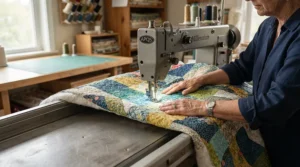
Real-World Scenarios: Matching a Sewing and Embroidery Machine to Your Life
These are illustrative profiles rather than real customers, built to show how budget, space and frequency interact.
Profile 1: the weekend maker. A £800-£1,000 budget, a kitchen table and a few hours a week. Priorities are small projects: names on kids’ clothes, patches, monograms. The Brother Innov-is M380D fits neatly. The Singer SE9185 suits if you favour long, shallow designs and a bigger stitch menu, though verify demo quality first.
Profile 2: the dressmaker-quilter. Ten-plus hours a week in a dedicated studio, with up to £3,000 to spend. Sewing quality leads. The Janome Atelier 9 is the sewing-first choice, while the Brother Innov-is V5LE wins if quilting bulk and large embroidery are both priorities.
Profile 3: the craft-stall seller. Personalised baby gifts and tote bags at markets, £2,000-£2,500 budget. A 260 x 160 mm hoop on the Brother Innov-is NV2700 keeps designs big and re-hooping minimal. One caution: Brother’s dealer listings show a shorter warranty for commercial use on some embroidery machines, so confirm the terms before you sell your work.
Matching machine to scenario beats chasing the biggest spec sheet. The best sewing and embroidery combo with large hoop is only best if your projects need that hoop.
Problem → Solution: Five Common Combo Machine Headaches
1. Puckering around the design. Usually a hooping or stabiliser issue. Re-hoop without stretching, use a heavier or fused stabiliser and check the design isn’t too dense for the fabric.
2. Thread nests under the hoop. Rethread the top thread with the presser foot raised, so the tension discs engage, and re-seat the bobbin. Nests are often a threading problem, not a faulty machine.
3. Design too big for the hoop. Check the embroidery hoop size against the design’s dimensions, resize in the machine or software, or split the design for multi-hooping. A larger hoop, such as the 260 x 160 mm one on the Brother Innov-is NV2700, solves this at source.
4. File won’t load. Machines read brand-specific formats, so convert the file in your software. Also check that your USB stick is small and formatted as the manual advises.
5. Wireless transfer fails. On the Brother Innov-is NV2700, the free transfer app is Windows-only, so fall back to USB on a Mac. Check your Wi-Fi band and software updates too.
Most “faults” in the first month are workflow errors, and each fix above costs nothing.
How to Choose a Sewing and Embroidery Machine: 7 Steps
- Start with your biggest realistic design. Measure it. If it’s 200 mm wide, a 100 mm hoop is a non-starter.
- Judge the sewing half honestly. Check workspace, speed and stitch range. A dual-purpose sewing machine that sews poorly is just a pricey embroidery unit.
- Compare hoop shape, not just area. The Singer SE9185‘s 170 x 100 mm suits borders but not tall motifs.
- Check file formats and connectivity. Make sure the machine reads the formats your software exports, and decide whether Wi-Fi or USB suits you.
- Weigh warranty and servicing. Several Brother models list three-year UK warranties, while other brands vary by dealer. Ask where servicing happens.
- Count total cost. Add software, extra hoops, stabiliser and thread to the machine price.
- Confirm compliance and seller. Electrical equipment sold in Great Britain should carry UKCA or CE marking under the Electrical Equipment (Safety) Regulations 2016, so check the machine and plug are properly marked.
Embroidery Hoop Size: What You Actually Need
Embroidery hoop size is the single most consequential spec, yet it’s the one most buyers skim. Here’s how the sizes on this list translate into projects.
- 100 x 100 mm: monograms, pocket logos, small patches.
- 170-180 mm wide: lettering, bag motifs, children’s clothing designs.
- 240-260 mm wide: cushion fronts, larger florals, substantial designs in a single hooping.
- 300 x 200 mm: jacket backs, tablecloth corners, big quilt blocks.
One trap: brands label hoop sizes differently, so the stated hoop dimensions and the actual stitchable area can differ. Always check the maximum embroidery area in the spec, in millimetres.
Sewing and Embroidery Combo With Large Hoop: When Bigger Pays Off
A larger hoop earns its premium when you repeatedly make big designs. It also reduces re-hooping errors, since every re-hoop risks misalignment. The Brother Innov-is V5LE offers 300 x 200 mm, and at the upper end, a dealer lists the Husqvarna Viking Designer Topaz 50 with a 360 x 200 mm hoop for around £4,000.
But bigger isn’t automatically better. Large hoops need more stabiliser, take longer per design and make small projects feel clumsy. If 90% of your work is small, a sewing and embroidery combo with large hoop is paying for capacity you’ll rarely use. If you need bulk beyond that, a 10-needle machine such as the Brother PR1055X, with a 360 x 200 mm area, sits in a different, dedicated-embroidery league.
Sewing Embroidery Combo vs Separate Machines: The Honest Maths
The sewing embroidery combo vs separate machines debate is mostly a money-and-space argument. Take two like-for-like embroidery areas: the Brother Innov-is NV2700 (combo, 260 x 160 mm) against the embroidery-only Brother Innov-is NV880E (also 260 x 160 mm) plus a separate sewing machine such as the Brother Innov-is A16.
| Factor | Combo (Brother Innov-is NV2700) | Separate (Brother Innov-is NV880E + Brother Innov-is A16) |
|---|---|---|
| Approximate outlay | around £2,000-£2,500 | around £1,850-£1,950 |
| Desk space | One footprint | Two footprints |
| Switching jobs | Attach or remove embroidery unit | None |
| Sewing while embroidering | No | Yes |
| Single point of failure | Yes | No |
| Best For | Small spaces, one learning curve | Frequent multitasking, small businesses |
The table shows the combo is not automatically cheaper once you price the equivalent hoop. The Brother Innov-is NV880E sits at roughly £1,500-£1,600 and the Brother Innov-is A16 at around £350. Separate machines win on productivity: you can stitch a 90-minute design while sewing something else. A combo wins on space and simplicity. For most hobbyists, the sewing embroidery combo vs separate machines decision comes down to whether you’d really use both at once.
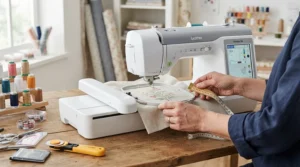
Digitised Designs: Where They Come From and How to Use Them
Digitised designs are embroidery files, sets of electronic instructions that tell the machine where to place each stitch. They arrive in three ways.
Built-in designs come with the machine and are ideal for learning, but libraries differ widely, from about 100 on the Husqvarna Viking Designer Topaz 40 to 258 on the Brother Innov-is NV2700.
Downloaded or purchased files extend your library. Check the format: Brother machines commonly use .PES files, Janome reads .jef, and generic formats such as .DST and .EXP circulate widely. Because machines tend to read brand-specific formats, convert before you load. Apps help: Brother’s Artspira and Singer’s mySewnet both offer connected libraries, though some content needs a subscription.
Self-digitised files give you total control. Commercial packages such as Brother’s PE-Design are bundled with some machines by UK dealers, while Ink/Stitch is a free, open-source option described by the University of Geneva’s wiki.
Whatever the source, stitch a test sample at the real size on scrap fabric first. Heavy resizing can alter stitch density, so use software that recalculates. Good digitised designs sew like silk; poor ones snap thread and pucker.
Dual-Purpose Sewing Machine: What You Gain and What You Trade
A dual-purpose sewing machine gives you a single touchscreen, one set of thread sensors and one learning curve. You also save a desk’s worth of space and, often, hundreds of pounds against equivalent separate machines.
The trade-offs are real, though. You can’t sew a seam while the embroidery runs. A single needle means one colour at a time, so a six-colour design needs thread changes. Swapping arms adds a minute or two each time. And if the main board fails, both jobs stop.
The better machines minimise the compromise. The Janome Atelier 9‘s 1,000-stitch speed and 300 stitches, or the Brother Innov-is V5LE‘s 500-plus stitches and long arm, mean the sewing half doesn’t feel like an afterthought. Cheaper models sensibly trim the sewing range.
Verdict: a dual-purpose sewing machine suits you if embroidery is an add-on to regular sewing. If embroidery is the main event, a dedicated machine pays back in speed.
Features That Actually Matter (And Those That Don’t)
Matter:
- Hoop size and shape. Everything else is secondary.
- Automatic thread cutting and jump-stitch trimming. These save hours of snipping.
- A clear touchscreen with on-screen editing. You’ll resize and combine constantly.
- Positioning aids. LED pointers and positioning markers help you land designs precisely.
- Workspace. More arm space eases quilts and large garments.
Don’t matter as much:
- Huge built-in design counts. You’ll download or digitise your own.
- Character libraries. Disney sets are charming but niche.
- Stitch counts above a couple of hundred. Most people use a dozen.
- Top-end speed. 1,050 versus 850 stitches per minute rarely changes embroidery quality.
Marketing loves big numbers, but the useful features are the ones you touch every session.
Long-Term Cost & Maintenance: What a Sewing and Embroidery Machine Really Costs
Take a £2,000 machine used three hours a week for five years. That’s about 780 hours, or roughly £2.56 an hour before consumables. Stretch it to ten years and the cost per hour roughly halves, which is why durability matters more than a small discount.
Consumables add up. Stabiliser, embroidery thread, needles and bobbins are ongoing costs, and a starter thread-and-stabiliser set can run to around £300. Software varies too, since some UK dealers bundle packages worth several hundred pounds with machines. Budget for periodic dealer servicing, and ask your dealer what they recommend for your model.
Know your rights as well. Under the Consumer Rights Act 2015, section 22 gives a short-term right to reject faulty goods, normally within 30 days of delivery. Manufacturer warranties, often two to three years on these brands, are on top of your statutory rights. Test every function in the first fortnight, both sewing and embroidery, so you can raise any fault promptly.
FAQ
❓ Can you sew regular seams on a sewing and embroidery machine?
❓ How much should I spend on a sewing and embroidery machine in the UK?
❓ Do all machines accept the same digitised designs?
❓ Can I embroider t-shirts and towels with a combo machine?
❓ Is an ex-display sewing and embroidery machine worth buying?
Conclusion
Here’s the honest summary. The best sewing and embroidery machine is the one whose hoop matches your biggest regular project and whose sewing half you’d happily use every week.
If you’re starting out, the Brother Innov-is M380D is the gentlest on-ramp, with the Singer SE9185 a budget alternative worth a demo. If you want room to grow, the Brother Innov-is F580 is the sensible middle. Sewing-first makers should look at the Janome Atelier 9, and anyone wanting built-in guidance can consider the Husqvarna Viking Designer Topaz 40. For most people stepping up, the Brother Innov-is NV2700 offers the best balance of hoop, stitches and money. If you need a true sewing and embroidery combo with large hoop, the Brother Innov-is V5LE is the one to beat.
Remember the bigger decisions too. Weigh the sewing embroidery combo vs separate machines trade-off honestly, treat digitised designs as a long-term investment and don’t overpay for a dual-purpose sewing machine feature you won’t use. Measure first, then buy.
✨ Ready to Find Your Perfect Match!
🔍 Take your creativity to the next level with these carefully selected machines. Click on any highlighted item to check current pricing and availability. These tools will help you create authentic, personalised pieces your family will love! 🧵
Recommended for You
- Combination Sewing Machines For Beginners: 7 Best Buys (2026)
- Combination Sewing Machine: 7 Best UK Picks (2026)
- WiFi-Enabled Sewing Machine For Small Business Use: 7 Best Picks 2026
Disclaimer: This article contains affiliate links. As an Amazon Associate, I earn from qualifying purchases. If you purchase products through these links, we may earn a small commission at no additional cost to you.
✨ Found this helpful? Share it with your friends! 💬🤗
