
In This Article
Combination sewing machines for beginners are computerised machines that handle everyday sewing (seams, hems, buttonholes, light quilting) and also stitch automatic embroidery designs, usually via a slide-on or swing-out embroidery unit. You get two crafts, one footprint and one purchase, which makes them a sensible launchpad when you don’t yet know where your hobby will wander.
And wander it will. Stitching hobbies breed like rabbits. You buy a machine to take up a pair of trousers, spot a monogrammed tote at a craft fair, and within a month you’re pricing embroidery hoops at midnight. Machine embroidery has travelled a long way from punched paper tape to files you can load from a USB stick. A combination machine puts that technology on your kitchen table without demanding a second desk.
Here’s how this guide works. I compared seven real machines stocked by UK retailers, read the specification sheets line by line, and gathered the owner feedback that genuinely exists. I haven’t tested any of these machines myself, and I won’t pretend otherwise. What you’ll get is spec-driven analysis, honest review themes and plain-English reasoning. Where review data is thin, I’ll tell you rather than paper over it.
Prices here are ranges, not quotes. At the time of research the seven machines sat between roughly £800 and £1,700. Stock and pricing shift from retailer to retailer, so check current price and availability before you commit. Whether you want a combination sewing machine for multiple crafts, a combination sewing machine for hobbyists who sew purely for pleasure, or a gentle multi-craft starter machine that won’t intimidate you, the table below is your map.
Quick Comparison: 7 Combination Sewing Machines for Beginners at a Glance
Skim this first, then dive into the detailed reviews further down.
| Machine | Tier | Price range (at time of research) | Max embroidery area | Best For |
|---|---|---|---|---|
| Brother Innov-is M380D | Budget | £800–£1,000 range | 100 × 100mm | Light, portable first machine |
| Singer Legacy SE300 | Budget | Around £1,000 | About 26 × 15cm | Big hoop on a small budget |
| PFAFF Creative Expect 350 | Mid-range | Around £1,150–£1,200 | 170 × 100mm | Touchscreen and Wi-Fi fans |
| Janome Memory Craft 1000 | Mid-range | Around £1,200 | 140 × 140mm | Built-in arm, free-arm embroidery |
| Brother Innov-is F580 | Mid-range | £1,450–£1,700 range | 180 × 130mm | Wi-Fi and a wide stitch range |
| bernette b79 | Premium | Around £1,700 | 260 × 160mm | Growing makers, larger projects |
| PFAFF Creative Ambition 640 | Premium | £1,600–£1,700 range | 240 × 150mm | Dressmakers adding embroidery |
Looking at the table, the Brother Innov-is M380D is the gentlest entry point, but its 100 × 100mm hoop is the smallest here. That’s fine for names and labels and restrictive for anything bigger. The Singer Legacy SE300 is the surprise on paper, with a hoop around 26 × 15cm for roughly a thousand pounds, though it has fewer comfort features than the mid-range machines. If you want to plan ahead, the bernette b79 and PFAFF Creative Ambition 640 offer the largest hoops, and you pay for that in weight and desk space.
💬 Just one click — help others make better buying decisions too!😊
Top 7 Combination Sewing Machines for Beginners: Expert Analysis
1. Brother Innov-is M380D — light, compact and gentle on first-timers
At 6.8kg, with a hard case in the box, the Brother Innov-is M380D is the machine you can carry to a class without needing a lie-down afterwards.
It packs 181 built-in stitches (ten one-step buttonholes included), 200 embroidery designs and a 100 × 100mm hoop. That hoop comfortably covers names, labels and small motifs, but a jacket-back design simply won’t fit. Sewing tops out at 850 stitches per minute and embroidery at 400. That’s a sensible pace while your hands are still learning, and a slide control lets you cap the speed.
My take: this is the most forgiving doorway into combination sewing machines for beginners on this list, and a tidy multi-craft starter machine for anyone still testing their commitment. Sixty-five of the built-in designs are licensed Disney characters, which parents will love, though they’re for personal, non-commercial use only. Wireless transfer exists, but the PC transfer software is Windows-only and some Artspira features need a subscription, so keep USB in mind as your fallback.
Review sentiment: the retailer’s product page says buyers consistently find it easy to set up. That’s a retailer summary rather than independent review data, so treat it as a pointer, not proof.
Pros:
- ✅ Lightweight, with a hard case included
- ✅ 200 designs, including 65 Disney favourites
- ✅ Wi-Fi, USB and Artspira connectivity
Cons:
- ❌ 100 × 100mm hoop limits bigger designs
- ❌ Modest 400 stitches-per-minute embroidery speed
Price: expect the £800–£1,000 range at the time of research (check current price). It’s good value if a small hoop covers your projects.
2. Singer Legacy SE300 — the biggest hoop for the smallest outlay
Few machines here offer as much embroidery room per pound as the Singer Legacy SE300. It ships with two snap-on hoops: a large 10¼ × 6in (roughly 26 × 15cm) and a small 4 × 4in.
Under the hood you get 250 sewing stitches, 200 embroidery designs and six alphabet options. Speeds reach 800 stitches per minute sewing and 700 embroidering. The large hoop handles cushion panels and bigger monograms that the 100mm machines can’t touch, while the small hoop saves stabiliser on little motifs. Designs travel by USB stick, and the supplied software is Windows-only, so Mac owners should plan around that.
It suits the budget-conscious maker with growing hobby needs who cares more about hoop size than screen polish. The trade-offs are real, though. On-machine editing is limited, and connecting a laptop reportedly needs an extra adapter.
Review themes are mixed, and the ones I could find come mostly from US listings. Owners praise the embroidery stitch quality. Others report fiddly reverse stitching, needing to adjust bobbin tension when switching modes, and an awkward embroidery-tray fit. One reviewer’s workaround was a spare bobbin for each mode.
Pros:
- ✅ Large 10¼ × 6in hoop included
- ✅ 250 stitches for everyday sewing
- ✅ Two hoops and 200 designs in the box
Cons:
- ❌ Reverse stitching reportedly fiddly
- ❌ Limited on-machine editing
Price: around £1,000 at the time of research. Some dealers list it as discontinued, so check current stock. It’s the best hoop-per-pound if you can find one, though you’ll need patience with its quirks.
3. PFAFF Creative Expect 350 — big touchscreen, generous warranty
A 7-inch colour touchscreen is the first thing separating the PFAFF Creative Expect 350 from its budget rivals. It makes laying out embroidery feel more like using a tablet than decoding a menu.
You get 250 sewing stitches (7mm maximum width), seven one-step buttonholes, 29 straight-stitch needle positions, 180 embroidery designs, ten fonts and a 170 × 100mm hoop area. Those 29 needle positions are a quiet gem for topstitching and zips, and the wider hoop fits lettering that 100mm machines can’t. On-screen editing lets you move, resize, rotate and combine designs without a computer. A corner-check feature traces the hoop’s edges before stitching, which saves wasted stabiliser. Six feet and two hoops come in the box.
Honest take: ideal for a confident beginner who wants Wi-Fi, mySewnet and 100MB of free cloud storage. The retailer notes you’ll want a PC, tablet or Wi-Fi to get the most from it. One detail the headline specs skip is that the machine has no automatic tension, so expect to adjust tension manually.
Review sentiment: I couldn’t find enough independent owner reviews to summarise a reliable consensus. The testimonials on the retailer’s page mostly praise service, not the machine itself.
Pros:
- ✅ 7-inch touchscreen with on-screen editing
- ✅ Wi-Fi, mySewnet and cloud storage
- ✅ Five-year parts and two-year labour warranty
Cons:
- ❌ No automatic tension
- ❌ Hoop area narrower than premium rivals
Price: around £1,150–£1,200 at the time of research. It’s a premium-feeling mid-tier choice backed by one of the most generous warranties here.
4. Janome Memory Craft 1000 — built-in embroidery arm, nothing to attach
The Janome Memory Craft 1000 hides its embroidery arm inside the body and swings it out when needed, so there’s no module to attach, store or lose.
Specs: 300 stitches (15 one-step buttonholes), 241 embroidery designs, a 140 × 140mm hoop, 860 stitches per minute sewing and 660 embroidering. A square hoop suits badges, quilt labels and centred motifs better than a wide-but-short area. Free-arm embroidery lets you hoop sleeves, cuffs and bag handles without unpicking seams. Two needle plates (including a straight-stitch plate) help with fine fabrics, and a knee lifter, automatic thread cutter and Superior Needle Threader round things out.
It’s a lovely fit for a maker with growing hobby needs and limited space. At 10kg with a carry handle, it moves between rooms easily. The trade-offs: USB only (no Wi-Fi), manual thread tension, and the retailer says it isn’t suited to very thick fabrics. It reads .jef files, so check your design sources.
Review sentiment: owner reviews I could verify were thin, so I won’t invent a consensus. The strongest signal is the retailer positioning it for beginners through to intermediates.
Pros:
- ✅ Swing-out embroidery arm, no attaching
- ✅ Free-arm embroidery for cuffs and sleeves
- ✅ 300 stitches and 241 designs
Cons:
- ❌ No Wi-Fi, USB transfer only
- ❌ Manual thread tension
Price: around £1,200 at the time of research. The two-year warranty is extendable to five years within 30 days of purchase, according to the retailer. Strong value for the versatility.
5. Brother Innov-is F580 — stitch-rich, Wi-Fi ready and refreshingly simple
The Brother Innov-is F580 is Brother’s roomiest combination machine in this round-up, with a colour touchscreen and about 7.4in of workspace right of the needle for wrangling quilts and garments.
It offers 241 sewing stitches (ten buttonholes plus five lettering fonts), 193 embroidery designs, 13 embroidery fonts and a 180 × 130mm hoop. Sewing runs to 850 stitches per minute and embroidery to 650. That hoop handles chest logos, bigger monograms and most name designs, but not jacket backs or large in-the-hoop projects. Wi-Fi and Artspira send designs wirelessly. My Custom Stitch lets you draw your own stitch patterns, and the automatic thread cutter and advanced needle threader take the sting out of repetitive jobs.
Honest take: this is the pick when beginner versatility matters more than a premium badge. It sits neatly between the Brother Innov-is M380D and the large-hoop machines. A European dealer’s guide praises the easy controls but flags the smaller continuous embroidery area as a limit on large files.
Review sentiment: independent owner feedback was thin, and most explainers online are retailer-written. Lean on the spec sheet and warranty terms rather than a nonexistent consensus.
Pros:
- ✅ 241 stitches with colour touchscreen
- ✅ Wi-Fi and Artspira design transfer
- ✅ Roomy 7.4in workspace for quilts
Cons:
- ❌ 180 × 130mm hoop caps large designs
- ❌ Retailer prices vary noticeably
Price: £1,450–£1,700 range depending on retailer (check current price). It’s good value if you’ll use the wireless features and wide stitch range.
6. bernette b79 — huge hoop, 500 stitches and room to grow
If you suspect your hobby will balloon, the bernette b79 is the machine that refuses to run out of road. It has a 260 × 160mm embroidery area and three hoops in the box.
Specs: 500 stitches (17 one-step buttonholes), 208 embroidery designs, seven alphabets, a 5-inch touchscreen and a 9-inch workspace, plus a knee lifter and extension table. That workspace and table give quilts and bulky layers somewhere to go, while automatic tension and thread sensors keep stitching tidy. Dual Feed feet help with thicker layers. Via USB it accepts many embroidery formats (EXP, VIP, VP3, HUS, PEC, DST, JEF, PES), which is handy when you source designs from different places. There’s no Wi-Fi.
Honest take: the retailer rates it intermediate and warns off anyone wanting absolute simplicity. I’d agree it’s a grow-into machine rather than a gentle first step. At 13.5kg it wants a dedicated desk, and a European dealer’s guide notes it needs more table space with the module attached.
Review sentiment: I couldn’t verify enough independent review data to summarise honestly.
Pros:
- ✅ 260 × 160mm hoop with three hoops included
- ✅ 500 stitches and 17 buttonholes
- ✅ Extension table and knee lifter included
Cons:
- ❌ Heavy at 13.5kg, needs desk space
- ❌ No Wi-Fi, USB transfer only
Price: around £1,700 at the time of research, with a two-year warranty. It’s expensive for a first machine, but strong value if you’ll use the headroom.
7. PFAFF Creative Ambition 640 — dual-feed control and a 240 × 150mm hoop
PFAFF’s built-in IDT dual-feed system moves fabric from above and below, which makes the PFAFF Creative Ambition 640 the sewing-first choice here.
It offers 150 stitches, seven buttonholes, 101 embroidery designs, a 240 × 150mm area and an 8in workspace. It runs at up to 800 stitches per minute and weighs 15.9kg. The big hoop handles jacket backs and in-the-hoop projects, and IDT helps with layered fabrics and quilts. Automatic thread cutter, automatic tension and a semi-automatic needle threader are all included.
Honest take: this has the least screen-led interface on the list. The retailer’s feature list shows no touchscreen, no on-screen editing, no Wi-Fi and no knee lift, with layout work handled through the included software. It suits a dressmaker who wants dependable feeding plus large embroidery, and it suits a screen-reliant beginner less. It’s a limited-edition model, so availability may be patchy, and at 15.9kg it’s a stay-at-home machine.
Review sentiment: one retailer-hosted customer comment says it works well once you’ve learnt the stitch options. That’s a single data point, not a trend.
Pros:
- ✅ IDT dual feed for layered fabrics
- ✅ 240 × 150mm embroidery area
- ✅ Automatic tension and thread cutter
Cons:
- ❌ No touchscreen or on-screen editing
- ❌ Heavy at 15.9kg
Price: £1,600–£1,700 range at the time of research. It’s good value for sewing-led makers, and less so for screen-led beginners.
Top 7 Spec Comparison: Side by Side
| Machine | Sewing stitches | Built-in designs | Max embroidery area | Connectivity | Weight | Best For |
|---|---|---|---|---|---|---|
| Brother Innov-is M380D | 181 | 200 | 100 × 100mm | Wi-Fi + USB | 6.8kg | Portability |
| Singer Legacy SE300 | 250 | 200 | About 26 × 15cm | USB stick | About 9kg | Hoop value |
| PFAFF Creative Expect 350 | 250 | 180 | 170 × 100mm | Wi-Fi + USB | 9.5kg | Touchscreen layouts |
| Janome Memory Craft 1000 | 300 | 241 | 140 × 140mm | USB | 10kg | Small spaces |
| Brother Innov-is F580 | 241 | 193 | 180 × 130mm | Wi-Fi + USB | 9.3kg | Wireless workflow |
| bernette b79 | 500 | 208 | 260 × 160mm | USB | 13.5kg | Growth |
| PFAFF Creative Ambition 640 | 150 | 101 | 240 × 150mm | USB | 15.9kg | Dressmakers |
Reading across, the bernette b79 leads on stitch count and hoop size, but at 13.5kg only the PFAFF Creative Ambition 640 (15.9kg) outweighs it. Wi-Fi appears only on the Brother Innov-is M380D, PFAFF Creative Expect 350 and Brother Innov-is F580, so if wireless matters, your shortlist just halved. Stitch counts look dramatic but matter less than hoop size and interface, as the next sections explain.
Combination Sewing Machine for Multiple Crafts: What One Machine Can Really Cover
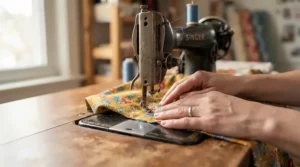
A combination sewing machine for multiple crafts is really three machines wearing one coat: a sewing machine, a quilting-capable machine and an embroidery machine. Knowing where that coat stops fitting saves you money and frustration.
What it handles well
- Garment sewing and alterations: seams, hems, zips and one-step buttonholes (ten styles on the Brother Innov-is M380D, up to 17 on the bernette b79).
- Quilting: piecing plus free-motion work with the feed dogs dropped, which every machine here supports in some form.
- Embroidery and monograms: names, labels, quilt labels and appliqué motifs.
- Personalising ready-made items: the Janome Memory Craft 1000‘s free-arm embroidery reaches cuffs, sleeves and bag handles.
What it doesn’t do
- Overlocking or coverstitch: those are separate machines.
- Sew while it embroiders: the embroidery module occupies the machine, so you can’t sew on it at the same time.
- Heavy production: every model here is a domestic single-needle machine.
If your crafts are sewing, light quilting and personalised gifts, this category covers you. If you dream of knit-garment production lines, plan a second machine eventually.
Combination Sewing Machine for Hobbyists: Who Gets the Most Out of One
A combination sewing machine for hobbyists rewards people who sew for the joy of it. Here’s how different makers tend to line up with the machines.
Gift-makers and parents
Names on babygrows, school bags and towels need small hoops and simple controls. The Brother Innov-is M380D suits this beautifully, and its licensed Disney designs are limited to personal use.
Quilters
Quilters care about workspace and fabric control. The bernette b79 (9in workspace, extension table) and Brother Innov-is F580 (about 7.4in) give bulky layers room, and the PFAFF Creative Ambition 640‘s dual feed helps layers travel together.
Dressmakers
A PFAFF Creative Expect 350 with its 29 needle positions or a Janome Memory Craft 1000 with free-arm embroidery adds finishing touches to cuffs and collars.
Would-be sellers
Be cautious. Retailer notes describe the Brother Innov-is M380D and PFAFF Creative Expect 350 as hobby machines, not production tools, and Brother’s warranty is shorter for commercial use.
Growing Hobby Needs: Buy for the Maker You’ll Be Next Year
Growing hobby needs are the quiet reason people outgrow their first machine within 18 months. Plan for them now and you’ll avoid the sting of an early upgrade.
The biggest limiter is hoop size. A European dealer’s guide suggests 180 × 130mm is often enough for names, chest logos and small motifs, while in-the-hoop projects, wide lettering and back designs call for roughly 240 × 150mm or more. That puts the bernette b79, Singer Legacy SE300 and PFAFF Creative Ambition 640 in “room to grow” territory. The Brother Innov-is M380D sits at the “start small” end.
The second limiter is file handling. Check that your machine reads the formats your favourite design sources offer. The bernette b79 lists the widest set here, while the Janome Memory Craft 1000 reads .jef.
A simple decision framework:
- ✅ If you’re unsure you’ll stick with it, choose the Brother Innov-is M380D, because the lower outlay limits your risk.
- ✅ If you love quilts and larger motifs, choose the bernette b79, because the hoop and workspace won’t hold you back.
- ✅ If you want wireless and a big screen, choose the PFAFF Creative Expect 350 or Brother Innov-is F580, because both reduce cable-juggling.
- ✅ If you’re short on space, choose the Janome Memory Craft 1000, because nothing needs attaching or storing.
Multi-Craft Starter Machine Value: Price Tiers, Total Cost and Maintenance
A multi-craft starter machine should earn its keep across several hobbies. Here’s how the tiers compare.
| Tier | Machines | Price range | What you gain | What you sacrifice | Best For |
|---|---|---|---|---|---|
| Budget | Brother Innov-is M380D, Singer Legacy SE300 | £800–£1,000 | Portability, hoop value | Editing polish or hoop size | Testing the hobby |
| Mid-range | PFAFF Creative Expect 350, Janome Memory Craft 1000, Brother Innov-is F580 | £1,150–£1,700 | Touchscreens, connectivity, built-in arm | Mid-sized hoops | Steady hobbyists |
| Premium | bernette b79, PFAFF Creative Ambition 640 | £1,600–£1,700 | Big hoops, dual feed | Weight, desk space, interface simplicity | Growing makers |
The jump from budget to mid-range buys convenience (touchscreens, Wi-Fi, a built-in arm), while the jump to premium buys capacity and fabric handling. If your projects fit a 100 × 100mm hoop, paying for 260 × 160mm is wasted money.
Running costs are modest but real: embroidery thread, stabiliser, needles and the occasional servicing visit. Cost-per-use helps. A machine costing around £1,200 and used twice a week for three years works out at under £4 per session. Warranty terms matter too. The retailer lists three years for Brother (one year for commercial use), five-year parts and two-year labour for PFAFF, two years for Janome (extendable to five) and two years for bernette. For the computerised Brother Innov-is M380D, the retailer advises against home oiling and recommends professional annual servicing.
Beginner Versatility: Features That Actually Matter (And Those That Don’t)
Beginner versatility isn’t about the longest spec sheet. It’s about features that remove friction while you learn.
Features that matter
- Needle threader and thread cutter: every machine here has some form of threader, and most have automatic cutting. They save minutes on every project.
- Thread sensors: a warning before the bobbin runs out can rescue a long embroidery design.
- Speed slider and start/stop button: perfect for slow, confident practice.
- On-screen editing: rotating, resizing and combining designs at the machine means you don’t need software on day one.
- Warranty and local servicing: support matters more to beginners than a fifth decorative stitch fan.
Features that don’t (yet)
- Stitch counts above 200: 241 and 500 stitches sound impressive, but most beginners use a dozen.
- Huge design libraries: 101 or 241 built-in designs are both plenty.
- Licensed character designs: wonderful if you want them, irrelevant if you don’t.
- Wi-Fi: a USB stick works independently of your network, so wireless is a convenience, not a necessity.
✨ Ready to Find Your Match?
🔍 Take your sewing and embroidery to the next level with these carefully selected machines. Click on any highlighted product name to check current pricing and availability, and remember that prices may vary between retailers. Your first personalised creation could be only a few evenings away!
How to Choose Combination Sewing Machines for Beginners
Choosing among combination sewing machines for beginners gets easy when you work through these steps in order. A craft retailer’s guide to picking a sewing machine covers the sewing basics if you want a second opinion.
- List three real projects. Names on towels need far less room than in-the-hoop bags, so let your actual plans set the specification.
- Match the hoop to the projects. Pick the smallest hoop that covers your likely designs, then add one size of headroom.
- Check how embroidery attaches. A swing-out arm (the Janome Memory Craft 1000) saves fiddling, while slide-on modules need storage space.
- Decide between USB and Wi-Fi. Wireless is convenient, but check which operating systems the transfer software supports.
- Measure your desk and your lifting arm. Weights run from 6.8kg to 15.9kg across these seven.
- Compare warranties and servicing. Ask where the nearest authorised engineer is before you buy.
- Budget for extras. Stabiliser, embroidery thread and needles are ongoing costs.
Combination Machine vs Separate Machines: Which Route Suits You?
A combination machine shares one body between two crafts, and that’s both its charm and its compromise. A sewing machine built purely for sewing, paired with a dedicated embroidery machine, lets you sew one part of a project while another stitches out. The combination route means you wait until the embroidery finishes before you sew again.
Cost cuts the other way. Embroidery-only machines at one UK stockist ran from roughly £740 to well over £1,500 at the time of research, on top of a sewing machine you’d already own or need to buy. For a beginner with one desk and one budget, a combination machine is usually the lower-risk route.
| Route | Space | Typical outlay | Workflow | Best For |
|---|---|---|---|---|
| Combination machine (e.g. Brother Innov-is F580) | One footprint | One purchase | Can’t sew while embroidering | Small spaces, new makers |
| Separate sewing and embroidery-only machines | Two footprints | Two purchases | Sew and embroider in parallel | Frequent embroiderers |
| Sewing machine with free-motion embroidery only | One footprint | Lowest | Manual, no digital designs | Artistic experimenters |
The table shows why combination machines suit most beginners: they trade a little workflow flexibility for a lot of savings and space. If you already own a sewing machine you love, an embroidery-only addition makes more sense. Otherwise, a PFAFF Creative Expect 350 or Brother Innov-is M380D covers both crafts in one go.
Common Mistakes When Buying Combination Sewing Machines for Beginners
Most regrets with combination sewing machines for beginners trace back to the same handful of errors.
- Choosing by entry price alone. A cheap machine with a small hoop can restrict you within months, and the Brother Innov-is M380D‘s 100 × 100mm limit is a good reminder to check before buying.
- Assuming the biggest number wins. A 500-stitch machine like the bernette b79 is superb, but only if you’ll use that headroom.
- Ignoring weight and desk space. The PFAFF Creative Ambition 640 at 15.9kg isn’t something you’ll carry to a class.
- Overlooking the transfer workflow. If the wireless software only works on Windows and you use a Mac, USB becomes your only option.
- Confusing editing with digitising. The machine’s screen resizes and rotates, but turning your own artwork into clean stitches needs separate software or a digitising service.
- Forgetting licensing limits. Built-in character designs like the Disney set on the Brother Innov-is M380D are for personal use only.
What to Expect: Real-World Performance
Specifications become useful only when you translate them into evenings at the machine. Take stitching speed. A hypothetical 5,000-stitch design, at top speed and ignoring colour changes and trims, would take about 12.5 minutes at 400 stitches per minute (the Brother Innov-is M380D), roughly 7.7 minutes at 650 (the Brother Innov-is F580), and about 7 minutes at 700 (the Singer Legacy SE300). Real jobs run longer because every colour change means stopping, rethreading and trimming.
That’s the quiet truth about single-needle machines: you’re a supervisor, not a spectator. Each thread colour is stitched one at a time, so a four-colour monogram needs four visits. Stabiliser choice and careful hooping matter more to quality than raw speed. Expect your first designs to be imperfect, and expect that to improve quickly.
Sewing performance feels different. Higher-end feeding systems like the PFAFF Creative Ambition 640‘s IDT and the bernette b79‘s Dual Feed help layered fabrics travel evenly. On lighter machines, a walking foot or careful pinning does similar work.
Safety, Warranty and Your Consumer Rights
Computerised sewing machines are electrical goods, so a few sensible habits apply. Keep fingers clear of the needle and the moving embroidery arm. Follow your manual’s guidance on unplugging when changing needle plates or cleaning. Look for UKCA or CE conformity marking on the rating plate, and ask the retailer if you can’t see one.
Your consumer rights matter at this price level. Which?’s guide to the Consumer Rights Act explains that goods must be of satisfactory quality, fit for purpose and as described. It also notes that your claim is against the retailer, not the manufacturer. Rejecting faulty goods within 30 days for a refund is the headline right, and a failed repair or replacement can also lead to a refund.
Manufacturer warranties sit on top of that. The retailer lists three years for Brother (one for commercial use), five-year parts and two-year labour for PFAFF, two years for Janome (extendable to five) and two years for bernette. Buying from an authorised dealer with in-house engineers makes servicing simpler later.
Your First 30 Days: A Practical Setup and Practice Plan
Getting the first month right sets the tone for years of stitching. Here’s a plan that works across all seven machines.
Days 1–3: Learn the sewing side. Unpack, thread, wind a bobbin and sew straight lines on scrap cotton. Try the speed slider, needle up/down and thread cutter. Practise a buttonhole on a spare piece.
Week 1: Build confidence. Sew a simple pouch or cushion cover using a few utility stitches. Keep the embroidery unit away until sewing feels natural.
Week 2: First embroidery. Attach the embroidery unit (or swing it out on the Janome Memory Craft 1000). Choose a small built-in design, use a fresh embroidery needle and stabiliser, and hoop the fabric drum-tight. Stitch a test piece before touching a real project.
Week 3: Import a design. Load a file by USB (or Wi-Fi on the PFAFF Creative Expect 350, Brother Innov-is F580 or Brother Innov-is M380D). Check the format first, and name your files clearly.
Week 4: Combine and clean. Try combining a letter set with a motif. Brush lint from the bobbin area after every bobbin or two, and book a first service reminder.
Common first-month mistakes: skipping stabiliser, loose hooping, and ignoring your manual’s oiling advice (computerised models like the Brother Innov-is M380D shouldn’t be oiled at home).
Real-World Scenarios: Three Makers, Three Machines
These are illustrative profiles, not real customers, to show how the decision framework works in practice.
Priya, flat-dweller with a young family. She has a £800–£1,000 budget, sews two or three evenings a week, and wants name labels and mending. Weight and storage matter because her sewing table doubles as a desk. The Brother Innov-is M380D fits: it’s 6.8kg with a hard case, and the small hoop covers names and small motifs. Its Disney designs would please her children, within personal-use limits.
Tom, retired quilter with a spare room. He has about £1,200 to spend and wants quilt labels and cushion panels. A Janome Memory Craft 1000 gives him a square 140 × 140mm hoop and a built-in arm. If he’d rather stretch toward £1,700, the bernette b79 offers a bigger hoop and 9in workspace for larger quilts.
Aisha, dressmaker comfortable with tech. She wants wireless transfer and a big screen. The PFAFF Creative Expect 350 or Brother Innov-is F580 suits her, and she’d choose between them based on hoop width versus stitch count. If dual-feed control matters more than a touchscreen, the PFAFF Creative Ambition 640 is worth a look.
Frequently Asked Questions
❓ Are combination sewing machines for beginners worth it compared with a basic sewing machine?
❓ What embroidery hoop size should a beginner choose?
❓ Can I use embroidery designs downloaded from the internet?
❓ Do I need Wi-Fi or a computer to use the embroidery features?
❓ How often should a combination sewing machine be serviced?
Conclusion
Choosing among combination sewing machines for beginners comes down to three questions: how big are your projects, how much desk do you have, and how fast will your hobby grow? The Brother Innov-is M380D is the gentle, light, lower-risk start. The Singer Legacy SE300 stretches your budget furthest on hoop size, if you can find one in stock. The PFAFF Creative Expect 350, Janome Memory Craft 1000 and Brother Innov-is F580 cover the middle ground with touchscreens, a built-in arm or wireless transfer. The bernette b79 and PFAFF Creative Ambition 640 are the grow-into options for makers who know where this is heading.
For a combination sewing machine for multiple crafts, prioritise hoop size and feeding. For a combination sewing machine for hobbyists, prioritise ease and support. And for any multi-craft starter machine, remember that beginner versatility means features that remove friction, not features that dazzle on a spec sheet. Plan for growing hobby needs, check current stock and price, and know your consumer rights before you buy.
✨ Ready to start stitching?
Click any highlighted machine name above to check current pricing and availability, then pick the one that fits your projects, your desk and your plans. Your first personalised creation is closer than you think! 🧵
Recommended for You
- Combination Sewing Machine: 7 Best UK Picks (2026)
- WiFi-Enabled Sewing Machine For Small Business Use: 7 Best Picks 2026
- WiFi Sewing Machine: 7 Best Picks For UK Sewists (2026)
Disclaimer: This article contains affiliate links. As an Amazon Associate, I earn from qualifying purchases. If you purchase products through these links, we may earn a small commission at no additional cost to you.
✨ Found this helpful? Share it with your friends! 💬🤗
