
In This Article
What is a combination sewing machine? It is one computerised machine that does two jobs: ordinary sewing (seams, hems, buttonholes, zips) and automated hoop embroidery, using a detachable or swing-out embroidery unit. In other words, it is a 2-in-1 sewing machine that saves space, cash and setup time compared with owning two separate machines.
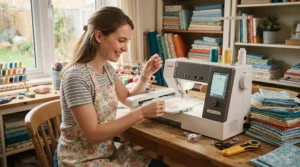
Here’s the twist nobody mentions in the shop. Machine embroidery used to be a specialist’s game, all dedicated equipment and spare-room budgets. Then computers and software got cheaper, and computerised machine embroidery spread from trade workshops into ordinary homes. The combination sewing machine is the format that carried it over the threshold.
Still, a combination sewing machine is a negotiated peace between two crafts, and the trade-offs hide in the small print. A hoop that sounds generous may be coaster-sized. A headline stitch count may be mostly decoration you’ll never touch. So this guide does what a product page can’t. It turns hoop and stitch capacity into real projects, weighs craft versatility against cost, and says plainly who should skip each model.
One note on method. Everything here rests on published manufacturer and UK dealer specifications, plus the review material I could verify. I haven’t tested these machines, so you’ll find analysis rather than invented anecdotes. Prices are ranges as of research time, so check current listings before you commit.
Combination Sewing Machine Quick Comparison Table (2026)
Here’s the shortlist at a glance, ordered roughly from gentlest on the wallet to most ambitious.
| Machine | Max hoop area (mm) | Built-in sewing stitches | Built-in embroidery designs | Price range | Best For |
|---|---|---|---|---|---|
| Brother Innov-is M380D | 100 x 100 | 181 | 200 | £800–£1,000 | First-timers, small motifs |
| Janome Memory Craft MC1000 | 140 x 140 | 300 | 241 | £1,050–£1,200 | Compact all-rounder |
| Pfaff Creative Expect 350 | 170 x 100 | 250 | 180 | £1,000–£1,200 | Wi-Fi fans, tricky fabrics |
| Husqvarna Viking Designer Topaz 40 | 240 x 150 | 208 | 100 | Around £1,300 and up | Bigger single-hoop designs |
| Brother Innov-is F580 | 180 x 130 | 241 | 193 | £1,600–£1,700 | Balanced step-up |
| Janome Atelier 9 | 170 x 200 | 300 | 250 | £2,300–£3,000 | Sewists adding embroidery |
| Brother Innov-is V5LE | 300 x 200 | 638 | 652 | Mid-£3,000s | Large designs, long-term growth |
Read the table sideways and a pattern emerges: hoop size climbs faster than price until the very top, where the Brother Innov-is V5LE charges a premium for sheer 300 x 200 mm headroom. The Janome Memory Craft MC1000 and Pfaff Creative Expect 350 share a price bracket but suit different temperaments. One rewards a tidy swing-out arm and 300 stitches; the other rewards Wi-Fi and dual-feed fabric handling. Meanwhile the Husqvarna Viking Designer Topaz 40 quietly offers the second-largest hoop area in the list for mid-bracket money, provided you can live with a slim built-in design library.
💬 Just one click — help others make better buying decisions too!😊
Top 7 Combination Sewing Machine Picks: Expert Analysis
Each pick gets the same treatment: what the specs mean in practice, who it suits, what verifiable review sentiment says, and an honest value verdict. Where I couldn’t verify real owner reviews, I say so rather than pad.
1. Brother Innov-is M380D — gentlest way into embroidery
If the goal is simply to discover whether you enjoy hoop embroidery, the Brother Innov-is M380D is the least intimidating door in the building.
It pairs 181 sewing stitches (ten of them one-step buttonholes) with 200 built-in designs, 65 of them Disney, and a 100 x 100 mm hoop. That hoop is roughly coaster-sized: lovely for monograms, pocket motifs and patches, hopeless for a jacket back. Sewing runs at up to 850 stitches per minute, but embroidery tops out at 400, so patience comes standard.
Based on the spec comparison, this is a family-friendly 2-in-1 sewing machine rather than a showpiece. The Disney library suits children’s clothes and gifts, and the 160 mm workspace copes with cushion covers and dresses. What most buyers overlook is colour: every machine in this guide stitches one thread colour at a time, and Disney characters are colour-hungry, so expect plenty of re-threading.
Independent reviews of the M380D itself are scarce. Marketplace owners of its predecessor, the Brother Innov-is M280D, praised how approachable it felt while warning that multi-colour Disney designs take time.
Pros:
- ✅ Gentle learning curve for first-time embroiderers
- ✅ 200 designs, including 65 Disney favourites
- ✅ USB and wireless options for adding designs
Cons:
- ❌ 100 x 100 mm hoop limits project size
- ❌ Embroidery speed capped at 400 stitches per minute
Expect roughly £800–£1,000 depending on dealer promotions; for a curious beginner, that is fair value.
2. Janome Memory Craft MC1000 — swing-out arm, tiny footprint
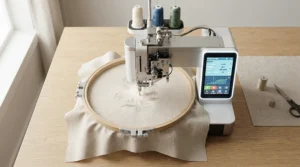
The Janome Memory Craft MC1000 keeps its embroidery arm built in and swings it out when needed, so there’s no separate unit to hunt for or store.
Sewing brings 300 stitches including 15 buttonholes at up to 860 stitches per minute, while embroidery offers 241 designs in a 140 x 140 mm hoop at up to 660. That square hoop is a little larger than a CD case, which is the sweet spot for tea-towel corners, bib appliqué and small bag panels. Dealers describe a compact footprint and a machine weight of about 10 kg, including the embroidery unit.
On paper, the MC1000 gives you a wider hoop, far more sewing stitches and Janome’s reputation for stitch quality than the Brother Innov-is M380D, for a modest step up in price. It suits the hobbyist who sews first and embroiders second. Dedicated embroiderers will outgrow 140 mm sooner than they expect.
I couldn’t find enough independent UK owner reviews to summarise honestly, so judge it on published merits and, ideally, a dealer demonstration.
Pros:
- ✅ 300 stitches with 15 one-step buttonholes
- ✅ Built-in swing-out arm, no detachable unit
- ✅ 140 x 140 mm hoop included
Cons:
- ❌ Free-arm hoops are optional extras
- ❌ Smaller 3.5-inch colour screen than rivals
Around £1,050–£1,200 at the time of research makes it strong value if sewing quality matters as much as embroidery.
3. Pfaff Creative Expect 350 — Wi-Fi smarts with dual-feed sewing
Pfaff’s party trick is IDT, an integrated dual-feed system that pulls fabric from above and below so layers travel together instead of creeping apart.
The Pfaff Creative Expect 350 offers 250 stitches and four sewing fonts, 180 embroidery designs, ten embroidery fonts and a 170 x 100 mm hoop. Speeds reach 850 stitches per minute for sewing and 450 for embroidery. The 7-inch colour touchscreen and Wi-Fi via the mySewnet app make it feel the most modern of the entry-tier models. Sewing space is a useful 165 mm.
A 170 x 100 mm hoop is wide but shallow. It’s ideal for names, slogans and border runs, less so for tall motifs. The catch is file handling: UK dealer listings note that direct imports need Pfaff’s VP3 format, so other formats need converting first. If your sewing involves slippery fabrics, quilted layers or stripes that must match, the dual feed is the real reason to buy.
One UK retailer listing I found showed no customer reviews yet, so there’s no verified sentiment to quote.
Pros:
- ✅ Dual-feed IDT handles slippery or layered fabrics
- ✅ Large 7-inch colour touchscreen
- ✅ Wi-Fi and mySewnet app integration
Cons:
- ❌ Hoop is wide but only 100 mm tall
- ❌ Direct imports limited to VP3 files
Around £1,000–£1,200 including seasonal bundles, and good value for sewing-led makers.
4. Husqvarna Viking Designer Topaz 40 — roomy 240 x 150 mm hoop
Hoop size is where the Husqvarna Viking Designer Topaz 40 earns its keep.
It stitches designs up to 240 x 150 mm, slightly wider than an A5 sheet. That fits a cushion panel or a generous chest logo in a single hooping. Sewing offers 208 stitches (565 if you count letters and characters) at up to 800 stitches per minute. Embroidery comes with 100 built-in designs, one font in three sizes, on-screen resizing and mirroring, and automatic jump-stitch trimming. The Sewing Advisor feature suggests settings for you, which helps newcomers.
The modest design library tells you Husqvarna expects you to bring your own artwork. That’s liberating if you plan to download or digitise, and underwhelming if you want a big built-in catalogue. At around 13 kg, it’s also heavier than the Brother models here.
UK magazine Sew’s review listing highlights the colour touchscreen, sensor system and design editing, but I couldn’t verify a broad pool of owner reviews.
Pros:
- ✅ Second-largest hoop area in this guide
- ✅ Sewing Advisor picks sensible settings
- ✅ On-screen resize, rotate, mirror and combine
Cons:
- ❌ Only 100 built-in designs and one font
- ❌ Heavier than comparable Brother machines
Around £1,300 on the most recent UK listing I found, so check the current price. If you value hoop size per pound, it’s a smart buy.
5. Brother Innov-is F580 — balanced, Wi-Fi-enabled all-rounder
The Brother Innov-is F580 is the machine I’d point at someone who wants a genuine step up without paying V5LE money.
Sewing delivers 241 stitches including ten one-step buttonholes, five sewing fonts and a 7.4-inch (190 mm) workspace. Embroidery offers 193 designs, 13 fonts and a 180 x 130 mm hoop, more than double the area of the Brother Innov-is M380D. Extras include sideways feeding, a knee lift, automatic thread cutting and wireless connection to Brother’s Artspira app.
In practice, 180 x 130 mm suits a child’s T-shirt design, a monogrammed shirt pocket or a quilt block, and the roomy workspace helps with larger sewing projects. Brother also sells the Brother Innov-is F540E (embroidery only) and the Brother Innov-is F560 (sewing only), so the F580 is effectively both rolled into one. It’s the sensible middle path.
UK listings I checked showed no customer reviews yet, so I can’t summarise owner sentiment.
Pros:
- ✅ Hoop area more than double the entry-level Brother
- ✅ Generous 7.4-inch workspace and knee lift
- ✅ Wi-Fi with Artspira app support
Cons:
- ❌ Priced well above the entry models
- ❌ Single-colour stitching means manual colour changes
Around £1,600–£1,700, which is fair for a well-balanced machine with a three-year dealer warranty.
6. Janome Atelier 9 — premium sewing with 1,000 stitches per minute
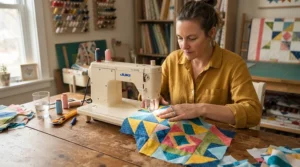
The Janome Atelier 9 is a sewing machine first, with embroidery layered on, and that’s its whole personality.
Sewing brings 300 stitches (11 buttonholes), up to 1,000 stitches per minute, AcuFeed Flex fabric feeding and an 8.3-inch workspace. Embroidery adds 250 designs, ten fonts and a 170 x 200 mm hoop, noticeably taller than the 100 mm-high hoops on cheaper machines. The box includes 22 feet and three hoops, and Wi-Fi is on board. Janome’s spec sheet quotes up to 200,000 stitches per design, which is serious headroom.
If you identify as a dressmaker or quilter who’d like embroidery as a bonus, the sewing refinement justifies the premium. If you embroider more than you sew, the Brother Innov-is F580 or Brother Innov-is V5LE deliver more hoop per pound.
One UK reviewer, who admitted not being a Janome devotee beforehand, called it a lovely machine and a sensible way into embroidery without paying for a dedicated embroidery model. That’s a single voice, not an aggregate.
Pros:
- ✅ 1,000 stitches per minute sewing speed
- ✅ 22 presser feet and three hoops included
- ✅ Generous 8.3-inch workspace
Cons:
- ❌ Premium price for a mid-sized hoop
- ❌ Around 15 kg once the embroidery unit is fitted
Around £2,300–£3,000 (ex-display units appear for less), best for sewing-led makers.
7. Brother Innov-is V5LE — 300 x 200 mm headroom
With the Brother Innov-is V5LE, you’re buying headroom.
Its 300 x 200 mm hoop is essentially an A4 sheet, big enough for cushion fronts, large appliqué and bold quilt blocks. Alongside that come 638 sewing stitches plus 14 one-step buttonholes, 652 designs with 17 fonts, speeds up to 1,050 stitches per minute, and automatic needle threading and thread cutting. A 300 x 200 mm hoop and a 100 x 100 mm hoop are supplied, and UK dealers list a three-year return-to-base warranty.
This is the right answer if you already know you’ll outgrow small hoops. It’s the wrong one if you’ll mostly stitch 100 mm monograms. At around 15.4 kg, it also lives on a sewing table rather than in a carry bag.
Verified independent owner reviews weren’t available in my research, so there’s no sentiment to report beyond dealer enthusiasm.
Pros:
- ✅ A4-sized hoop for large designs
- ✅ 652 built-in designs and 17 fonts
- ✅ 1,050 stitches per minute speed
Cons:
- ❌ Priciest and heaviest machine in this guide
- ❌ Overkill for small monogram work
Mid-£3,000s: expensive, but a credible long-term investment if big designs are your goal.
Setting Up Your Combination Sewing Machine: A 30-Day Practical Guide
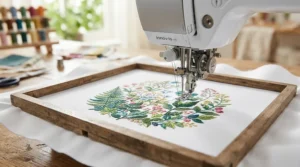
The first month decides whether a combination sewing machine becomes a joy or a dust-gatherer. This schedule dodges the classic mistakes.
Week 1 — Foundations. Read the threading diagram once, properly. Place the machine on a stable table with clear space behind it, because the embroidery carriage glides back and forth and anything in its path will halt it. Fit a fresh embroidery needle and wind a bobbin with lightweight embroidery bobbin thread rather than whatever’s in the drawer. Brother, for example, supplies a 60-weight pre-wound bobbin with the Brother Innov-is M380D.
Week 2 — Test stitching. Hoop a scrap of calico with stabiliser beneath it, tightening until the fabric is taut but not stretched. Stitch one small built-in design start to finish, then study where it puckers and why.
Week 3 — Real fabric. Move to a tea towel or tote bag. Use a water-soluble topper on towelling so the stitches don’t sink.
Week 4 — Routine. Brush lint from the bobbin area after every project, change needles regularly, and back up any downloaded designs.
The classic first-month mistakes? Mixing thread weights, skipping stabiliser, and forgetting that some machines won’t sew decorative stitches while the embroidery arm is attached. Check your manual, because every multi-function sewing machine has its own quirks.
Real-World Scenarios: Matching a Combination Sewing Machine to Your Life
Specs only matter when they meet a real routine. Here are three buyer profiles and the machines that fit them.
If you’re a student or first-time maker with about £1,000 to spend, a kitchen-table setup and a few sessions a month, start with the Brother Innov-is M380D. Its small hoop suits monograms and patches, and the Disney designs make quick gifts. If you can stretch the budget, the Pfaff Creative Expect 350 adds Wi-Fi and dual feed.
If you sew clothes weekly and want names, logos and decorative touches, the Janome Atelier 9 earns its premium through fast, refined sewing, while the Brother Innov-is F580 delivers a bigger hoop for far less. Your sewing-to-embroidery ratio decides between them.
If you sell personalised gifts at craft fairs, a larger hoop means fewer re-hoopings and faster output. The Husqvarna Viking Designer Topaz 40 and Brother Innov-is V5LE both suit that rhythm. Check warranty terms for commercial use, because some Brother UK listings reduce cover to one year on certain models.
Problem → Solution: Fixing Common Combination Sewing Machine Headaches
Even a well-chosen combination sewing machine throws the odd tantrum. Four common problems have straightforward fixes.
- Puckering around the design. Usually a stabiliser or hooping issue. Use a firmer stabiliser, hoop the fabric taut without stretching, and reduce design density if your machine allows.
- Thread breaking mid-design. Re-thread completely, fit a fresh needle, and check that your thread weight suits the design. Metallic threads need slower speeds.
- Design bigger than the hoop. Resize on screen, which the Husqvarna Viking Designer Topaz 40, Brother Innov-is F580 and Pfaff Creative Expect 350 all support, or choose a machine with more hoop and stitch capacity.
- Misaligned outlines. Hooping loosely lets fabric shift. Re-hoop firmly and use positioning guides.
How to Choose a Combination Sewing Machine: 7 Steps
A combination sewing machine is always computerised, so you can skip the mechanical-versus-computerised decision that UK craft retailer Hobbycraft’s buying guide puts first. Then work through these steps.
- Start with hoop size. Decide what you’ll stitch: monograms need about 100 mm, jacket backs need 240 mm and above.
- Judge the sewing side honestly. Embroidery sells the machine, but sewing is what you’ll use most days.
- Check the workspace. More space to the right of the needle helps with quilts and curtains.
- Confirm file formats and connectivity. USB is standard; Wi-Fi saves trips to the computer.
- Weigh the footprint. A 15 kg machine rarely travels to classes.
- Budget for the extras. Hoops, threads and stabilisers add up.
- Check warranty and dealer support. On a four-figure purchase, local servicing matters.
If you want a multi-function sewing machine that grows with you, prioritise steps 1 and 7.
2-in-1 Sewing Machine or Two Machines? Combination Sewing Machine vs Standalone Embroidery Machine
The combination sewing machine vs standalone embroidery machine debate comes down to space, hoop size and how you split your time. A 2-in-1 sewing machine wins on footprint and shared accessories. A dedicated machine wins on hoop size: the Brother Innov-is NV880E offers 260 x 160 mm and the Janome Memory Craft 550E LE stretches to 200 x 360 mm. Embroidery-only machines in that class typically cost around £1,500–£1,700. The humble sewing machine has been refined for well over a century, so a separate mid-range sewing machine of decent quality is easy to find.
| Factor | Combination sewing machine | Standalone embroidery machine |
|---|---|---|
| Footprint | One machine, one table | Two machines, two spaces |
| Max hoop area | 100 x 100 to 300 x 200 mm | Up to 200 x 360 mm (Janome Memory Craft 550E LE) |
| Upfront cost | £800–£3,500 range | Around £1,500+ plus a sewing machine |
| Best For | Space-limited sewists | Embroidery-first, high-volume makers |
At the top end, the Brother Innov-is V5LE costs about what a Brother Innov-is NV880E plus a decent sewing machine would, so the maths is closer than it looks. Choose combination if space and flexibility matter. Choose separate machines if embroidery dominates your week and you want to keep stitching while sewing something else.
Hoop and Stitch Capacity: What the Numbers Actually Mean
Hoop and stitch capacity is the most misunderstood spec on any combination sewing machine. Here’s what the hoop sizes look like in real life:
- 100 x 100 mm (Brother Innov-is M380D): roughly a drinks coaster
- 140 x 140 mm (Janome Memory Craft MC1000): a little bigger than a CD case
- 170 x 100 mm (Pfaff Creative Expect 350): wide and shallow, ideal for names and slogans
- 180 x 130 mm (Brother Innov-is F580): a postcard and a bit
- 240 x 150 mm (Husqvarna Viking Designer Topaz 40): slightly wider than A5
- 170 x 200 mm (Janome Atelier 9): bigger than a standard paperback
- 300 x 200 mm (Brother Innov-is V5LE): essentially an A4 sheet
On stitch capacity, a count of 181 versus 638 sewing stitches matters less than it looks. Most sewists lean on a couple of dozen utility stitches. Embroidery speed matters more: the Brother Innov-is M380D stitches at 400 per minute, while the Janome Atelier 9 reaches 800. The Janome Atelier 9 spec sheet also quotes up to 200,000 stitches per design, plenty for large, dense artwork. When a design exceeds your hoop, you’ll need to resize it or choose a bigger machine.
Craft Versatility: What a Multi-Function Sewing Machine Can Really Do
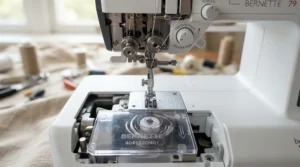
Craft versatility is the real prize. A multi-function sewing machine isn’t just two machines in one; it’s a crossover of skills.
- Personalised gifts: towels, tote bags, name labels and monogrammed shirts.
- Quilting and appliqué: the Brother Innov-is F580 and Brother Innov-is M380D are both marketed for sewing, quilting and embroidery.
- Free-motion work: drop-feed facilities on the Janome Atelier 9 and Brother Innov-is F580 open up free-motion stitching.
- Decorative sewing: sideways feeding on the Brother Innov-is F580 produces crisp decorative stitches.
- Custom designs: retailers sometimes bundle digitising software with Brother machines, so check any offer before relying on it.
Craft versatility rises with hoop size and software support. A small-hoop machine suits patches and monograms; a large hoop opens cushions and quilt blocks.
Multi-Function Sewing Machine Features That Actually Matter (And Those That Don’t)
Marketing loves big numbers, but a few features earn their place and others don’t.
Worth paying for:
- Automatic needle threader and thread cutter
- On-screen editing (resize, rotate, mirror)
- USB or Wi-Fi design transfer
- A hoop that matches your projects
- Sewing workspace and speed control
Easy to ignore:
- Huge stitch libraries you’ll never use
- Novelty design packs, unless you love them
- 1,000 stitches-per-minute sewing speeds, since embroidery runs far slower
- Dozens of built-in designs you’ll replace with downloads
Think of it as buying for the 90% of tasks you’ll do, not the 10% that look good on a spec sheet.
Long-Term Cost and Maintenance: What a Combination Sewing Machine Really Costs
Sticker price is only the start. Hoops, threads, stabilisers and software add up, and one UK embroidery supplier lists a starter set of threads and stabiliser at around £290.
Amortised, a machine in the £1,600 bracket used weekly for five years works out at roughly £6 a session. Warranties vary: UK dealers list three years on several Brother models, five on the Pfaff Creative Expect 350 and two on the Janome Atelier 9. Budget for periodic servicing and keep the machine covered and lint-free.
| Machine | Price band | Value angle | Best For |
|---|---|---|---|
| Brother Innov-is M380D | £800–£1,000 | Cheapest route into hoop embroidery | Beginners |
| Janome Memory Craft MC1000 | £1,050–£1,200 | Strong sewing plus compact embroidery | Hobbyists |
| Pfaff Creative Expect 350 | £1,000–£1,200 | Wi-Fi and dual feed | Sewing-led makers |
| Brother Innov-is F580 | £1,600–£1,700 | Balanced hoop and workspace | Step-up buyers |
| Janome Atelier 9 | £2,300–£3,000 | Premium sewing | Dressmakers |
| Brother Innov-is V5LE | Mid-£3,000s | Maximum hoop headroom | Large-design makers |
The sweet spot for most people sits in the £1,000–£1,700 range, where hoop sizes jump meaningfully without premium-tier pricing. Go higher only if you have a specific need, like A4 hoops or 1,000-stitch speeds.
Safety, Regulations and Warranty: Buying a Combination Sewing Machine in the UK
Your combination sewing machine is mains-powered, so it falls under low-voltage electrical rules. Government guidance on placing manufactured products on the market in Great Britain explains that businesses can use either UKCA or CE marking to sell most such products in Great Britain, while Northern Ireland follows EU rules including CE marking. In practice, look for the marking on the rating label.
Buy from a UK seller with a UK plug and warranty, since machines built for other markets may use different mains voltage. Keep hands, hair and cuffs clear of the moving hoop carriage, unplug before changing needles, and keep children and pets away while it stitches. Finally, read the warranty: some UK listings reduce cover to one year for commercial use.
FAQ
❓ Can a combination sewing machine sew and embroider at the same time?
❓ What hoop and stitch capacity should a beginner look for?
❓ Which embroidery file formats work on a combination sewing machine?
❓ Should I buy a combination sewing machine from Amazon or a specialist dealer?
❓ Is a multi-function sewing machine worth it if I only embroider occasionally?
Conclusion
A combination sewing machine is the most space-efficient way to add embroidery to a sewing life, provided you match the hoop to your projects. For beginners and small motifs, the Brother Innov-is M380D is a gentle, low-risk start. For sewing quality plus compact embroidery, the Janome Memory Craft MC1000 and Pfaff Creative Expect 350 make a strong pair, with the Pfaff Creative Expect 350 adding Wi-Fi and dual feed. If hoop size is your priority, the Husqvarna Viking Designer Topaz 40 gives the most room per pound, and the Brother Innov-is F580 offers the best balance overall. At the premium end, the Janome Atelier 9 suits sewing-led makers and the Brother Innov-is V5LE suits anyone whose designs keep growing.
Whatever you choose, weigh combination sewing machine vs standalone embroidery machine honestly against your space and your habits, check warranty and dealer support, and treat every price here as a range. Then thread up, hoop a scrap and start stitching.
🧵 Ready to stitch smarter?
Tap any highlighted machine name to check current pricing and availability, then pick the machine that fits your projects, your table and your budget. Happy stitching! ✨
Recommended for You
- WiFi-Enabled Sewing Machine For Small Business Use: 7 Best Picks 2026
- WiFi Sewing Machine: 7 Best Picks For UK Sewists (2026)
- WiFi-Enabled Sewing Machine: 7 Best Picks (2026)
Disclaimer: This article contains affiliate links. As an Amazon Associate, I earn from qualifying purchases. If you purchase products through these links, we may earn a small commission at no additional cost to you.
✨ Found this helpful? Share it with your friends! 💬🤗
